Introduction
In the last lesson, we focused on the high-level architecture of your application, learning to separate pure logic from side effects using the "Functional Core, Imperative Shell" pattern. This gives us clean, testable functions that act as building blocks.
Now, we zoom in on the code inside those functions. A common anti-pattern, especially for those coming from languages like Java, is to create deeply nested conditional logic. This lesson directly tackles that problem. Your goal is to apply guard clauses and early returns to flatten nested conditional logic and improve readability. We will transform complex, indented if/else structures into flat, easy-to-read, and robust Python code.
1. The Anti-Pattern: The "Pyramid of Doom"
Coming from a Java background, you've likely seen and written code that looks something like this:

This style, often called the "Pyramid of Doom" or "Arrow Code," creates several problems:
- High Cognitive Load: You have to keep track of multiple conditions in your head to understand the logic at the deepest level.
- Difficult to Read: The main "happy path" (where everything succeeds) is buried deep inside the nests.
- Error-Prone: It's easy to mismatch an
elseblock with its correspondingif, leading to subtle bugs.
Pythonic code avoids this structure in favor of a flatter, more linear approach. This visual metaphor captures the goal perfectly:
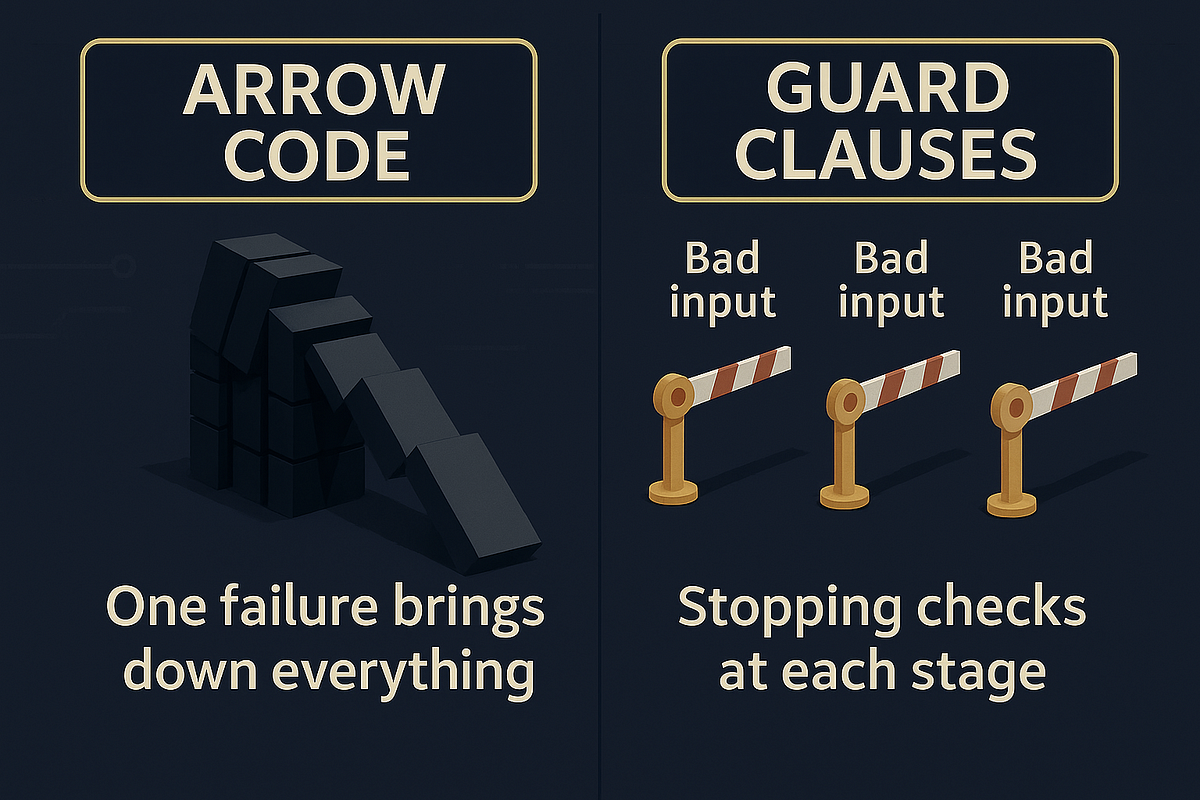
The article from Refactoring.Guru offers a blunt but accurate description of this problem.
Replace Nested Conditional with Guard Clauses
Let's read a short section from the article "Replace Nested Conditional with Guard Clauses" to understand why this pattern is so problematic.
Read the section titled "Why Refactor". The description of the "conditional from hell" and its "arrow, pointing to the right in the direction of pain and woe" is a memorable way to frame the issue.
2. The Solution: Guard Clauses and Early Returns
The Pythonic solution is to use guard clauses. A guard clause is a conditional check placed at the top of a function that validates preconditions or handles edge cases, exiting immediately if a condition isn't met.
The core idea is to invert the conditional logic. Instead of nesting if user_is_valid: ..., you write if not user_is_valid: return. This gets the failure cases out of the way immediately, leaving the main logic flat and un-nested.
This article gives a very clear "before and after" illustration.
Write Cleaner Python with Guard Clauses
The article "Write Cleaner Python with Guard Clauses" provides a concise definition and a perfect, simple example of this refactoring technique.
Read the first four sections: "What Is a Guard Clause?", "The Problem: Pyramid of Doom", "The Fix: Exit Early", and "Why Guard Clauses Improve Readability". This will give you a solid conceptual foundation.
To see this applied directly to Python, let's look at another clear before-and-after example from Refactoring.Guru, which directly contrasts the nested Java-style with the flat Pythonic style.
Replace Nested Conditional with Guard Clauses
This resource provides a direct, language-specific comparison that is highly relevant to your goal.
Focus on the two Python code blocks under the multi-language examples. Observe how the nested if/else structure is transformed into a series of independent if statements with early returns.
3. A Step-by-Step Refactoring Demonstration
Now, let's see how to apply this technique to a more complex, realistic piece of business logic. The following video by ArjanCodes is a masterclass in this refactoring process. He starts with a deeply nested function and methodically flattens it.
How to Refactor Insanely Complicated Business Logic (Step by Step)
This video, "How to Refactor Insanely Complicated Business Logic," walks through a real-world refactoring scenario. It's a perfect demonstration of moving from unreadable nested code to a clean, maintainable function.
Watch the first segment (00:00 - 02:57) to understand the initial, complex approve_order function. Then, watch the core refactoring segment (06:05 - 11:23) where he applies guard clauses to remove indentation levels step-by-step. Pay close attention to how he inverts the logic of each if statement to create an early exit.
A Note on Professional Practice: In the video (from 02:57 to 06:05), the presenter first writes "characterization tests." These tests lock in the current behavior of the code before refactoring, acting as a safety net. This is a critical professional step to ensure you don't accidentally change the logic. While we will cover testing in detail in a later module, it's an important practice to be aware of now.
For a second, more concise demonstration, this video from Indently provides another excellent side-by-side comparison.
Nesting “If Else” Can Seriously Damage Your Code Quality, Do THIS Instead In Python
This video, "Nesting “If Else” Can Seriously Damage Your Code Quality," provides another clear walkthrough of the guard clause pattern.
Watch from 01:43 to 05:35. This segment shows the refactoring process and then explicitly compares the nested version to the guard clause version, highlighting the reduction in cognitive load and potential for error.
4. Taking It One Step Further: Named Helper Functions
After applying guard clauses, your code is flatter, but the conditions themselves might still be complex and hard to parse. The final step to achieving maximum readability is to extract these complex conditions into small, named, pure functions. This makes your guard clauses self-documenting.
This practice directly connects to the previous lesson's focus on small, single-responsibility functions.
How to Refactor Insanely Complicated Business Logic (Step by Step)
Let's return to the ArjanCodes video. After flattening the logic, he improves it further by giving the conditions meaningful names.
Watch from 13:06 to 15:24. Notice how if not is_eligible_amount(...) is far more readable than the complex boolean expression it replaced. This combines the power of guard clauses with the clarity of well-named functions.
Exercise: Refactor a Nested Function
Here is a function that processes a user's subscription upgrade request. It's written in a nested, non-Pythonic style.
Your task is to refactor upgrade_subscription into a flat, readable function using guard clauses and early returns.
The "Bad" Code:
class User:
    def __init__(self, is_logged_in: bool, has_active_subscription: bool, balance: float):
        self.is_logged_in = is_logged_in
        self.has_active_subscription = has_active_subscription
        self.balance = balance

def upgrade_subscription(user: User, upgrade_price: float) -> str:
    """Processes a subscription upgrade request."""
    if user.is_logged_in:
        if not user.has_active_subscription:
            if user.balance >= upgrade_price:


                # In a real app, this would deduct the balance and upgrade the sub
                return "Success: Subscription upgraded."
            else:
                return f"Error: Insufficient balance. Need ${upgrade_price:.2f}, have ${user.balance:.2f}."
        else:
            return "Error: User already has an active subscription."
    else:
        return "Error: User is not logged in."


# --- Test Cases ---
user_guest = User(is_logged_in=False, has_active_subscription=False, balance=100.0)
user_active_sub = User(is_logged_in=True, has_active_subscription=True, balance=100.0)
user_low_balance = User(is_logged_in=True, has_active_subscription=False, balance=5.0)
user_valid = User(is_logged_in=True, has_active_subscription=False, balance=100.0)

print(f"Guest: {upgrade_subscription(user_guest, 10.0)}")
print(f"Active Sub: {upgrade_subscription(user_active_sub, 10.0)}")
print(f"Low Balance: {upgrade_subscription(user_low_balance, 10.0)}")
print(f"Valid User: {upgrade_subscription(user_valid, 10.0)}")
Solution
Here is the refactored code. Notice how each potential failure case is handled at the top, leaving the final success case clean and un-nested at the bottom.
class User:
    def __init__(self, is_logged_in: bool, has_active_subscription: bool, balance: float):
        self.is_logged_in = is_logged_in
        self.has_active_subscription = has_active_subscription
        self.balance = balance

def upgrade_subscription_refactored(user: User, upgrade_price: float) -> str:
    """Processes a subscription upgrade request using guard clauses."""


    # Guard clause 1: Check login status
    if not user.is_logged_in:
        return "Error: User is not logged in."


    # Guard clause 2: Check for existing subscription
    if user.has_active_subscription:
        return "Error: User already has an active subscription."


    # Guard clause 3: Check balance
    if user.balance < upgrade_price:
        return f"Error: Insufficient balance. Need ${upgrade_price:.2f}, have ${user.balance:.2f}."


    # The "happy path" - all checks passed
    return "Success: Subscription upgraded."


# --- Test Cases ---
user_guest = User(is_logged_in=False, has_active_subscription=False, balance=100.0)
user_active_sub = User(is_logged_in=True, has_active_subscription=True, balance=100.0)
user_low_balance = User(is_logged_in=True, has_active_subscription=False, balance=5.0)
user_valid = User(is_logged_in=True, has_active_subscription=False, balance=100.0)

print("\n--- Refactored ---")
print(f"Guest: {upgrade_subscription_refactored(user_guest, 10.0)}")
print(f"Active Sub: {upgrade_subscription_refactored(user_active_sub, 10.0)}")
print(f"Low Balance: {upgrade_subscription_refactored(user_low_balance, 10.0)}")
print(f"Valid User: {upgrade_subscription_refactored(user_valid, 10.0)}")
Conclusion
You have just learned one of the most effective techniques for improving code readability and maintainability. By replacing nested conditionals with guard clauses, you make your code's intent clearer and its structure simpler.
Key Takeaways:
- Avoid the "Pyramid of Doom": Deeply nested
if/elseblocks are a code smell that indicates overly complex logic. - Use Guard Clauses to Exit Early: Check for all failure conditions, invalid states, or edge cases at the very top of your function.
- Invert Your Conditions: Instead of checking for success (
if condition:), check for failure (if not condition: return). - Keep the Happy Path Flat: The main, successful execution flow of your function should have minimal indentation.
- Combine with Helper Functions: For maximum clarity, extract complex boolean logic into small, well-named helper functions.
In the next lesson, we will continue exploring control flow by examining the try/except/else/finally structure. You'll see how exceptions provide another powerful mechanism for non-linear control flow, often working hand-in-hand with guard clauses to handle errors robustly.