Hello! Welcome to the third lesson in our module on insulin and glucose metabolism.
Introduction
In our last lesson, we explored the intricate molecular signaling inside a cell after insulin binds to its receptor. We traced how this single event triggers the PI3K/Akt pathway, the cell's primary metabolic command-and-control system.
Today, we will see the results of that signaling cascade. We will move from the molecular "how" to the physiological "what" and "where." This lesson addresses the learning outcome: Describe insulin's primary effects on glucose uptake, glycogen synthesis, and lipid metabolism. We will examine how insulin orchestrates the body's response to a meal, directing the flow of energy into storage in its three main target tissues: skeletal muscle, the liver, and adipose (fat) tissue. Understanding these normal functions is the essential foundation for later understanding the dysfunction that occurs in PCOS.
Let's begin by establishing a core principle: Insulin is the body's primary anabolic hormone. "Anabolic" means "to build up." In the fed state (after eating), insulin's job is to take the energy from food—primarily glucose—and store it for later use.
Biochemistry, Insulin Metabolic Effects
This brief introduction from the StatPearls article provides a high-level overview of insulin as an anabolic hormone and lists its main target tissues and effects, setting the stage for our lesson.
Please read the 'Introduction' and the short 'Cellular Level' section. This will give you a concise summary of insulin's role and the tissue-specific responses we are about to discuss.
1. Insulin's Effects on Carbohydrate Metabolism
After a meal, blood glucose levels rise, triggering insulin secretion. Insulin's main job is to bring that blood glucose back down to a normal range. It accomplishes this through a coordinated, multi-tissue strategy.
A. Promoting Glucose Uptake in Muscle and Fat
The most immediate way insulin lowers blood sugar is by telling skeletal muscle and fat cells to take glucose out of the bloodstream. As we learned previously, the PI3K/Akt pathway triggers the movement of GLUT4 transporters to the cell membrane. These transporters are like gates that open to allow glucose to enter the cells.
- Skeletal Muscle: This is the largest site for glucose disposal in the body. After a meal, your muscles soak up a huge amount of glucose from the blood, which they will use for immediate energy or store for later.
- Adipose Tissue: Fat cells also use GLUT4 to take up glucose, which is a key step in converting excess energy into stored fat.
The following video provides an excellent visual walkthrough of how insulin acts on these tissues.
Endocrinology | Pancreas: Insulin Function
The first part of this video from Ninja Nerd clearly illustrates how insulin stimulates glucose uptake in muscle cells via GLUT4 transporters. It's a great visual reinforcement of the pathway we learned about.
Watch the segment on muscle tissue from 17:17 to 19:30. Focus on how insulin binding leads to the activation of GLUT4 transporters and the subsequent entry of glucose into the cell.
To reinforce this specific, crucial mechanism, the short clip below provides a focused animation of the GLUT4 vesicles moving to the cell membrane.
Insulin Signalling Pathway | AKT/PI3k Signalling Pathway
This short clip from Hussain Biology provides a clear, animated depiction of the final step of the insulin signaling pathway: the translocation of GLUT4 to the cell membrane.
Watch from 2:51 to 3:48. This visualizes exactly how the internal signal results in the appearance of glucose 'gates' on the cell surface.
B. Promoting Glycogen Synthesis (Glycogenesis)
Once glucose is inside the liver and muscle cells, insulin doesn't just let it sit there. It directs the cell to package the glucose molecules together into a large, branched polymer called glycogen. This process is called glycogenesis (glyco = glycogen, genesis = creation).
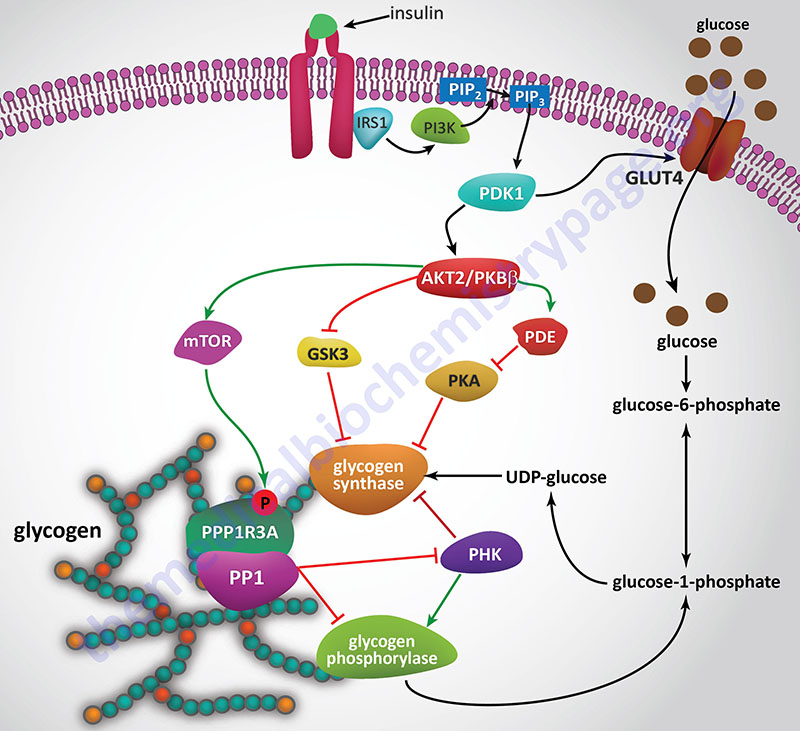
The mechanism for this, which we touched on in the last lesson, involves the activated Akt kinase.
- Akt phosphorylates and inactivates an enzyme called GSK3 (Glycogen Synthase Kinase 3).
- GSK3's normal job is to inhibit another enzyme, Glycogen Synthase.
- By inhibiting the inhibitor (GSK3), insulin effectively removes the brakes, allowing Glycogen Synthase to become active and start linking glucose molecules into glycogen.
- In the Liver: Glycogen is stored as a reserve to maintain stable blood glucose levels between meals.
- In Muscle: Glycogen is stored as a private fuel source for the muscle's own use during exercise.
The Ninja Nerd video you watched earlier also explains this process clearly for both liver and muscle tissue.
Endocrinology | Pancreas: Insulin Function
Let's revisit the Ninja Nerd video to see how insulin promotes glycogen synthesis in both the liver and muscle.
Please review two short clips: Liver (15:00 - 15:40): Note the conversion of glucose to glycogen. Muscle (22:45 - 23:25): Observe the same process occurring in the muscle cell.
Test your understanding!
The video mentions that the liver has GLUT2 transporters, which are insulin-independent, while muscle has GLUT4 transporters, which are insulin-dependent. Why is this difference important for the liver's function in maintaining blood glucose homeostasis?
Show answer
The liver's GLUT2 transporters are always present on the cell surface, allowing glucose to move freely in or out of the cell based on its concentration gradient. This is crucial because the liver must be able to:
- Take up glucose when blood sugar is high (after a meal), as insulin signaling will then trap it and convert it to glycogen.
- Release glucose into the blood when blood sugar is low (during fasting) to keep the brain and other organs supplied with energy.
If the liver relied on insulin-dependent GLUT4, it would not be able to release glucose effectively during fasting when insulin levels are very low. The insulin-independent GLUT2 allows the liver to be a glucose "buffer" for the entire body.
C. Inhibiting Glucose Production in the Liver
In addition to promoting glucose storage, insulin also tells the liver to stop making and releasing its own glucose. During fasting, the liver maintains blood sugar through two processes:
- Glycogenolysis: Breaking down stored glycogen.
- Gluconeogenesis: Synthesizing new glucose from sources like amino acids.
Insulin powerfully inhibits both of these processes. As we learned, Akt phosphorylates the transcription factor FOXO1, preventing it from turning on the genes for the enzymes needed for gluconeogenesis. Insulin signaling also activates enzymes (like Protein Phosphatase 1) that directly shut down the process of glycogen breakdown. This "shut-off" signal is just as important as the "uptake" signal for lowering blood sugar efficiently.
2. Insulin's Effects on Lipid (Fat) Metabolism
When you consume more energy than you need for immediate use or glycogen storage, insulin directs this excess to be stored as fat. This process is called lipogenesis (lipo = fat, genesis = creation).
Insulin promotes lipogenesis in two key ways:
- Providing Building Blocks: In fat cells (adipocytes), the glucose that enters via GLUT4 is converted into molecules that form the "backbone" (glycerol) and "tails" (fatty acids) of triglycerides, the main form of stored fat.
- Activating Fat-Making Enzymes: Insulin signaling increases the activity and expression of key enzymes like Acetyl-CoA carboxylase and Fatty Acid Synthase, which are responsible for building fatty acid chains from the products of glucose metabolism.

Furthermore, insulin is a potent inhibitor of fat breakdown (lipolysis). It blocks the action of an enzyme called Hormone-Sensitive Lipase (HSL), which is responsible for releasing fatty acids from stored triglycerides into the bloodstream.
So, in the fed state, insulin's message is clear: "Stop burning fat, start building and storing it."
The final segment of the Ninja Nerd video explains these effects in adipose tissue beautifully.
Endocrinology | Pancreas: Insulin Function
This segment on adipose tissue explains how insulin drives lipogenesis—the creation of fat.
Watch from 23:48 to 28:10. Pay close attention to how glucose is used to form both glycerol and fatty acids, which are then assembled into triglycerides for storage.
Biochemistry, Insulin Metabolic Effects
This section from the StatPearls article provides a concise summary of insulin's dual role in lipid metabolism: promoting fat synthesis while inhibiting its breakdown.
Please read the section 'Role in Lipid Metabolism'. This text clearly explains how insulin inhibits hormone-sensitive lipase, reinforcing the video's content.
Conclusion
Today, we've connected the molecular signaling pathways from our last lesson to the concrete physiological actions of insulin throughout the body. We've seen how this single hormone masterfully coordinates the body's energy storage after a meal.
Key Takeaways:
- Insulin is an anabolic hormone that promotes energy storage in the "fed" state.
- In Muscle & Fat: Insulin stimulates glucose uptake by promoting GLUT4 translocation to the cell membrane.
- In Liver & Muscle: Insulin promotes the storage of glucose as glycogen (glycogenesis) by activating glycogen synthase.
- In the Liver: Insulin powerfully inhibits the production and release of glucose (gluconeogenesis and glycogenolysis).
- In Adipose Tissue & Liver: Insulin promotes the conversion of excess glucose into fat (lipogenesis) and strongly inhibits the breakdown of stored fat (lipolysis).
Preview of the Next Lesson:
We now have a clear picture of what insulin is supposed to do. This sets the stage for a critical question in the study of PCOS: What happens when the body's tissues stop listening to these signals? In our next lesson, we will formally define insulin resistance and explore the key molecular mechanisms that cause this breakdown in communication, a cornerstone of PCOS pathophysiology.