Hello! Welcome to our next lesson on the clinical features of Polycystic Ovarian Syndrome (PCOS).
In our last session, we took a detailed look at hirsutism, one of the primary signs of hyperandrogenism, and learned how to quantify it using the modified Ferriman-Gallwey score. Today, we will explore another cornerstone of the PCOS diagnosis: menstrual dysfunction. Understanding this is essential, as it is often the first symptom that brings a patient to a clinician.
Our learning outcome for this lesson is to describe the spectrum of menstrual irregularities seen in PCOS, from oligomenorrhea to amenorrhea. We will define these terms precisely, explore the underlying hormonal reasons for these irregularities, and understand how they fit into the diagnostic framework of PCOS.
From Normal Cycles to Menstrual Dysfunction
Before we can understand what is abnormal, we must have a clear picture of what is normal. A regular menstrual cycle is the result of a beautifully orchestrated sequence of hormonal events involving the hypothalamus, pituitary gland, and ovaries (the HPO axis).
To refresh your understanding of these events from a modern medical perspective, please watch the first part of the following video.
Menstruation - Physiology and Disorders; Amenorrhea, Oligomenorrhea, Hypermenorrhea, Dysmenorrhea
The video 'Menstruation - Physiology and Disorders' from MEDucation Made Easy provides a concise review of the normal menstrual cycle.
Watch the video from the beginning until 03:38. Focus on the roles of FSH and LH, the development of the follicle, ovulation, and the function of the corpus luteum in producing progesterone, which leads to a predictable menstrual bleed.
As the video shows, a regular, predictable bleed is the hallmark of an ovulatory cycle—a cycle in which an egg is released. In PCOS, this regularity is disrupted because ovulation does not occur consistently. This condition is called chronic anovulation (chronic lack of ovulation) or oligo-ovulation (infrequent ovulation). This leads to a spectrum of menstrual disorders.
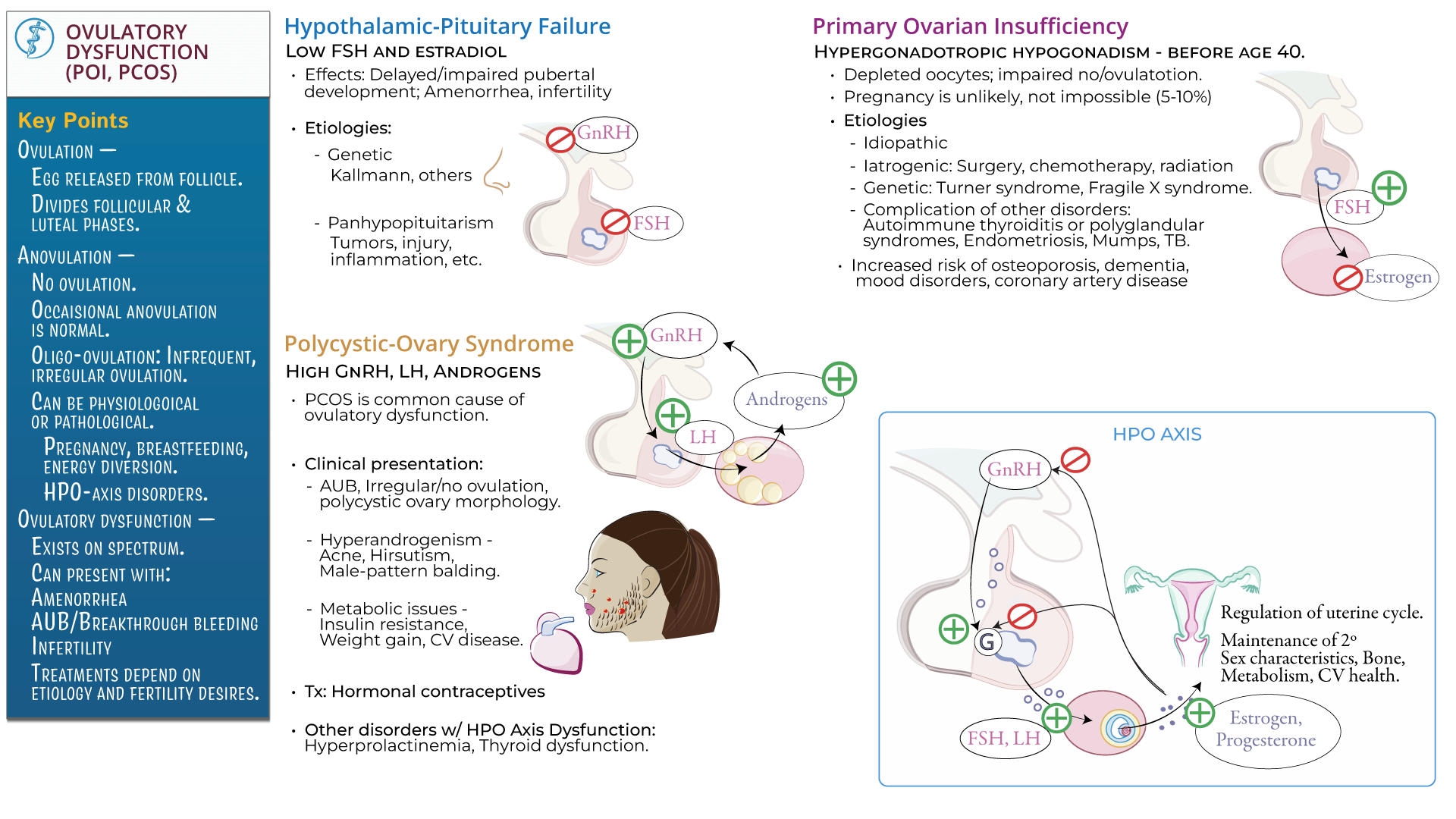
Defining the Spectrum: Oligomenorrhea and Amenorrhea
The menstrual irregularities in PCOS range from infrequent periods to a complete absence of periods. Let's define the key terms used to describe this spectrum.
- Oligomenorrhea: This term literally means "few menstrual flows." It refers to infrequent menstruation.
- Amenorrhea: This term means "no menstrual flow." It refers to the absence of menstruation. It is typically classified as:
- Primary Amenorrhea: The failure to start menstruating by age 15 or within 3 years of breast development.
- Secondary Amenorrhea: The cessation of periods for three or more months in someone who previously had regular cycles. In the context of PCOS, we are almost always dealing with secondary amenorrhea or severe oligomenorrhea.
- Dysfunctional Uterine Bleeding (DUB): This is an older term sometimes used to describe irregular, unpredictable, and often heavy bleeding that results from chronic anovulation.
The following resource provides clear definitions for these conditions and lists PCOS as a primary cause.
Polycystic Ovarian Syndrome Clinical Presentation
The resource 'Polycystic Ovarian Syndrome Clinical Presentation' from Medscape directly describes the menstrual abnormalities seen in PCOS.
Please read the section titled 'Menstrual abnormalities.' This will reinforce the definitions of oligomenorrhea and secondary amenorrhea and their direct link to chronic anovulation in PCOS.
What Counts as "Irregular"? The Official Guidelines
To standardize the diagnosis, international evidence-based guidelines provide precise definitions for what constitutes an irregular cycle. These definitions are crucial as they account for normal variations, especially during adolescence.
Polycystic Ovarian Syndrome - StatPearls - NCBI Bookshelf
The StatPearls article 'Polycystic Ovarian Syndrome' provides the most current, evidence-based definitions of menstrual irregularity according to the 2023 international guidelines.
Please find the 'History and Physical' section and read the list under the heading 'According to the 2023 International Evidence-Based PCOS Guidelines, irregular menstrual cycles are defined as follows:'. Note how the definition changes based on the time since menarche (the first period).
To summarize the key points from the guideline:
- First year after menarche: Irregular cycles are considered normal due to the immaturity of the HPO axis.
- 1 to 3 years after menarche: Cycles are irregular if they are shorter than 21 days or longer than 45 days.
- More than 3 years after menarche: Cycles are irregular if they are shorter than 21 days or longer than 35 days (which corresponds to fewer than 8 cycles per year).
- At any point >1 year after menarche: A single cycle lasting more than 90 days is considered irregular.
The Pathophysiology: Why Anovulation Happens in PCOS
Now we arrive at the central question: what is the underlying mechanism that disrupts the menstrual cycle in PCOS? The answer lies in the hormonal imbalances we have begun to discuss.
The key issue is a disruption in the normal pulsatile release of Gonadotropin-Releasing Hormone (GnRH) from the hypothalamus. In PCOS, GnRH pulses are often faster and of higher amplitude. This preferentially stimulates the pituitary to release Luteinizing Hormone (LH) over Follicle-Stimulating Hormone (FSH), leading to a state of high LH and relatively low FSH.
This hormonal imbalance sets off a cascade of events within the ovary:
- Excess Androgen Production: The high levels of LH constantly stimulate theca cells in the ovary to produce androgens (like testosterone).
- Increased Estrogen Levels: These excess androgens are converted into estrogen (specifically, estrone) in peripheral tissues, like fat cells. This leads to a state of chronically elevated, non-cyclical estrogen.
- FSH Suppression: The persistently high estrogen level sends a continuous negative feedback signal to the pituitary, which suppresses the release of FSH.
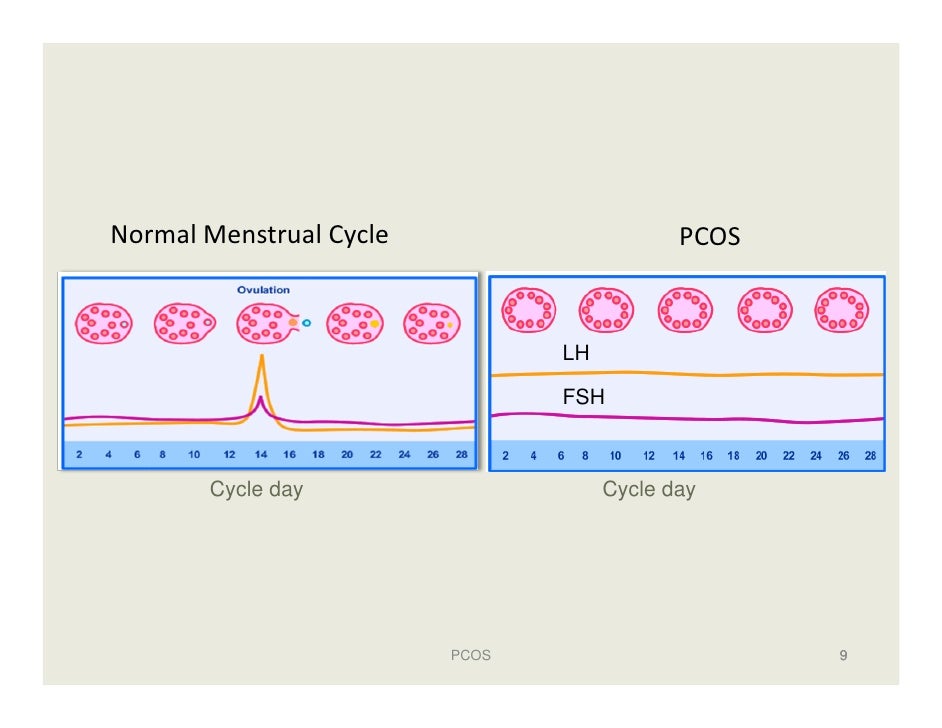
- Follicular Arrest: FSH is crucial for the final maturation of ovarian follicles. Without a sufficient FSH surge, the follicles begin to develop but then stall in an immature state. They fail to grow into a single, dominant follicle that can ovulate. This state is known as follicular arrest.
- Anovulation: Because no follicle becomes dominant and matures, the LH surge required to trigger ovulation never happens. The result is chronic anovulation.
- Irregular Cycles: Without ovulation, no corpus luteum is formed. Without a corpus luteum, there is no cyclical production and withdrawal of progesterone. It is the predictable drop in progesterone that triggers a menstrual bleed. In PCOS, the endometrium is exposed to continuous estrogen stimulation without the balancing effect of progesterone, leading to infrequent, unpredictable shedding (oligomenorrhea) or no shedding at all (amenorrhea).
This complex process is explained very clearly in the following animated video.
Poly Cystic Ovarian Syndrome (PCOS) / Stein–Leventhal syndrome / Hyperandrogenic anovulation
The video 'Poly Cystic Ovarian Syndrome (PCOS)' by Dr. G Bhanu Prakash provides an excellent animated explanation of the hormonal cascade that leads to anovulation and irregular cycles.
Watch the segment from 06:27 to 12:27. Pay close attention to how the speaker connects high LH to high androgens, then to high estrogens, and finally to low FSH, follicular arrest, and anovulation. This is the central pathophysiological mechanism of menstrual dysfunction in PCOS.
The image below provides a powerful visual summary, contrasting the dynamic, successful follicle development in a normal cycle with the state of arrested development seen in PCOS.
Test your understanding!
A key step in the pathophysiology of anovulation in PCOS is the suppression of FSH. Why do persistently high estrogen levels lead to low FSH, and what is the direct consequence of low FSH on the ovarian follicles?
Show answer
Persistently high estrogen levels exert a continuous negative feedback effect on the pituitary gland. In a normal cycle, estrogen levels rise and fall, creating both negative and positive feedback at different times. In PCOS, the constant high level of estrogen primarily results in negative feedback, which suppresses the pituitary's secretion of FSH.
The direct consequence of low FSH is follicular arrest. FSH is the "Follicle-Stimulating Hormone," and it is essential for nurturing a cohort of follicles and ensuring one becomes dominant and fully mature. Without adequate FSH stimulation, the follicles cannot complete their development, stall at a small size, and fail to ovulate.
Conclusion
In this lesson, we have dissected the second major clinical feature of PCOS: menstrual irregularity. We have moved beyond simple descriptions to understand the precise, evidence-based definitions and the complex hormonal web that causes this dysfunction.
Key Takeaways:
- Menstrual irregularity in PCOS is a spectrum, most commonly presenting as oligomenorrhea (infrequent periods) or secondary amenorrhea (absent periods).
- The root cause is chronic anovulation—the failure of the ovary to release an egg regularly.
- The underlying pathophysiology involves abnormal GnRH secretion, leading to high LH and relatively low FSH. This hormonal state causes excess ovarian androgen production, follicular arrest, and a failure to ovulate.
- Official diagnostic guidelines provide specific, age-dependent criteria for defining an irregular menstrual cycle, which is crucial for accurate diagnosis, especially in adolescents.
Preview of the Next Lesson:
We have now examined two of the three Rotterdam criteria in detail: clinical hyperandrogenism (hirsutism) and ovulatory dysfunction (menstrual irregularity). But how do we confirm the "hyperandrogenism" part with lab tests? In our next lesson, we will focus on this as you learn to outline the biochemical investigations used to confirm hyperandrogenism. We will explore which hormones are measured and what their typical levels reveal in a woman with PCOS.