Hello! Welcome to the fifth lesson in our module on the physiology of the normal menstrual cycle.
Introduction
In our previous lessons, we have explored the events of the ovarian cycle in detail. We've traced the journey from the follicular phase, where estrogen from the developing follicle dominates, to the luteal phase, defined by the progesterone secreted from the corpus luteum.
Today, we will shift our primary focus from the ovary to the uterus. The uterus is not a passive bystander; its inner lining, the endometrium, undergoes a dramatic, cyclical transformation that is perfectly synchronized with the events in the ovary. This lesson will fulfill the learning outcome: to correlate the endometrial changes (proliferative and secretory phases) with the ovarian cycle. We will connect the hormonal signals from the ovary to the structural and functional changes in the endometrium, creating a complete picture of the menstrual cycle.
1. The Endometrium: A Tale of Two Layers
Before we explore the dynamic changes, we must first understand the structure of the endometrium. It consists of two distinct layers, each with a specific role.
- Stratum Basalis (Basal Layer): This is the deeper, permanent layer of the endometrium. It is not shed during menstruation. Its primary role is to serve as a reservoir of cells that regenerate the functional layer after each cycle. It has its own dedicated blood supply from straight arteries.
- Stratum Functionalis (Functional Layer): This is the superficial layer that lines the uterine cavity. It is highly responsive to ovarian hormones. It thickens throughout the cycle to prepare for a potential pregnancy and is shed during menstruation if implantation does not occur. Its blood supply comes from the distinctive spiral arteries, which are crucial for both its growth and its eventual breakdown.
To get a clear visual understanding of these layers and their blood supply, please watch the introductory part of the following video.
Female Reproductive Cycle | Menstrual Cycle
This clip from Ninja Nerd provides an excellent visual introduction to the endometrial layers and their unique blood supplies, which is fundamental to understanding the uterine cycle.
Please watch from 00:43 to 04:46. Pay close attention to the distinction between the stratum functionalis and stratum basalis, and the difference between the spiral and straight arteries.
2. The Ovarian-Uterine Correlation
The menstrual cycle is best understood as two synchronized cycles: the ovarian cycle (follicular and luteal phases) and the uterine cycle (menstrual, proliferative, and secretory phases). The hormones from the ovarian cycle are the directors, and the endometrial phases are the performance.
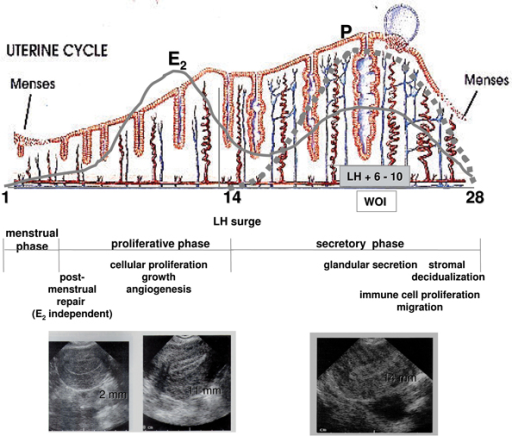
Let's break down this correlation step-by-step.
3. The Proliferative Phase: Building the Lining under Estrogen's Influence
The proliferative phase of the endometrium happens in lockstep with the follicular phase of the ovarian cycle.
- Ovarian Driver: As ovarian follicles grow during the follicular phase, their granulosa cells produce increasing amounts of estrogen (specifically, estradiol).
- Uterine Response: This rising estrogen stimulates the endometrium to rebuild and thicken. This is why the follicular phase of the ovary corresponds to the proliferative phase of the uterus.
The key effects of estrogen on the endometrium are:
- Regeneration: After menstruation sheds the old functionalis layer, estrogen stimulates the cells of the stratum basalis to divide and regenerate a new stratum functionalis.
- Proliferation: Estrogen causes rapid mitosis (cell division) in the endometrial glands and stroma, leading to a significant increase in the thickness of the lining.
- Angiogenesis: It promotes the growth and elongation of the spiral arteries into the new tissue.
- Gland Formation: It stimulates the development of uterine glands, which appear as straight, narrow tubes during this phase.
This preparation creates a thick, vascularized lining, ready for the influence of the next key hormone.
Female Reproductive Cycle | Menstrual Cycle
This next segment from the Ninja Nerd video clearly explains how estrogen from the ovarian follicular phase drives the changes seen in the uterine proliferative phase.
Please watch from 04:46 to 10:08. Focus on how estrogen orchestrates the regeneration of the stratum functionalis, angiogenesis of spiral arteries, and the initial formation of uterine glands.
For a more text-based explanation, you can review the following resource.
Physiology, Menstrual Cycle - StatPearls - NCBI Bookshelf
The StatPearls article 'Physiology, Menstrual Cycle' provides a concise written account of how the follicular phase events in the ovary drive the proliferative phase in the uterus.
Please read the section titled 'Mechanism', and focus on the subsection 'Proliferative phase events'. This details how estradiol from the growing follicles stimulates endometrial development.
4. The Secretory Phase: Maturing the Lining under Progesterone's Command
Following ovulation, the cycle enters the secretory phase, which is perfectly aligned with the luteal phase of the ovarian cycle.
- Ovarian Driver: After ovulation, the corpus luteum forms and begins to secrete large amounts of progesterone, along with a secondary peak of estrogen.
- Uterine Response: Progesterone acts on the estrogen-primed endometrium, transforming it from a growing tissue to a mature, receptive, and nutritive lining ready for implantation. This is the secretory phase.
The key effects of progesterone are:
- Inhibiting Proliferation: Progesterone counteracts estrogen's proliferative effect, halting further significant growth in endometrial thickness.
- Promoting Secretion: It causes the uterine glands to become tortuous (coiled) and begin secreting a nutrient-rich fluid containing glycogen, glycoproteins, and lipids. This provides vital nourishment for a potential embryo.
- Vascular Development: The spiral arteries become even more coiled and elongated, maximizing blood flow to the surface.
- Stromal Changes: The endometrial stroma becomes edematous (swollen), and its cells begin to differentiate into specialized decidual cells (decidualization), a critical process for implantation.
Test your understanding!
A patient undergoes an endometrial biopsy. The pathologist's report notes "straight, tubular glands with mitotic figures" and a thin endometrium. Which phase of the ovarian cycle was this patient most likely in, and which hormone was dominant?
Show answer
The patient was most likely in the follicular phase of the ovarian cycle. The described endometrial changes—straight glands, cell division (mitosis), and a thin lining—are characteristic of the proliferative phase, which is driven by the dominant hormone of the follicular phase: estrogen.
The following resources provide excellent descriptions of the secretory phase.
Female Reproductive Cycle | Menstrual Cycle
This clip continues the Ninja Nerd explanation, now focusing on the powerful effects of progesterone during the secretory phase.
Please watch from 10:08 to 14:00. Note how progesterone shifts the endometrium's function from growth to secretion and maturation.
The Normal Menstrual Cycle and the Control of Ovulation - NCBI
For a very detailed, day-by-day histological description of the endometrial changes, which aligns with your goal of in-depth theoretical understanding, this resource is invaluable.
Please read the section 'Hormonal Effects on the Reproductive Tract', focusing on the subsection 'Endometrium'. It describes the specific microscopic changes that occur in the glands and stroma on each day of the luteal/secretory phase.
5. Summary of the Correlation
Let's synthesize this information into a clear table that summarizes the relationship between the ovarian and uterine cycles.
| Ovarian Cycle | Primary Hormone | Uterine Cycle | Key Endometrial Events |
|---|---|---|---|
| Follicular Phase (Days 1-14) | Estrogen | Menstrual Phase (Days 1-5) | Shedding of stratum functionalis due to previous hormone withdrawal. |
| Proliferative Phase (Days 6-14) | Regeneration and proliferation of stratum functionalis; growth of glands and spiral arteries. | ||
| Luteal Phase (Days 14-28) | Progesterone | Secretory Phase (Days 14-28) | Glandular secretion of nutrients; increased coiling of spiral arteries; stromal edema and decidualization. |
Conclusion
Today, we have connected the dots between the ovary and the uterus, demonstrating that the endometrial changes are a direct and predictable response to the hormonal symphony conducted by the ovary.
Key Takeaways:
- The uterine cycle is a mirror image of the ovarian cycle, driven by ovarian hormones.
- The ovarian follicular phase corresponds to the uterine proliferative phase. Rising estrogen causes the endometrial lining (stratum functionalis) to rebuild and thicken.
- The ovarian luteal phase corresponds to the uterine secretory phase. High levels of progesterone from the corpus luteum cause the endometrium to mature, become secretory, and prepare for implantation.
- This coordinated process ensures that the uterus is perfectly prepared for a potential embryo at the precise time it might arrive.
Preview of the Next Lesson:
We have seen how the endometrium is built up and matured. But what happens when pregnancy does not occur and the hormonal support from the corpus luteum is withdrawn? This triggers the final phase of the uterine cycle: menstruation. In our next lesson, we will focus on this event, exploring the learning outcome: "Describe the hormonal and cellular mechanisms leading to menstruation when pregnancy does not occur." We will examine the vascular and biochemical events that lead to the orderly breakdown and shedding of the stratum functionalis, resetting the stage for a new cycle to begin.