Hello! Welcome back to your English course.
In our last lesson, you learned the building blocks of English words: the alphabet letters and their sounds. That was a fantastic start! Today, we will use that foundation to learn another essential skill for daily conversation: how to count from 1 to 100.
Knowing numbers is very important for making friends and for everyday life. You will use them to talk about your age, understand prices when you shop, give your phone number, and tell the time. By the end of this lesson, you will be able to say, read, and understand any number from 1 to 100.
1. The First Twenty Numbers (0-20)
The first numbers in English, from 0 to 20, are unique. You need to memorize them. Once you know these well, learning the rest will be much easier.
Let's start by watching a video that will guide you through the pronunciation of numbers 0 through 20. The instructor speaks slowly and clearly.
1 - 100 English Numbers | Learn and Practice Pronunciation and Spelling
This video from Shaw English Online will teach you numbers 0-10 and then 11-20. Listen carefully and repeat each number out loud. This is the most important step.
Watch the video from 00:20 to 04:02. The first part covers 0-10, and the second part covers 10-20. Try to say the numbers along with the speaker.
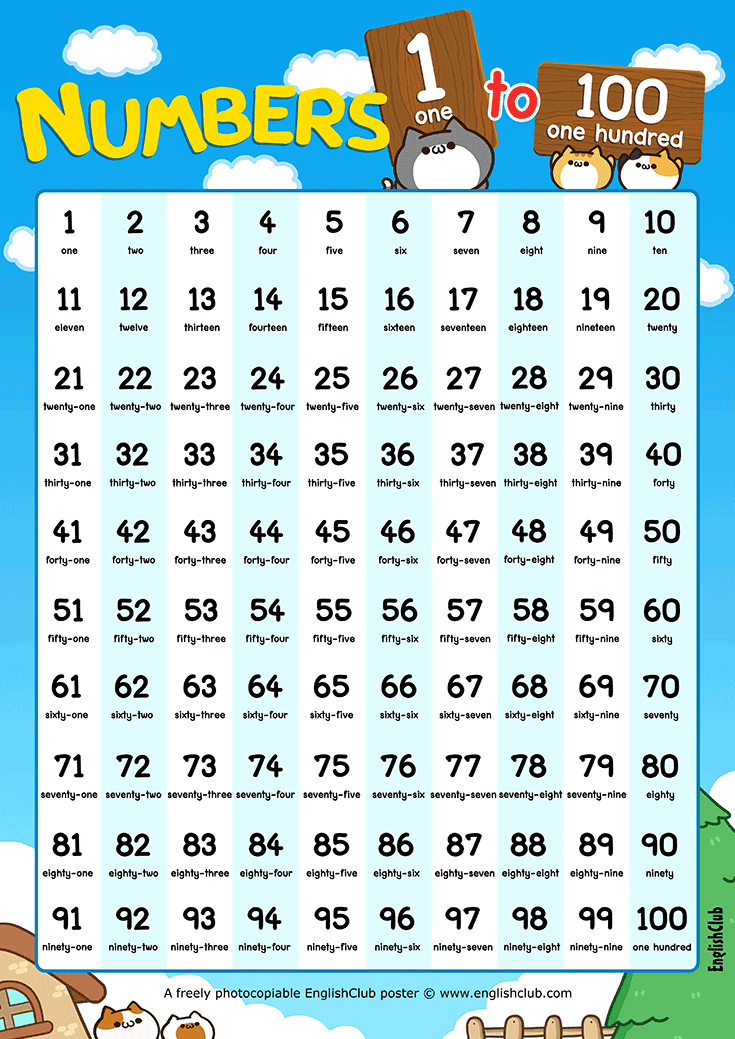
Great! As you practice, you can use this chart as a quick reference. It shows all the numbers from 1 to 100 with their English spellings.
Test your understanding!
How do you write these numbers in words?
- 8
- 13
- 20
Show answer
- eight
- thirteen
- twenty
2. The Pattern for Numbers 21-100
Now for the good news! After 20, the numbers follow a simple and predictable pattern.
First, you need to learn the "tens":
- 20 - twenty
- 30 - thirty
- 40 - forty
- 50 - fifty
- 60 - sixty
- 70 - seventy
- 80 - eighty
- 90 - ninety
- 100 - one hundred
To make any other number, you just combine the "ten" with a number from 1 to 9. For example:
- 21 = twenty + one (twenty-one)
- 35 = thirty + five (thirty-five)
- 88 = eighty + eight (eighty-eight)
The next part of the video explains this pattern.
1 - 100 English Numbers | Learn and Practice Pronunciation and Spelling
Let's continue with the same video. This part will teach you the 'tens' (20, 30, 40, etc.) and show you how to combine them to make any number up to 100.
Watch from 04:02 to 06:00. Pay attention to how the numbers like 'twenty-one', 'twenty-two', etc., are formed.
3. Pronunciation: -teen vs. -ty
A common point of confusion for new learners is the difference in sound between numbers like 13 (thirteen) and 30 (thirty).
The key is the stress:
- For numbers 13-19, the stress is on the -teen part. The sound is long: "thir-TEEN".
- For the "tens" numbers (30, 40, 50...), the stress is on the first part. The sound is short: "THIR-ty".
This video gives excellent practice for hearing and saying the difference.
1 - 100 English Numbers | Learn and Practice Pronunciation and Spelling
This is a very important part of the lesson. The video will compare numbers like 13 and 30 side-by-side. Listen very carefully to the difference in pronunciation.
Watch from 06:00 to 07:49. Repeat the pairs of numbers out loud (e.g., thirteen, thirty). The video includes a small quiz where you listen and identify the number.
Test your understanding!
Listen to yourself say these two numbers out loud: 15 and 50.
Can you hear the difference? Which part of the word is stronger or longer in each one?
Show answer
For 15 (fifteen), the stress is on the second part: "fif-TEEN".
For 50 (fifty), the stress is on the first part: "FIF-ty".
4. Practice Makes Perfect
You have now learned all the rules for counting to 100! The final step is to practice so you can say the numbers quickly and confidently.
Activity 1: Video Practice
First, continue with the video you have been watching. It has a great practice section with random numbers.
1 - 100 English Numbers | Learn and Practice Pronunciation and Spelling
This last part of the video will show you random numbers on the screen. Try to say the number out loud before the instructor does.
Watch from 07:49 to 10:29. This is a fun way to test how much you remember.
Activity 2: Interactive Practice
For your own practice, this website is an excellent tool. You can move your mouse over any number from 1 to 100 and hear its pronunciation. Use this to review any numbers you find difficult.
Use the 'Numbers - English' webpage from LanguageGuide.org to practice pronunciation at your own speed.
On the webpage, move your mouse over the numbers. You will see the written word and hear the sound. Practice with numbers you are not sure about, like 13/30, 14/40, 15/50.
Conclusion
Excellent work today! You have learned a skill that is fundamental to using English in the real world.
Here are the key takeaways from our lesson:
- Numbers from 0 to 20 must be memorized.
- Numbers from 21 to 99 follow a simple pattern: say the "ten" (twenty, thirty, etc.) and then the "one" (one, two, etc.).
- Pay close attention to the pronunciation difference between -teen numbers (like fourteen) and -ty numbers (like forty).
In our next lesson, we will learn how to use subject pronouns (like 'I', 'you', 'he', 'she') with the verb 'to be' ('am', 'is', 'are'). This will allow you to form your first complete sentences in English, such as "I am a student" or "He is 25 years old."
Keep practicing your numbers! Try counting things around you during the day. See you next time