Introduction
In our last lesson, we established the foundational "operating system" of the common law, where legal principles are derived from both legislative statutes and, crucially, judge-made case law. We saw that judges don't just apply law; they shape it by interpreting statutes and applying the doctrine of precedent (stare decisis).
Today, we delve into one of the most significant areas of law built almost entirely on judicial precedent: Tort Law. A tort is a civil wrong that one person commits against another, resulting in harm, and it provides a legal avenue for the injured party to seek compensation. This is the primary legal battleground where liability for AI-induced harm is determined. Your prior work in digital transformation for healthcare clinics has likely involved navigating risks and client responsibilities; tort law provides the formal legal structure for those considerations.
This lesson will equip you with the core principles of Tort Law, focusing on negligence and strict liability, and the vital concept of causation. Our goal is to understand these legal doctrines and then analyze their direct relevance and application to harms caused by AI systems, from autonomous vehicles to diagnostic algorithms.
What is Tort Law?
A "tort" is distinct from a crime or a breach of contract.
- A crime is a wrong against the state, prosecuted by the state, with the goal of punishment.
- A breach of contract is the failure to fulfill a private agreement, with the goal of enforcing the promise.
- A tort is a breach of a general duty owed to society (e.g., the duty not to be careless), with the goal of compensating the victim for their losses, typically through monetary damages.
Tort liability can be organized into three main categories, based on the nature of the defendant's conduct.
Episode 1.2: An Overview of Tort Law – Intentional Torts, Negligence, and Strict Liability
To begin, let's watch a brief overview from the Center for Innovation in Legal Education that introduces the three main types of tort liability. This will give us a clear framework for the rest of the lesson.
Please watch the following segments: The Three Main Types (03:51 - 04:43): This introduces the three categories: intentional torts, negligence, and strict liability. Negligence (05:38 - 06:25): Focus on the definition of negligence as liability for carelessness. Strict Liability (06:25 - 07:44): Pay attention to the concept of liability without fault, especially the example of a defective product.
As the video explains, the three categories are:
- Intentional Torts: The defendant desired to cause the harm or knew with substantial certainty that it would occur (e.g., battery, defamation).
- Negligence: The defendant acted carelessly, causing unintentional harm. This is the most common type of tort.
- Strict Liability: The defendant is liable for harm even if they were not at fault. This applies in specific situations, such as abnormally dangerous activities or selling defective products.
While intentional torts could apply to AI (e.g., programming an AI for a malicious purpose), most legal questions surrounding AI failures fall under negligence and strict liability. Let's explore these in detail.
Negligence: The "Reasonable Person" Standard
Negligence is the workhorse of tort law. To succeed in a negligence claim, a plaintiff must prove four elements.

Let's break down these elements, which form the prima facie case for negligence.
How to Analyze Negligence on a Torts Essay (Pt. 1): Palsgraf & The Duty of Care
The legal education channel Studicata provides an excellent series on torts. This first video introduces the four elements of negligence and then dives deep into the first, and often most complex, element: Duty of Care.
Please watch the following segments: The Four Elements (00:00 - 00:52): This clearly lists the four elements: Duty, Breach, Causation, and Damages. Duty Analysis Intro (01:01 - 01:47): Understand that analyzing duty is a two-step process. Cardozo's 'Zone of Danger' (06:21 - 08:09): This explains the majority opinion in the landmark Palsgraf case, which established that a duty is only owed to foreseeable victims. Andrews' Dissent (08:09 - 12:10): Pay close attention to the alternative view: that a duty is owed to everyone, and foreseeability should be analyzed under causation. How to Analyze (12:10 - 13:16): This summarizes why it's important to understand both legal approaches.
The Four Elements of Negligence
-
Duty of Care: The defendant must have owed a legal duty to the plaintiff to act with a certain level of care. As the Palsgraf case illustrates, the dominant view (Cardozo's) is that this duty extends only to those within the "zone of foreseeable danger." An AI developer clearly owes a duty to the intended user, but do they owe a duty to a bystander harmed in a freak accident? The scope of this duty is a critical legal question.
-
Breach of Duty: The defendant's conduct must have fallen below the standard of care. This standard is typically that of a "reasonable person" under the circumstances. In the context of AI, this becomes the "reasonable AI developer," "reasonable data scientist," or "reasonable doctor using an AI tool." Proving a breach would involve showing that the defendant's actions (e.g., using a biased dataset, failing to test adequately) were not what a reasonably competent professional in their field would have done.
-
Causation: The defendant's breach must be the legal cause of the plaintiff's harm. This is a two-part test:
- Factual Causation ("But-For" Test): "But for" the defendant's careless act, would the plaintiff have been injured?
- Legal Causation (Proximate Cause): Was the harm a foreseeable result of the defendant's act? This element is designed to cut off liability for bizarre, unforeseeable chains of events. Notice how Justice Andrews in Palsgraf preferred to analyze the foreseeability of the victim here, rather than under the 'duty' element.
-
Damages: The plaintiff must have suffered a legally recognized injury (e.g., physical injury, property damage).
Test your understanding!
An AI-powered agricultural drone is programmed to spray pesticide. Due to a coding error, it misidentifies a neighboring organic farm as part of its target zone and sprays it, destroying the crops. The organic farmer sues the drone's software developer for negligence.
Using the four elements, what must the farmer prove?
Show answer
- Duty: The farmer must prove the developer owed a duty of care to neighboring landowners to prevent their software from causing foreseeable harm like crop damage. This is likely to be established, as a neighboring farm is within the "zone of foreseeable danger."
- Breach: The farmer must prove the developer breached the standard of care of a "reasonable AI developer." Evidence of a coding error that a competent programmer would have caught during testing would likely establish a breach.
- Causation: The farmer must prove the coding error was both the factual ("but for" the error, the crops would not have been sprayed) and legal (crop damage is a foreseeable result of a pesticide drone malfunction) cause of the loss.
- Damages: The farmer must prove the financial value of the destroyed crops.
Strict Liability: Liability Without Fault
In some cases, the law imposes liability even if the defendant was as careful as possible. This is called strict liability.
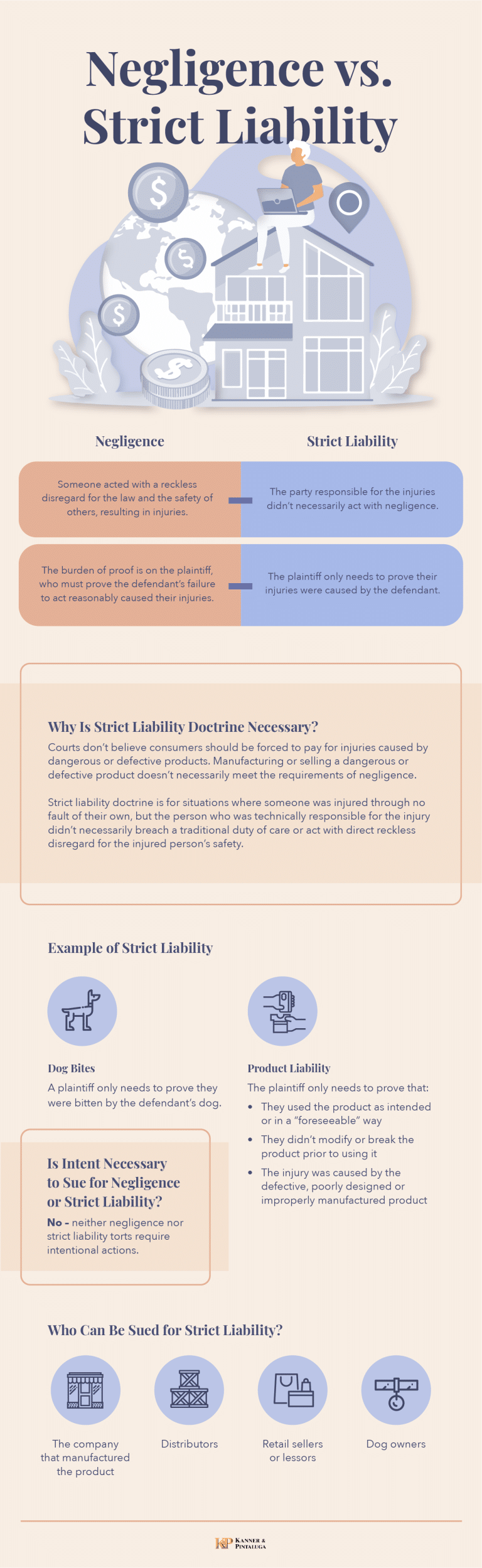
The two most relevant applications for AI are:
- Abnormally Dangerous Activities: Activities that involve a high degree of risk of serious harm, which cannot be eliminated by exercising reasonable care (e.g., blasting with dynamite). There is a legal debate about whether deploying certain types of highly autonomous AI could be considered an abnormally dangerous activity.
- Product Liability: A manufacturer or seller of a product is strictly liable for harm caused by a product that is sold in a defective condition. A product can be defective in its manufacture, design, or because of a failure to warn of non-obvious dangers.
This is a major avenue for AI litigation. If an AI system is considered a "product," its developer could be strictly liable for harms caused by its "defective" design—for example, an algorithm that is inherently biased or unsafe.
The choice between a fault-based (negligence) and no-fault (strict liability) regime is one of the most significant policy questions in AI governance.
Crafting a Liability Regime for AI Systems in India
This report from the AI Knowledge Consortium, 'Crafting a Liability Regime for AI Systems in India', directly addresses this central debate. It sets up the arguments for and against applying strict liability to AI developers.
Please read the Executive Summary (page 1) and the Introduction (pages 7-8). Focus on understanding the core tension between fault-based liability (negligence) and strict liability, and why some scholars argue that the unique characteristics of AI might justify a strict liability approach.
The Challenge: Proving the Case Against an Opaque AI
We now have the legal frameworks: negligence and strict liability. But applying them to AI presents a profound practical challenge: opacity, or the "black box" problem.
How can a plaintiff prove that a developer was negligent or that an AI was defective when it may be impossible, even for the developer, to explain exactly why the AI made a specific decision? Your technical background in data analytics gives you a head start in grasping the depth of this issue, which stems from the non-linear and statistical nature of complex models.
This challenge of "explainability" is where law and computer science collide.
AI Opacity and Explainability in Tort Litigation
The academic paper 'AI Opacity and Explainability in Tort Litigation' by Fraser et al. provides a sophisticated analysis of this very problem. It directly connects the legal elements we've just learned to the technical reality of AI systems.
Please read the following sections: Introduction (Section 1, pages 1-2): Focus on how the authors frame the problem of AI opacity and the need for explanations that are legally salient. What needs to be explained in product liability and negligence claims (Section 4.2, pages 5-6): This is the most important part. See how the authors break down the elements of negligence (duty, breach, causation) and product liability, and discuss how Explainable AI (XAI) might be used to prove them. Pay special attention to the discussion of causation and the 'but for' test.
As Fraser et al. argue, proving a case requires explanations that are specifically tailored to the legal elements. For example, to prove causation in a negligence case, a plaintiff needs to show that 'but for' the developer's negligence, the harm would not have occurred. As the paper suggests (and explores in later sections you can skim if interested, like Section 6), one could theoretically use counterfactual XAI methods to do this—by demonstrating that had the developer taken a reasonable precaution (like using a more balanced dataset), the model's error rate would have been significantly lower, and the accident would have been avoided.
Case Studies in Practice
Let's see how these principles play out in plausible scenarios, drawn from the AIKC report.
-
Case 1: Medical Negligence (Resource LINK, Section 4)
A doctor uses an AI diagnostic tool that misdiagnoses a patient, leading to harmful treatment. The AI was trained on a dataset that under-represented the patient's demographic.- Negligence: A case could be made against the doctor for medical negligence for relying on the AI without seeking a second opinion, breaching the standard of care for a reasonable physician.
- Product Liability: A case could be made against the AI developer under strict product liability, arguing the AI tool was a "defective product" due to its biased design (the unrepresentative training data).
-
Case 2: Autonomous Vehicle Collision (Resource LINK, Section 5)
An autonomous vehicle with a malfunctioning sensor causes a minor collision.- Product Liability: The owner could sue the vehicle manufacturer for providing a defective product. The manufacturer might, in turn, sue the sensor's component manufacturer, illustrating the complexity of liability in modern supply chains (the "component part" doctrine).
These examples show that tort law does not provide one simple answer. Instead, it offers a set of tools to analyze fault and attribute responsibility, even in a world of complex, interdependent technological systems.
Conclusion
This lesson provided your first formal introduction to Tort Law, a critical pillar of civil liability. We've seen how centuries-old principles, forged through judicial precedent, are now being adapted to address the novel challenges of artificial intelligence.
Key Takeaways:
- Tort law allows individuals to claim compensation for harms caused by others' civil wrongs.
- Negligence is the primary framework for harms caused by carelessness. It requires the plaintiff to prove four elements: duty, breach, causation, and damages. The foreseeability of harm and the "reasonable person" standard are central to the analysis.
- Strict Liability imposes liability without fault, most notably for defective products. This is a powerful tool for holding manufacturers accountable and is a focal point of the debate on AI liability.
- The greatest practical challenge in applying tort law to AI is the opacity or "black box" nature of complex models, which makes proving elements like breach and causation incredibly difficult. This has spurred the field of Explainable AI (XAI) as a potential bridge between technology and legal proof.
Preview of the Next Lesson:
We have explored the duties we owe to people generally (torts). In our next lesson, we will turn to Contract Law, which governs the duties we voluntarily assume through agreements. This is essential for understanding the legal relationships defined by terms of service for AI platforms, API agreements, and the burgeoning world of automated "smart" contracts.