Introduction
In our last lesson, we established the fundamental chain of determinism in AI: Training Data → Features → Parameters → Behavior. We saw that an AI model's actions are a direct consequence of the parameters it learns from the data it's shown. This sets the stage for a crucial question with profound legal and ethical implications: what happens when the initial data is flawed?
Today, we will answer that question by focusing on one of the most significant risks in AI systems: bias. Our learning outcome is to identify sources of bias in datasets and explain their propagation through the machine learning lifecycle. We will move beyond a general acknowledgment of bias to a structured, technical understanding of where it comes from and how it infects every stage of AI development.
For your goal of mastering AI governance, this lesson is critical. Understanding the specific technical pathways of bias is a prerequisite for designing effective legal remedies, compliance frameworks, and auditing procedures. You cannot regulate what you cannot diagnose.
A Framework for Understanding Bias
To begin, it's helpful to have a clear framework. The U.S. National Institute of Standards and Technology (NIST) provides an excellent one, categorizing bias into three main types. This structure will help us organize our thinking.
Towards a Standard for Identifying and Managing Bias in ...
The NIST Special Publication 'Towards a Standard for Identifying and Managing Bias in AI' is a foundational document in this field. It provides a robust taxonomy of bias. We'll start by reading the section that introduces this framework.
Please read Section 2.1, 'Characterizing AI bias' (pages 3-8). Focus on understanding the definitions and distinctions between the three main categories: Systemic Bias: Resulting from institutional and societal norms. Statistical and Computational Bias: Stemming from errors in sampling and representation. Human Bias: Reflecting cognitive errors in human judgment during the AI lifecycle. This framework will serve as our guide for the rest of the lesson.
While this framework is comprehensive, the lines between these categories often blur. Systemic and human biases are frequently the root causes of the statistical biases we find in datasets. Let's watch a video that provides some powerful, intuitive examples of how this happens.
MIT 6.S191: AI Bias and Fairness
This lecture from MIT's Introduction to Deep Learning course vividly demonstrates how societal and cultural context becomes embedded in AI systems.
Watch the segment from 00:10 to 08:31. Pay close attention to the examples: The 'watermelon' example shows how our personal 'prototypes' create bias. The 'bride' and 'spices' examples demonstrate how a model trained on data from one cultural context (North America/Europe) fails when applied to another (South Asia/Philippines). Given your international background, these examples of cultural bias in data will be particularly clear.
These examples highlight a core problem: AI models learn from data that is a snapshot of our world, complete with all its existing inequalities, stereotypes, and cultural assumptions.
Sources of Bias in the Dataset
Bias almost always originates in the data. Let's dissect the primary sources of this "data poisoning." The image below provides an excellent visual map of where different biases can arise in the machine learning process. We will focus first on the Data Generation Biases shown in the top half.
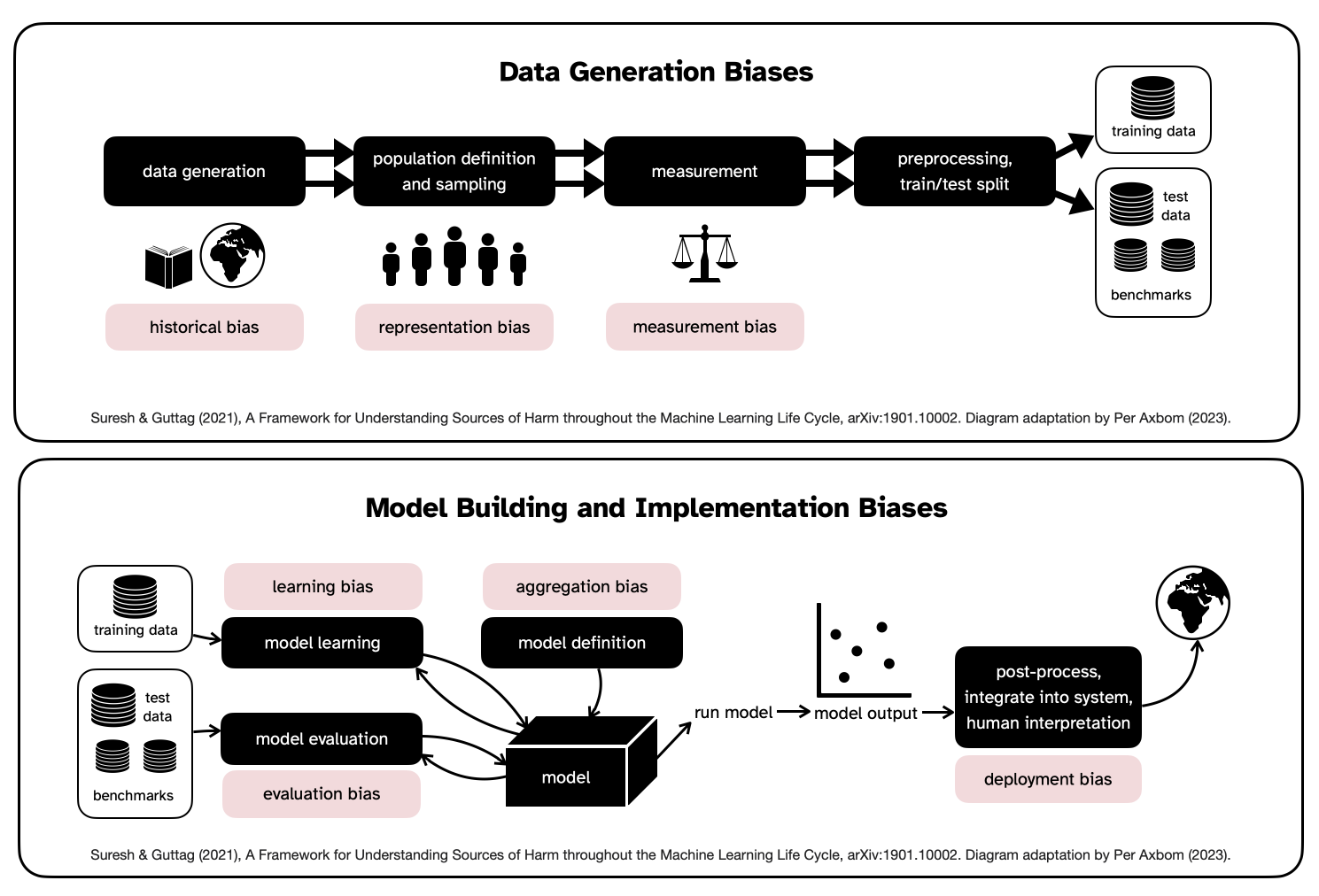
1. Historical Bias (A form of Systemic Bias)
This occurs when the data reflects historical or ongoing societal prejudices, even if the data is factually accurate.
A classic example, which you've likely encountered in your legal research, is predictive policing. An AI trained on historical arrest data for drug-related crimes might recommend sending more police to minority neighborhoods. This isn't because more crime happens there, but because those neighborhoods have been historically over-policed. The data reflects the bias of past policing practices, not an objective reality of crime distribution. The Harvard Kennedy School paper "Model Behavior" describes this phenomenon well in its analysis of the PredPol system.
2. Representation and Sampling Bias (A form of Statistical Bias)
This is arguably the most common source of bias. It occurs when the dataset does not accurately reflect the environment where the model will be deployed. This can happen in several ways:
Class Imbalance: Certain groups or outcomes are severely underrepresented in the data. A model trained on such data will naturally perform poorly on the minority class because it optimizes for overall accuracy.
Your consulting work in healthcare provides a relevant context. Imagine training an AI to detect a rare but aggressive form of cancer from MRI scans.
MIT 6.S191: AI Bias and Fairness
Let's return to the MIT video, which provides an excellent explanation of class imbalance and its consequences, using a medical imaging example.
Watch the section on class imbalance from 15:57 to 22:08. Notice how the model can achieve 99.997% accuracy on the glioblastoma detection task by simply always predicting 'healthy'. This illustrates why overall accuracy is a misleading metric and how catastrophic the consequences of class imbalance can be.
Feature Imbalance: Even if your classes are balanced (e.g., equal numbers of male and female faces), the features within those classes might not be. For example, a facial recognition dataset may have an equal number of men and women, but if the images of women are predominantly light-skinned, the model will be biased against darker-skinned women. This is precisely what the Gender Shades study found.
MIT 6.S191: AI Bias and Fairness
The MIT video also covers this more subtle form of bias within balanced classes.
Watch the segment from 24:07 to 27:12. It uses hair color distribution in facial datasets as a clear example of feature imbalance.
3. Measurement Bias
This bias is introduced by the data collection process itself. It happens when the proxy variable we choose to measure a real-world phenomenon is flawed or inconsistent across groups.
For example, a company might use an AI to score developer candidates based on their contributions to open-source software. This measures coding activity but may be a biased proxy for skill, as it could systematically disadvantage developers who have less free time due to family responsibilities or other work.
The Harvard paper provides another excellent example with the Arkansas interRAI system, where an assessor marked an amputee as having no "foot problems," leading to a flawed data point that the algorithm then used to make a critical decision about their care.
Propagation of Bias Through the ML Lifecycle
A biased dataset is like a polluted well. Any model that drinks from it will become sick. Let's trace how this "sickness" propagates through the entire lifecycle, using the stages outlined in the "Model Behavior" paper. This paper is exceptionally well-suited to your background, as it bridges technical concepts with public sector governance.
Model Behavior: Mitigating Bias in Public Sector Machine ...
The paper 'Model Behavior' from Harvard's Kennedy School offers a brilliant, step-by-step case study of how bias permeates the ML development process. It uses a fictional but realistic example of an algorithm to detect inappropriate opioid prescriptions.
Please read Section III ('how machine learning complicates the issue of bias') and the subsequent case study ('examples of bias, applied to a fictional local government algorithm'). This corresponds to pages 5-10. As you read, pay attention to Table 1 and the 6 stages. Notice how a seemingly small, biased decision at each step compounds the problem: Training Data Identification: The initial sample is already skewed. Pre-processing: Cleaning the data by dropping missing values introduces another systematic bias. Model Selection: The choice of algorithm itself can bake in assumptions that lead to bias. Accuracy Evaluation: Looking only at overall accuracy hides poor performance on specific subgroups. Insights Presentation: How the results are displayed to a human user can create bias. Feedback Incorporation: Flawed feedback loops can cause the model to become more biased over time.
Bias Amplification: Making a Bad Situation Worse
Crucially, AI models don't just reflect the bias in their training data; they can amplify it. This happens because the model seeks the strongest possible signal to minimize its error. If a spurious correlation related to a protected attribute (like gender or race) is present, the model will latch onto it and exploit it, making the final predictions more biased than the original data.
How To Make Algorithms Fairer | Algorithmic Bias and Fairness
Creator Jordan Harrod provides a very clear explanation of this phenomenon, which she calls 'bias amplification'.
Watch the segment from 07:49 to 10:20. Focus on the cooking/gender example. The dataset was 33% more likely to associate cooking with women, but the trained model was 68% more likely to do so. This is a clear demonstration of amplification and a critical concept for legal liability.
Test your understanding!
A large multinational corporation wants to use an AI to automate the initial screening of résumés for its legal department. The model is trained on ten years of the company's hiring data. Historically, the firm has hired more male lawyers and promoted them more quickly. The training data includes features like the candidate's university, previous employers, duration at each job, and gaps in employment history.
Identify at least two potential sources of bias in the dataset and explain how they might propagate through the lifecycle and be amplified by the model.
Show answer
- Source 1 (Historical Bias): The dataset reflects the company's past, potentially biased, hiring and promotion practices. It encodes a correlation between being male and being 'successful' at the company.
- Source 2 (Measurement Bias): 'Gaps in employment history' could be a biased proxy for a lack of commitment. It might disproportionately penalize women who took time off for maternity leave.
Propagation and Amplification:
- Data: The biased historical and measurement data is collected.
- Training: During training, the model learns that being male and having no employment gaps are strong predictors of being hired. It will assign high positive weights to these features (or proxies for them, like attendance at certain universities or participation in certain activities).
- Amplification: To minimize its error on the historical data, the model might learn an overly strong rule. For example, it might not just prefer candidates with no employment gaps but aggressively penalize any gap, amplifying the initial bias against mothers beyond what even biased human recruiters might have done.
- Deployment: When deployed, the model systematically down-ranks female candidates and anyone with a non-traditional career path, perpetuating and hardening the firm's historical biases into an automated, seemingly 'objective' system.
Conclusion
Today we have mapped the anatomy of algorithmic bias. We've seen that it is not a monolithic problem but a collection of distinct issues that can arise and compound at every stage of the AI lifecycle.
Key Takeaways:
- Bias in AI can be categorized as systemic, statistical, or human, though these are often interconnected.
- The primary source of bias is the training data, which can be flawed by historical prejudices, poor representation (class/feature imbalance), or faulty measurement.
- Bias propagates through the entire ML lifecycle: from problem formulation and data pre-processing to model training, evaluation, and deployment.
- Critically, models can amplify existing biases, making their outputs more discriminatory than the data they learned from. This creates significant legal and reputational risk.
Preview of the Next Lesson:
Our discussion has revealed a major challenge: these biases can be subtle and hidden within the complex mathematics of the model. If a model with billions of parameters is making biased decisions, how can we discover the why? This leads us directly to our next topic: the performance-transparency tradeoff and the technical challenges of explainability (XAI). We will explore why modern AI is often a 'black box' and discuss the emerging techniques designed to peer inside.