Introduction
Welcome back. In our previous lesson, we investigated how bias infects AI systems, originating in flawed data and propagating through the entire machine learning lifecycle. We saw that models can not only reflect but also amplify societal biases, creating significant legal and ethical risks. This raised a critical question: if a complex model is making unfair decisions, how can we look inside it to understand why?
This brings us to the heart of today's lesson, where we will tackle the "black box" problem. Our learning outcome is to explain the performance-transparency tradeoff and the technical challenges of explainability in complex models. We'll explore why the most powerful AI models are often the most opaque and delve into the technical difficulties of making their reasoning understandable to humans.
For your goal of mastering AI governance, this is a pivotal topic. Legal frameworks like the EU's GDPR have introduced a "right to explanation," making model transparency not just a technical goal but a legal requirement. Understanding the practical and theoretical limits of explainability is essential for drafting and enforcing such regulations.
The "Black Box" Problem and the Accuracy-Interpretability Tradeoff
As we saw in the last module, many modern AI systems, especially those using deep learning, are built on neural networks. These models can contain millions or even billions of parameters, creating an intricate web of mathematical relationships that are virtually impossible for a human to follow.

This complexity leads to a fundamental challenge known as the accuracy-interpretability tradeoff.
- Interpretable Models: Simpler models, like linear regression or decision trees, are inherently transparent. You can easily examine their structure to understand how a decision is made. However, they often struggle to capture the complex, non-linear patterns found in real-world data, leading to lower predictive accuracy.
- Complex Models: Deep neural networks excel at finding subtle patterns in high-dimensional data (like images or text), achieving state-of-the-art performance. This accuracy comes at the cost of transparency.
To formalize this concept and understand why it's a central obstacle, please read the following excerpt.
Explainable AI (XAI) for trustworthy and transparent decision ...
This paper, 'Explainable AI (XAI) for trustworthy and transparent decision-making,' clearly articulates the tradeoff and its implications.
Please read the subsection 'Challenges in Achieving AI Transparency' and the section 'Trade-off Between Model Accuracy and Interpretability' within the 'Limitations of XAI' chapter. To find the first part, search for the heading 'Challenges in Achieving AI Transparency' within the introduction. To find the second part, search for the heading '8.2. Trade-off Between Model Accuracy and Interpretability'. Focus on how the paper frames this tradeoff as a primary challenge for deploying AI in high-stakes domains.
Two Paths to Understanding: Interpretability vs. Explainability
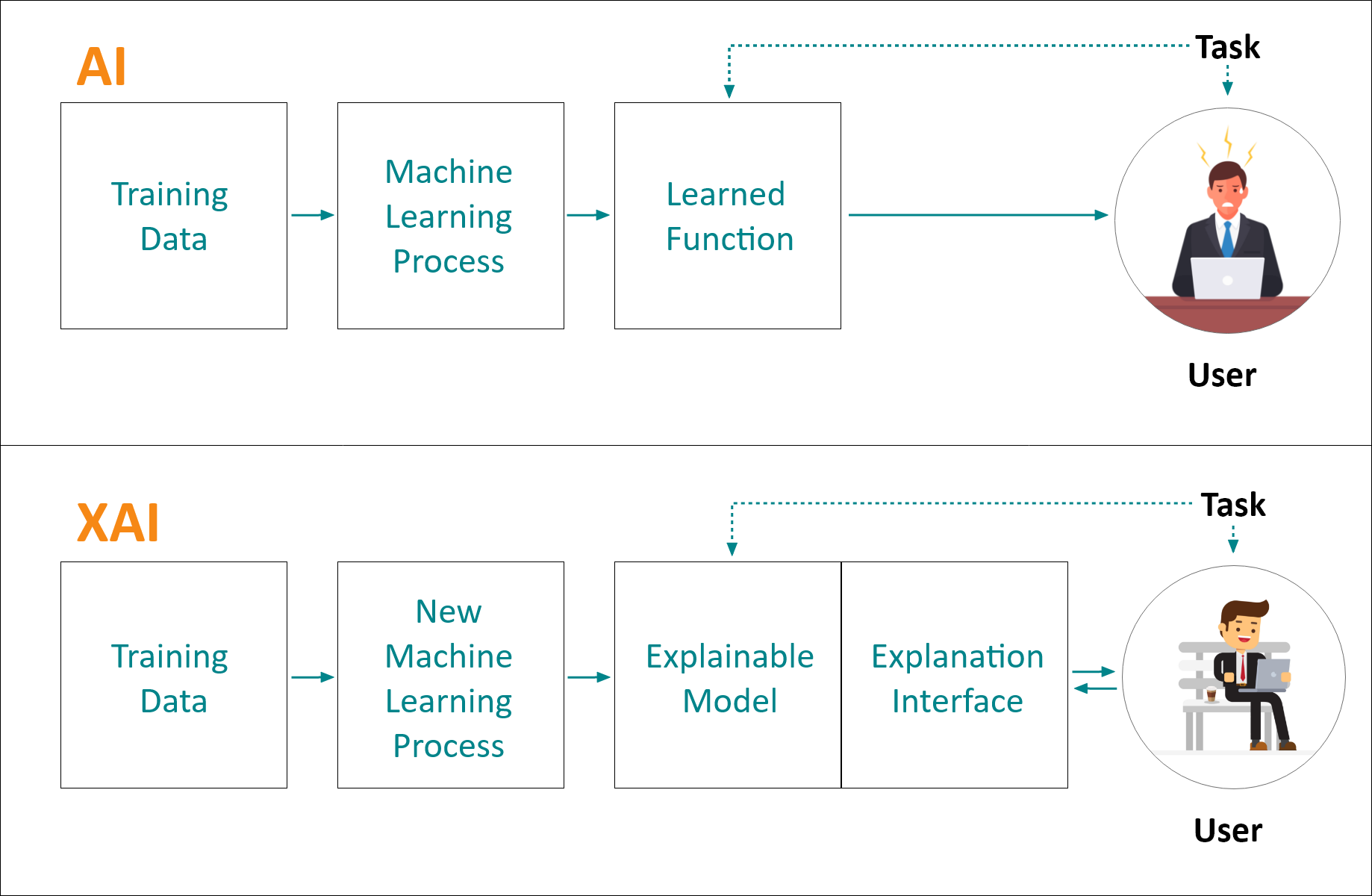
In response to the "black box" problem, the field of Explainable AI (XAI) has emerged. It offers two distinct philosophical and technical approaches to achieving transparency.
-
Intrinsic Interpretability (or Ante-hoc): This approach involves designing models that are transparent from the ground up. The goal is to build a model whose internal logic is inherently understandable to a human. Think of a simple decision tree or a linear regression model. Proponents argue that if a model is interpretable by design, you don't need to "explain" it later.
-
Post-Hoc Explainability: This approach accepts the use of black-box models and focuses on developing secondary techniques to explain their decisions after they have been trained. These methods treat the AI as a black box and probe it to generate an approximation of its reasoning for a specific decision.
The following video provides a clear introduction to this fundamental distinction and why the need for explanation is so critical from both a practical and legal standpoint.
Interpretable Deep Learning - Deep Learning in Life Sciences - Lecture 05 (Spring 2021)
This lecture from Manolis Kellis at MIT introduces the core concepts of interpretability and provides the essential vocabulary for our discussion.
Please watch two segments from the video: 00:25 - 05:47: This section defines interpretability and explains its importance for debugging, discovery, and the legal 'right to explanation'. It introduces the core concepts of ante-hoc vs. post-hoc methods. 10:28 - 12:25: This part provides a more detailed explanation of ante-hoc (building interpretable models) vs. post-hoc (interpreting complex models after the fact) approaches. Pay close attention to the distinction and the motivations behind each.
The Case for Interpretability: Is the Tradeoff a Myth?
While post-hoc explainability is the dominant approach in industry, a strong counter-argument, championed by researchers like Professor Cynthia Rudin, posits that in many high-stakes domains, the accuracy-interpretability tradeoff is a false dichotomy. They argue that we should prioritize building inherently interpretable models and that doing so often does not lead to a meaningful loss in performance—and can even improve it.
This viewpoint has profound implications for AI governance. If complex black boxes are not strictly necessary for accuracy, then regulators and courts might be less tolerant of their use in areas like criminal justice, healthcare, and finance.
Let's explore this argument in detail.
Interpretability vs. Explainability in Machine Learning
Professor Cynthia Rudin's talk, 'Interpretability vs. Explainability in Machine Learning,' is a classic articulation of this perspective. It provides compelling, real-world evidence challenging the necessity of black-box models.
Please watch the following three key segments of this talk: The Dangers of Black Boxes (02:45 - 07:30): Prof. Rudin highlights catastrophic failures of black-box models in criminal justice (COMPAS) and public health, directly linking opacity to real-world harm. Interpretable Models in Practice (07:30 - 15:27): She presents a case study of the '2HELPS2B' score, an interpretable model for predicting seizures that is not only accurate but also trusted and used by doctors because they can understand it. Debunking the Accuracy Claim (15:27 - 18:08): This is the core of her argument. She presents a head-to-head comparison showing that a very simple, interpretable model achieves the same accuracy as the complex, proprietary COMPAS model for recidivism prediction.
Rudin's work suggests that before accepting a "black box" solution, we must ask a critical question: Have we exhausted all efforts to build an inherently interpretable model that is just as good?
The Technical Challenges of Post-Hoc Explainability
Despite the compelling case for interpretability, complex models like large language models (LLMs) and advanced computer vision systems remain state-of-the-art for many tasks. In these cases, we must rely on post-hoc methods. However, these methods come with significant technical challenges that anyone involved in AI governance must understand. An explanation is not necessarily the truth.
Challenge 1: Explanations are Approximations, Not Reality
The most significant challenge is that a post-hoc explanation is a simplified model of another model. It is an approximation, and it can be wrong. Relying on an inaccurate explanation can be more dangerous than having no explanation at all.
Interpretability vs. Explainability in Machine Learning
Let's return to Professor Rudin's talk, where she makes a powerful critique of post-hoc methods.
Watch the segment from 18:08 to 32:23. This is a dense but crucial part of her argument. Focus on these key ideas: 'Double Trouble': When you use a post-hoc explanation, you are now trusting two models (the black box and its explainer), which are guaranteed to disagree at some point. Approximations can be misleading: She deconstructs the famous ProPublica analysis of the COMPAS model, arguing that their conclusion (that the model was racially biased beyond its inputs) was the result of using a poor linear approximation (an 'explanation') of a non-linear black box. Vulnerability to Errors: She highlights how complex models with many inputs (like COMPAS) are extremely vulnerable to simple typos, a problem that is much easier to spot and correct in a simple, interpretable model.
Challenge 2: Instability, Computational Cost, and User Confusion
Even when we accept the premise of post-hoc explanations, popular methods like LIME (Local Interpretable Model-Agnostic Explanations) and SHAP (SHapley Additive exPlanations) have well-documented technical limitations.
Explainable AI (XAI) for trustworthy and transparent decision ...
The paper 'Explainable AI (XAI) for trustworthy and transparent decision-making' provides a concise summary of the practical limitations of these widely used techniques.
Please read the subsections that describe the limitations of SHAP and LIME. Start at the heading '4.2.2. LIME (Local Interpretable Model-Agnostic Explanations)'. Read through the strengths and then focus on the paragraphs discussing its instability and lack of global interpretability. Go back to '4.2.1. SHAP (SHapley Additive Explanations)'. After the strengths, read the paragraphs discussing its computational cost, approximation errors, and assumption of feature independence. Also, quickly skim these additional sections on general limitations: '8.1. Scalability Issues in XAI for Complex Models' '8.4. Challenges in Explaining Non-Linear Relationships and High-Dimensional Data' '8.8. Computational Overhead and Performance Constraints'
A final, counter-intuitive challenge is that providing an 'explanation' might not actually make the model more understandable to a human user. It can sometimes lead to information overload and confusion.
An Empirical Study of the Accuracy-Explainability Trade-off ...
A fascinating empirical study titled 'It’s Just Not That Simple' tested how well users understood different types of models. Their findings disrupt common assumptions about explainability.
Please read Section 6, 'Discussion' (it's about one page long). Focus on the two main reasons the authors give for their key finding that there was no significant difference in explainability between black-box and interpretable models: User confusion: More information (like a complex decision tree diagram) can confuse users. Weaknesses in intrinsic explainability: 'Interpretable' models themselves have design flaws that can mislead users.
This research underscores that explainability is not just a technical property of a model, but a human-computer interaction problem. An explanation is only useful if the end-user can correctly interpret it.
Test your understanding!
Imagine you are a legal officer for a financial regulator. A bank is using a complex deep learning model to approve or deny mortgage applications. A lawsuit alleges the model is discriminatory. The bank's data science team provides you with a LIME explanation for a specific loan denial, showing that 'low income' and 'short credit history' were the top two factors.
Based on what you've learned about the limitations of post-hoc methods, what critical follow-up questions would you ask the bank's team?
Show answer
You should ask questions that probe the technical challenges we've discussed:
- Regarding Instability (LIME): "Can you run the LIME explanation for this same applicant ten more times and show me the results? I want to see if the explanation is stable or if the top factors change with each run."
- Regarding Approximation Error: "This LIME explanation is a linear approximation. Your model is highly non-linear. What is the fidelity score or measure of error for this specific explanation? How confident are you that this simple explanation accurately reflects what your complex model is actually doing?"
- Regarding Local vs. Global Behavior: "This explains one decision. Can you provide a global explanation (e.g., aggregated SHAP values) for the entire model? I need to know if factors like the applicant's neighborhood or race, which don't appear in this local explanation, have a significant impact on decisions overall."
- Challenging the Black Box Premise: "Before you deployed this deep learning model, did you attempt to build an inherently interpretable model, such as a Generalized Additive Model (GAM) or a rule-based system? If so, what was the performance gap that justified using a black box for such a critical decision?"
Conclusion
Today, we have navigated the complex and often contentious landscape of AI explainability. We've seen that the incredible performance of modern AI frequently comes at the cost of transparency, creating a difficult tradeoff for developers and policymakers.
Key Takeaways:
- The accuracy-interpretability tradeoff is a central challenge in AI: the most accurate models (e.g., deep neural networks) are often the least transparent "black boxes."
- There are two main approaches to transparency: building intrinsically interpretable models from the start, or applying post-hoc explanation techniques to black boxes.
- The necessity of the tradeoff is debated. In many high-stakes domains, simpler, interpretable models can achieve comparable accuracy to their black-box counterparts, questioning the need for opacity.
- Post-hoc explanation methods suffer from serious technical challenges: they are mere approximations, can be unstable and computationally expensive, and may even confuse human users rather than enlighten them. From a legal standpoint, an "explanation" cannot be taken at face value.
Preview of the Next Lesson:
Our discussion on explainability has focused on understanding a model's reasoning process. But what if the model's output isn't just opaque, but factually wrong? In our next lesson, we will analyze the phenomenon of 'hallucination' in LLMs and its implications for reliability and evidence. We will shift from the problem of understanding a model's logic to the problem of trusting its output, a critical issue for the use of AI in legal research and evidence generation.