Introduction
Welcome to the first lesson of our module on AI in the Justice System. In our previous module, we concluded by analyzing how the Indian IT Act is being adapted to regulate harmful AI-generated content like deepfakes. We saw how old laws are stretched to fit new technological realities. Now, we shift our focus from AI as a subject of regulation to AI as a tool within the legal and judicial process itself.
Today's lesson addresses a foundational question: What is 'access to justice,' and how can AI technologies both enhance and impede it? This concept is central to your goal of understanding AI governance, as it forces us to weigh technological efficiency against core principles of fairness, equity, and the rule of law. Your experience in implementing digital transformation in healthcare, where technology is also a double-edged sword affecting patient access and outcomes, will provide a useful parallel for our discussion.
1. The Access to Justice Gap
Before we can analyze AI's impact, we must first define "access to justice." It is more than just the ability to hire a lawyer; it is the practical ability of all people, regardless of their means, to understand their rights, navigate legal processes, and obtain fair and timely resolutions. For millions, this access is theoretical, not real, creating what is known as the "justice gap."
To understand the human dimension of this problem, please watch the beginning of this powerful TEDx talk. The speaker uses a compelling personal story from India and global statistics to frame the issue.
AI in Law: A New Era of Accessible Justice | Noah Wong | TEDxMenloSchool
In this video, 'AI in Law: A New Era of Accessible Justice', Noah Wong vividly illustrates the 'access to justice' problem, defining it as a crisis of resources.
Watch the first 2 minutes and 44 seconds of the video. Pay attention to how the speaker connects the lack of legal access to a lack of resources, not a lack of empathy or legal rights on paper.
As the video highlights, the justice gap is fundamentally a problem of resource scarcity. To build on this with a more formal legal definition, we'll turn to a comprehensive report on the subject.
The report 'AI in our Justice System' by the organization JUSTICE provides a robust legal framework for our discussion. This section formally defines 'access to justice' and roots it in fundamental principles of human rights and the rule of law.
Please read the section titled 'GOAL ONE: Equal and effective access to justice' (from page 24). Focus on how the report breaks down this goal into practical components like information, procedural mechanisms, and timeliness. Note its reference to both historical principles like the Magna Carta and modern human rights law.
From these resources, we can distill a clear definition: Access to justice is the principle that the legal system must be practically available and effective for everyone. Barriers are not just financial; they include complexity, language, delays, and a lack of information. This is the problem that proponents of legal AI aim to solve.
2. The Promise: How AI Can Enhance Access to Justice
AI technologies are proposed as a powerful solution to the resource scarcity at the heart of the justice gap. They can act as efficiency multipliers and create new channels for legal assistance where none existed before.
The opportunities are broad, as illustrated by the following framework developed at Stanford Law School.

Let's explore these categories with specific examples. The JUSTICE report you just read outlines several key opportunities. Broadly, AI can help by:
-
Providing Legal Information and Procedural Support:
- AI-powered chatbots and search tools can help individuals understand their rights, diagnose legal problems, and navigate complex court procedures. This democratizes access to basic legal knowledge, which has historically been the domain of experts.
- Automated document assembly can help litigants-in-person draft court forms and legal letters, reducing errors and overcoming procedural hurdles. This is analogous to the workflow automation you implemented in healthcare clinics.
-
Overcoming Language and Literacy Barriers:
- Automated translation can make legal information accessible to non-native speakers, a crucial requirement for ensuring fairness in diverse societies.
- As seen in Noah Wong's TEDx talk (Resource LINK), tools like voice bots can bypass literacy issues entirely, providing vital case information to illiterate prisoners in their own language. This is a powerful example of designing technology for a specific, marginalized community.
-
Increasing the Capacity of Legal Professionals:
- AI tools for document review, legal research, and case management can automate time-consuming tasks. This frees up lawyers (especially those in under-funded legal aid or public defense) to focus on higher-value strategic work and serve more clients.
- This empowers smaller firms and solo practitioners, who are often the primary legal service providers for low- and middle-income individuals.
DETERMINANTS OF SOCIALLY RESPONSIBLE AI ...
This article from the Duke Law & Technology Review provides an academic perspective on how AI can specifically empower marginalized communities and the smaller law firms that serve them.
Please read the subsections '1. Marginalized Communities' and '2. Small and Medium-Sized Firms' (within Part I. JUSTICE FOR ALL). Note the argument that AI can level the playing field by providing affordable tools that reduce the overhead of running a practice.
Test your understanding!
Imagine an individual in a remote village in India who is a victim of a land-grabbing scheme by a powerful local figure. They have limited funds and education. Based on the materials, identify three distinct ways AI could enhance their access to justice.
Show answer
- Information Access: They could use a multilingual chatbot on a simple smartphone to understand their property rights under Indian law and learn the basic steps for filing a complaint.
- Procedural Support: An AI-powered document assembly tool could guide them through creating the necessary legal notice or court filing in the correct format, a task that would otherwise require a lawyer.
- Finding Representation: An AI-driven platform could connect them with a pro-bono lawyer or a small, affordable law firm in the nearest town that specializes in property disputes, bridging the gap between client and counsel.
3. The Peril: How AI Can Impede Access to Justice
While the potential benefits are significant, deploying AI in the justice system carries substantial risks. Unchecked, these technologies can create new barriers, entrench existing inequalities, and undermine the very fairness they are meant to promote.
This mind map gives a comprehensive overview of the potential harms.
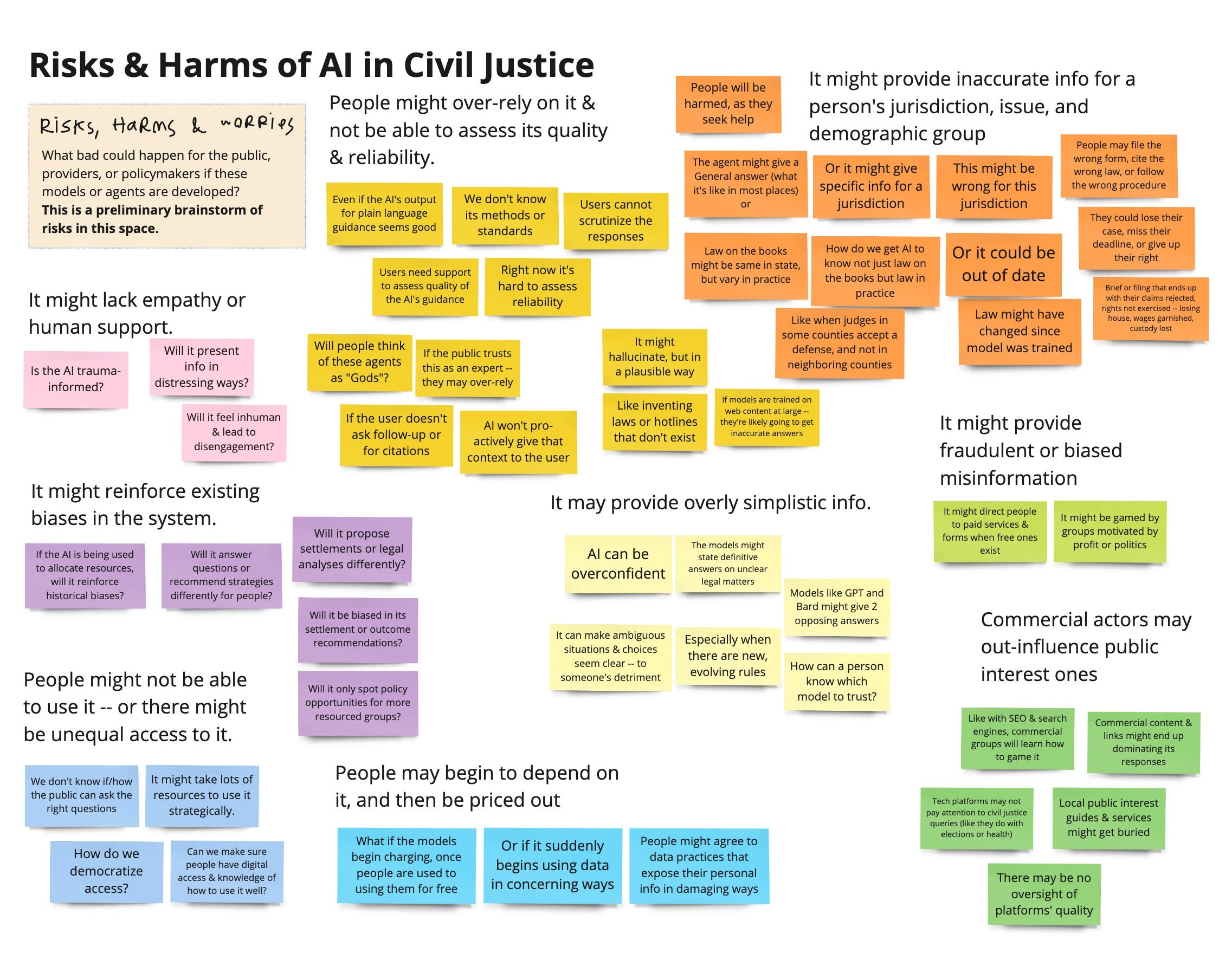
To analyze these risks with the necessary legal rigor, we will return to the JUSTICE report, which provides a systematic breakdown.
Understanding and mitigating risk is a cornerstone of responsible governance. The 'AI in our Justice System' report provides an excellent taxonomy of the risks AI poses to the rule of law.
Please read the section 'c. Understanding the Risks' (starting on page 32) and the 'Case Study: Legal advice chatbots' (on page 44). As you read, focus on identifying the distinct categories of risk: Technical Risks: Issues inherent to the technology itself (e.g., poor data, bias, hallucination). Individual Harm Risks: Dangers to individuals interacting with the system (e.g., digital exclusion, inequality of arms). Systemic Risks: Broader negative impacts on the justice system (e.g., eroding public trust, stagnating legal development).
Drawing from the report and other resources, the primary ways AI can impede access to justice include:
-
Creating a Two-Tier System:
- Inequality of Arms: If powerful litigants (e.g., corporations, the state) use sophisticated, expensive AI for case analysis and strategy while self-represented or legal-aid-funded litigants rely on free, less reliable tools, AI will amplify existing power imbalances rather than reduce them.
- Algorithmic Exclusion: Individuals with low digital literacy or no access to technology may be shut out from an increasingly digitized justice system, effectively denying them access.
-
Promoting Inaccurate and Unreliable Information:
- Hallucinations: As the case study on legal advice chatbots shows, LLMs can confidently invent fake case law or provide incorrect legal advice. A person relying on such a tool could miss a filing deadline or make a fatally flawed legal argument, destroying their case. This is a critical risk you'll revisit as a future lawyer.
- Outdated Information: The law is constantly changing. AI models trained on old data can provide advice that is no longer valid, leading users astray.
-
Entrenching Bias and Discrimination:
- If an AI tool is trained on historical judicial data that reflects societal biases (e.g., against certain castes, religions, or genders), it will learn and perpetuate those biases. An AI tool might advise a user that their claim is weak, not based on the law, but based on a biased statistical correlation, thus discouraging them from pursuing a valid case.
-
Eroding Trust through Opacity:
- Many commercial AI tools are "black boxes." If a person is denied a benefit or receives a negative outcome influenced by an opaque algorithm they cannot understand or challenge, it undermines their right to a reasoned decision and erodes public trust in the legitimacy of the justice system.
Test your understanding!
Let's revisit our land-grabbing victim. They use a free legal advice chatbot. What are three distinct ways this AI tool could impede their access to justice?
Show answer
- Hallucination/Inaccuracy: The chatbot might "hallucinate" a non-existent government form or provide an incorrect deadline for filing a claim with the local land revenue office, causing the victim to lose their right to challenge the seizure.
- Inequality of Arms: The powerful land-grabber may employ a sophisticated legal AI that analyzes decades of local case law to find obscure precedents favoring their position, which the victim's free chatbot cannot match, creating a significant strategic disadvantage.
- Embedded Bias: If the chatbot's training data reflects historical biases where courts in that region have disproportionately ruled against people from the victim's social or economic group, it might inaccurately advise them that their case is weak, discouraging them from pursuing it.
Conclusion
Today, we defined 'access to justice' not just as a theoretical right but as a practical challenge of resource scarcity and systemic barriers. We then analyzed the dual role of AI, acknowledging its immense potential to enhance access while also recognizing the profound risks it poses.
Key Takeaways:
- Access to Justice: Is the practical ability for everyone to vindicate their legal rights, impeded by a "justice gap" caused by high costs, complexity, and delays.
- AI's Promise (Enhancement): AI can bridge this gap by democratizing legal information (chatbots), automating procedures (document assembly), overcoming barriers (translation), and increasing the capacity of legal aid providers.
- AI's Peril (Impediment): Unchecked, AI can worsen the gap by creating a two-tiered system ("inequality of arms"), spreading misinformation ("hallucinations"), entrenching societal biases, and eroding public trust through opacity.
- The Central Challenge: The core task for AI governance in this domain is to harness the benefits while mitigating the risks—a theme of responsible innovation that aligns with your career goals.
Preview of the Next Lesson:
Having established this foundational understanding, our next lesson will zoom in on one of the most prominent applications of AI in the legal world. We will analyze the use of AI in legal practice for research, document review, and contract analysis. This will allow us to move from the general concept of access to justice to the specific tools that are transforming the daily work of lawyers and law firms.