Introduction
Welcome back. In our last lesson, we explored the concept of 'access to justice' and debated the dual nature of AI as both a potential solution to the "justice gap" and a potential creator of new inequalities. We looked at the high-level promise and peril.
Today, we transition from the general public's access to justice to the specific ways AI is transforming the daily work of legal professionals. This lesson directly addresses how to analyze the use of AI in legal practice for research, document review, and contract analysis. We will move beyond functional overviews to examine the underlying technology, the practical applications, and the critical professional responsibilities that emerge. Your experience in implementing workflow automation and CRM systems in healthcare provides a strong parallel; here, the "clients" are law firms and the "data" consists of complex legal documents, but the core challenge of leveraging technology to manage information and improve efficiency remains central.
1. The Lawyer's Workflow, Reimagined
At its heart, a significant portion of legal work involves processing information: gathering facts from documents, researching case law, analyzing the two, and drafting new documents. AI, particularly generative AI, is intervening at each of these stages.
To get a clear overview of this transformation, please watch the following video from IBM Technology. It provides an excellent framework for the tasks we will explore in detail.
How AI Impacts the Practice of Law
The video 'How AI Impacts the Practice of Law' outlines the four core areas of legal work being reshaped by generative AI. It serves as a great introduction to our topic.
Please watch the segment from 01:15 to 08:05. As you watch, note down the four key activities the speaker identifies (gathering facts, researching the law, analyzing, and drafting documents) and the specific role AI plays in each.
As the video explains, AI tools are not just automating rote tasks; they are becoming partners in the cognitive work of law. However, to truly appreciate their impact, we need to understand the fundamental technical challenge they are designed to solve.
2. The Core Problem: Taming Unstructured Data
Legal work is built on a foundation of documents—contracts, case files, statutes, court filings, and emails. From a data perspective, this is all unstructured data. It doesn't fit neatly into the rows and columns of a database. It contains complex language, varied formatting, and intricate relationships between documents.
Your work with CRM systems involved structuring client data for analysis. In law, the challenge is magnified. For example, a single corporate transaction might involve a Master Service Agreement (MSA), several Statements of Work (SOWs) that refer to the MSA, and subsequent amendments and invoices that refer to the SOWs. Understanding the legal obligations requires processing this entire hierarchy.
This next video provides a superb technical explanation of this problem and introduces the advanced AI concepts used to address it. This will satisfy your interest in a deeper technical dive.
LLMs and AI Agents: Transforming Unstructured Data
This video, 'LLMs and AI Agents: Transforming Unstructured Data,' explains the technical challenges of processing complex documents and how modern AI, including LLMs and 'AI agents,' are designed to overcome them.
Watch from 00:55 to 07:59. Focus on two key concepts: The definition of the 'unstructured data problem' in the context of documents. The idea of 'vertical and horizontal hierarchies' among documents. Think about how this applies to a set of legal case files or transactional documents.
Having established the problem, let's now analyze the specific AI solutions being deployed in legal practice.
3. Key Applications of AI in Legal Practice
We will now dissect the three core areas mentioned in our learning outcome, integrating the technical concepts with practical examples from the legal field, including the Indian context. For a comprehensive overview, we will rely on a detailed report from the British Institute of International and Comparative Law (BIICL).
Use of Artificial Intelligence in Legal Practice
The report 'Use of Artificial Intelligence in Legal Practice' by BIICL is a thorough survey of how AI tools are being used by lawyers. We will use it to structure our analysis.
First, please read the introduction and the list of seven areas of work on the first two pages. This will give you a mental map of the landscape of legal AI tools.
3.1. Legal Research
Traditional legal research involves keyword searches in databases like Westlaw or LexisNexis. AI-powered research is fundamentally different. It uses Natural Language Processing (NLP) to understand the semantic meaning and context of a query, not just matching keywords.
How it works:
- Instead of searching for "negligence" and "medical," a lawyer can ask a natural language question: "What constitutes medical negligence for a misdiagnosis case in Maharashtra?"
- The AI can retrieve relevant statutes, regulations, and case law, and even summarize the key principles or holdings from those cases.
- Tools like Thomson Reuters' Westlaw Precision and Casetext's CoCounsel are leading examples. In India, the Supreme Court's SUPACE (Supreme Court Portal for Assistance in Courts Efficiency) portal is designed to provide similar research assistance to judges.
Artificial Intelligence in India's Legal System
Let's explore the specifics of AI in legal research and the Indian context.
Please read the subsections 'Legal Research' (under 'AI in the e-Courts Project') and the description of the SUPACE portal. Note the specific functionalities SUPACE offers, like the Chatbot that summarizes cases and the Logic Gate for fact extraction.
Analysis and Risks:
The greatest promise of AI in research is efficiency and depth. The greatest risk is hallucination. As we've discussed, LLMs can confidently invent plausible-sounding but entirely fake case citations and legal principles.
A now-infamous case, Mata v. Avianca, Inc., saw a US lawyer sanctioned by a court for submitting a brief filled with fictitious case law generated by ChatGPT. This is a stark reminder that AI is an assistant, not an authority. The lawyer retains the ultimate professional responsibility for the accuracy of their work.
3.2. Document Review and e-Discovery
In litigation, e-discovery (the process of finding and producing electronically stored information) can involve millions of documents. Manually reviewing them is a monumental task, historically done by junior lawyers. AI radically accelerates this.
How it works:
- Using a technique called Technology-Assisted Review (TAR), lawyers first label a small sample of documents as "relevant" or "not relevant."
- The AI model learns the characteristics of a relevant document and then automatically classifies the entire dataset, flagging the most likely relevant documents for human review.
- This is where the concepts from the IBM video on unstructured data become critical. The AI is not just looking at text; it's using a Transformer architecture to understand context, identify concepts, and find patterns.

Analysis and Risks:
The benefit is a massive reduction in time and cost. The risks include:
- Errors in Training: If the initial set of documents labeled by humans is flawed, the AI will learn the wrong patterns and may miss critical evidence.
- Lack of Explainability: A "black box" model may flag a document as relevant, but it can be difficult to understand precisely why, making it hard to validate or challenge the results.
- Data Security: Uploading vast troves of sensitive client data to a third-party AI platform raises significant confidentiality concerns.
3.3. Contract Analysis
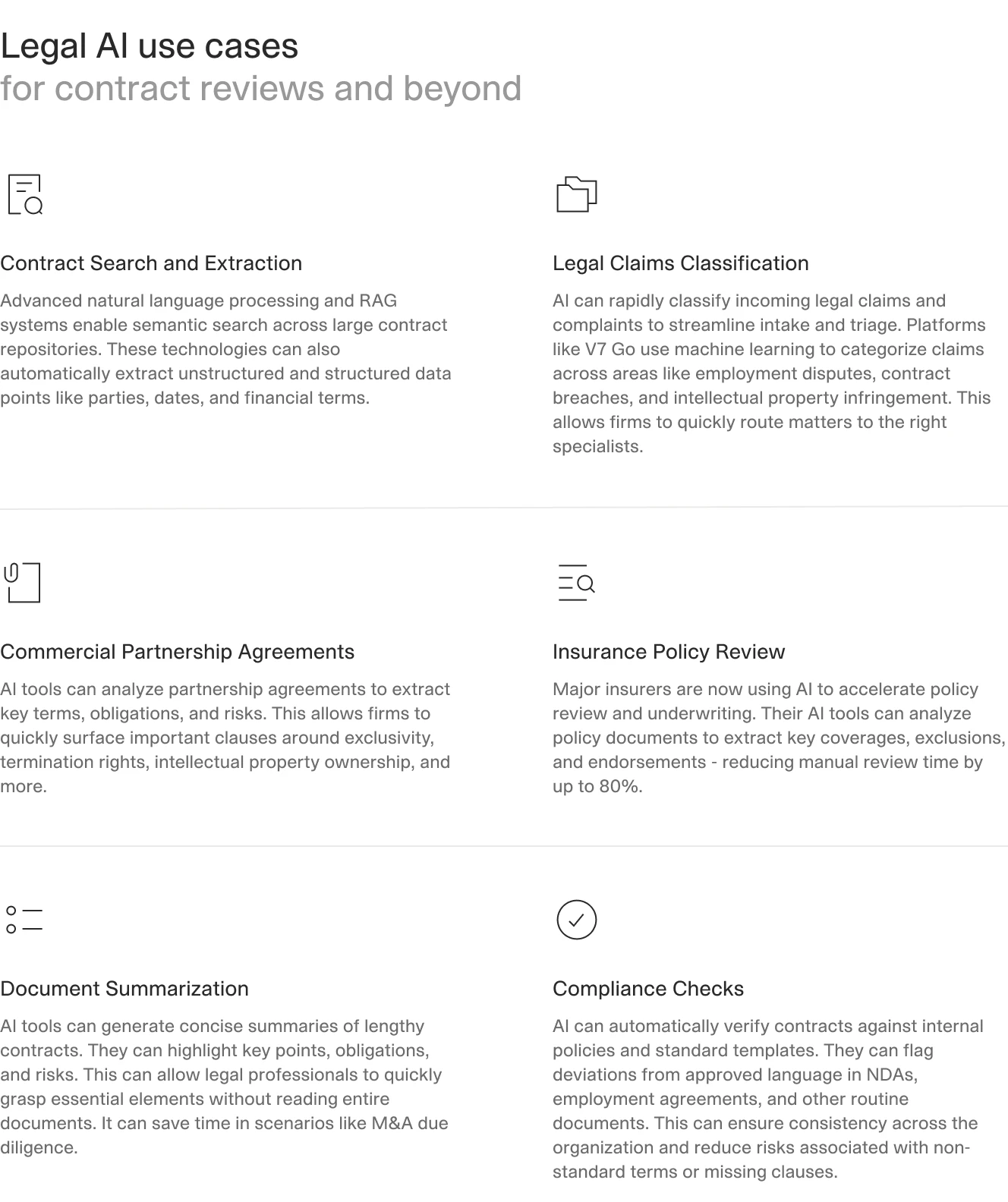
Contract analysis is a specialized form of document review focused on drafting, reviewing, managing risk, and extracting key data from contracts.
How it works:
- Drafting: AI tools like Spellbook or Genie AI can suggest clauses or even draft an entire first-pass contract based on a few prompts, using a firm's own templates and style guides.
- Review: AI can scan an incoming third-party contract and flag non-standard or risky clauses by comparing it against a database of similar agreements or a pre-defined playbook. For example, it can instantly identify a problematic limitation of liability clause.
- Data Extraction: AI can read thousands of contracts and extract key data points (e.g., renewal dates, governing law, liability caps) into a structured database for contract lifecycle management (CLM). This is a direct parallel to your work in extracting key metrics for KPI tracking systems.
Use of Artificial Intelligence in Legal Practice
The BIICL report provides excellent detail on how AI is used for document automation and predictive analysis in the context of contracts.
Please read Section 2 ('Document automation') and Section 3 ('Predictive legal analysis'). Note the examples of specific tools (like Robin AI and IronClad) and the different tasks they perform, from drafting to due diligence.
Test your understanding!
You are in-house counsel for a company acquiring a smaller startup. The startup has over 500 sales contracts with different customers. The acquisition is time-sensitive. How could you leverage AI for contract analysis in this due diligence process? Name three specific tasks.
Show answer
- Risk Flagging: Use an AI tool to rapidly scan all 500 contracts and flag any with unusual or high-risk clauses, such as unlimited liability, non-standard termination rights, or unusual intellectual property assignments.
- Data Extraction: Automate the extraction of key terms from all contracts into a spreadsheet, such as contract value, expiry date, renewal terms, and governing law. This provides a structured overview for financial and strategic analysis.
- Change of Control Analysis: Specifically task the AI to identify all contracts that contain "change of control" clauses that might be triggered by the acquisition, allowing you to prioritize which contracts require customer consent.
4. The Lawyer's Burden: Accountability and Ethics
As we've seen, these tools are powerful but imperfect. This places a heavy burden of supervision and accountability on the legal professional. Using an AI tool does not absolve a lawyer of their ethical duties.
This is not just a theoretical concern. It has direct implications for liability.
Artificial Intelligence in India's Legal System
This final reading from the paper on AI in India's legal system crystallizes the issue of liability, which is a core part of our analysis.
Please read the subsections 'Fabricated information' and 'User liability'. Focus on the principle that professionals who rely on AI are still accountable and can be held liable for negligence if they fail to apply their own judgment and recheck sources.
The key ethical and professional duties that you must analyze when considering the use of AI in legal practice are:
- Duty of Competence: Lawyers must have a sufficient understanding of the technology's benefits and risks to use it competently. A lawyer who uses ChatGPT for research without understanding the risk of hallucination may be breaching this duty.
- Duty of Confidentiality: Lawyers have a strict obligation to protect client information. Using a public AI tool and inputting sensitive client data (e.g., "Draft a settlement offer for my client, [Name], who was injured at [Company]'s factory") is a flagrant breach of this duty. Firms must use enterprise-grade, secure AI platforms.
- Accountability & Supervision: The final work product is the lawyer's responsibility. The AI is a tool, like a junior associate. Its work must be supervised, verified, and checked. As the Mata v. Avianca case showed, telling the judge "the AI did it" is not a defense.
Conclusion
Today we moved from the abstract to the concrete, analyzing how AI is reshaping the core work of lawyers. We saw that the central challenge is taming vast amounts of unstructured text, a problem that modern LLMs, built on architectures like the Transformer, are uniquely equipped to handle.
Key Takeaways:
- AI is actively transforming legal practice in research (semantic search), document review (e-discovery), and contract analysis (drafting, review, data extraction).
- These tools provide immense efficiency gains but come with significant risks, most notably hallucination, bias, and confidentiality breaches.
- The use of AI does not diminish professional responsibility. On the contrary, it heightens the importance of the lawyer's duties of competence, confidentiality, and supervision.
- The lawyer's role is shifting from a 'doer' of repetitive tasks to a 'supervisor' and 'strategist' who leverages AI tools while maintaining critical human judgment and ethical oversight.
Preview of the Next Lesson:
Having examined how AI assists lawyers in their practice, we will next explore its role in the dispute resolution process itself. Our next lesson will describe the role of AI in Alternative and Online Dispute Resolution (ADR/ODR), analyzing how technology can be used not just to prepare for disputes, but to actively help resolve them.