Introduction
Welcome to your next lesson on the mechanics of modern AI. In our previous session, we did a deep dive into the architecture of the Transformer model, dissecting its core components: word embeddings, the Query-Key-Value mechanism of self-attention, and the structure of a Transformer block. We now understand how a Transformer works on a technical level.
Today, we will address the crucial follow-up question: Why was this architecture so revolutionary? The learning outcome for this lesson is to describe the significance of the Transformer model for the development of Large Language Models (LLMs). We will bridge the gap between architectural design and the emergence of massive, powerful models like GPT-4, which are central to our study of AI law and governance.
We'll explore:
- The "sequential bottleneck" of pre-Transformer models like RNNs.
- How the Transformer's design enabled unprecedented parallelization and scale.
- The different "flavors" of Transformer models and why one became dominant for today's LLMs.
- The resulting paradigm shift towards "foundation models."
1. The Pre-Transformer Era: The Sequential Bottleneck
Before 2017, the state-of-the-art for processing sequential data like text was a class of models called Recurrent Neural Networks (RNNs), and their more sophisticated variant, Long Short-Term Memory (LSTM) networks.
The core idea of an RNN is intuitive: it processes a sentence one word at a time, from left to right. At each step, it takes in a word's embedding and combines it with a "hidden state" or "memory" from the previous step. This updated hidden state is then passed on to the next step. This sequential process seems like a natural fit for language.
However, RNNs suffered from two critical limitations that hindered the development of very large models.
First, watch this short clip that introduces RNNs and their fundamental problems.
Transformers, explained: Understand the model behind GPT, BERT, and T5
This video from Google Cloud Tech succinctly explains the concept of RNNs and their main drawbacks, setting the stage for why Transformers were necessary.
Watch from 01:30 to 02:38. Pay close attention to the two main problems discussed: handling long sequences and the difficulty of parallelization.
Let's formalize these two limitations:
-
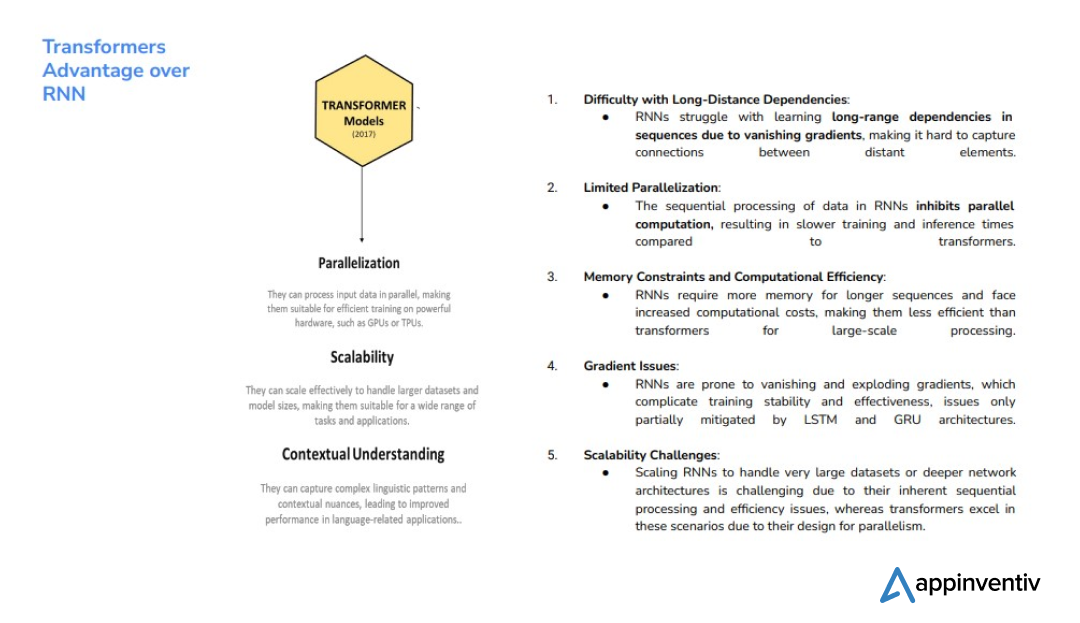
The Sequential Processing Problem: RNNs are inherently sequential. To compute the hidden state for the 10th word, you must first compute it for the 9th, which requires the 8th, and so on. This makes it impossible to parallelize the computation within a single training example. In an era of hardware (GPUs) designed for massive parallel matrix operations, this sequential dependency was a major performance bottleneck, making it incredibly slow and expensive to train on large datasets.
-
The Long-Range Dependency Problem: While LSTMs were an improvement over basic RNNs, they still struggled to maintain context over very long distances. Information from the beginning of a long document could effectively "fade away" by the time the model reached the end. This is often linked to the technical issue of "vanishing gradients" during backpropagation, where the error signal from the end of the sequence becomes too weak to update the model's parameters related to the beginning of the sequence.
The image below provides a clear summary of these challenges and contrasts them with the advantages of the Transformer architecture.
2. The Transformer's Breakthrough: Unlocking Parallelization and Scale
The "Attention Is All You Need" paper was revolutionary precisely because it proposed a high-performing architecture that completely did away with recurrence.
As we learned in the previous lesson, the self-attention mechanism allows the model to calculate the contextualized embedding for every token in the sequence simultaneously. The comparison between a Query vector and all Key vectors is a large matrix multiplication—an operation that GPUs are exceptionally good at. Because no token's calculation depends on the prior completion of another token's calculation, the entire process is massively parallelizable.
This was the critical breakthrough. By breaking the sequential bottleneck, the Transformer architecture allowed researchers to leverage modern computing hardware to its full potential.
Transformers, explained: Understand the model behind GPT, BERT, and T5
Let's return to the Google Cloud Tech video to see how this parallelization capability directly translated into the ability to create massive models.
Watch from 02:38 to 03:13. The key insight here is the connection between parallelization, the ability to train on huge datasets (like 45 terabytes for GPT-3), and the creation of very large models.
The significance is clear: The Transformer's parallelizable design made it feasible to train models with billions of parameters on internet-scale datasets. This is what enabled the "Large" in Large Language Models. Without this architectural innovation, the computational cost and time required to train models like GPT-3 would have been prohibitive.
The following article provides a good textual summary of this shift.
How Transformers Work: A Detailed Exploration of ...
This article from DataCamp, 'How Transformers Work', clearly explains the transition from RNNs to Transformers, highlighting the performance and dependency issues that Transformers solved.
Read the section titled 'The shift from RNN models like LSTM to Transformers for NLP problems'. It reinforces the two main problems with RNNs and positions Transformers as the natural improvement.
3. A Fork in the Road: The Three Flavors of Transformers
The original Transformer architecture, designed for machine translation, had two parts: an Encoder to "understand" the source sentence and a Decoder to "generate" the target sentence. Following its publication, researchers began adapting this architecture, leading to three main families of Transformer-based models. Understanding these is key to seeing why the generative models you are familiar with (like ChatGPT) took their specific form.
The Transformer Architecture: A Deep Dive
This article from dev.to provides an exceptionally clear breakdown of the three main types of Transformer models. It explains what each is good for and why one type became dominant.
Read the sections 'Three Types of Transformer Models' and 'Quick Decision Guide: Which Type Should You Use?'. Focus on the distinct purpose and attention mechanism of each type: Encoder-Only, Decoder-Only, and Encoder-Decoder.
Let's summarize the key distinctions:
-
Encoder-Only (e.g., BERT, RoBERTa):
- How it works: Uses only the encoder part of the Transformer. It looks at the entire input text at once (bidirectional attention).
- Purpose: Excellent for "understanding" tasks. It's trained by masking words in a sentence and trying to predict them. This gives it a deep contextual understanding of the text.
- Use Cases: Sentiment analysis, document classification (e.g., spam filtering), and identifying named entities in legal documents. It cannot, however, generate free-form text.
-
Encoder-Decoder (e.g., T5, BART, the original Transformer):
- How it works: Uses both stacks. The encoder gets a full, bidirectional understanding of an input sequence, and the decoder generates an output sequence based on that understanding.
- Purpose: Ideal for sequence-to-sequence tasks where you transform an input text into a different output text.
- Use Cases: Machine translation (English → French), text summarization (long article → short summary).
-
Decoder-Only (e.g., GPT series, Llama, Claude):
- How it works: Uses only the decoder part of the Transformer. It processes text strictly from left to right, using "causal masking" to ensure that when predicting a word, it can only see the words that came before it (unidirectional/autoregressive attention).
- Purpose: Trained exclusively on a simple task: predict the next word.
- Use Cases: Open-ended text generation, chatbots, code completion, creative writing. This is the architecture of all modern LLM assistants.
The great surprise in the field was just how powerful and versatile the Decoder-Only models became when scaled up. By simply learning to predict the next word on a massive corpus of text, these models implicitly learned to perform translation, summarization, and classification "in-context" without being explicitly structured for those tasks. This incredible versatility is why they have come to dominate the field of generative AI.
Test your understanding!
You are tasked with building an AI system for a law firm. The system needs to read through thousands of contracts and classify each one by contract type (e.g., "Employment Agreement," "Lease Agreement," "Non-Disclosure Agreement"). Based on what you've just learned, which of the three Transformer architectures would be the most suitable starting point for this specific task, and why?
Show answer
The most suitable architecture would be an Encoder-Only model, like BERT.
The task is one of classification, not generation. It requires a deep, holistic understanding of the entire document to correctly categorize it. The bidirectional attention mechanism of an encoder is perfect for this, as it allows every part of the text to be understood in the context of every other part. A decoder-only model would be overkill and less directly suited to the task, while an encoder-decoder model is designed for transforming sequences, not classifying them.
4. The Result: Emergence of Foundation Models
This combination—a scalable architecture (Transformer) and a versatile training objective (next-word prediction on a decoder-only model)—gave rise to what are now called foundation models.
A foundation model is a very large AI model trained on a vast quantity of broad, unlabeled data that can be adapted to a wide range of downstream tasks. The significance of the Transformer is that it made the creation of these models possible. Instead of building a specialized model for every single NLP task, organizations could now train one massive foundation model and then fine-tune it or use prompting (in-context learning) for many different applications.
Let's return to the DataCamp article, which introduces this concept and lists several real-world examples that were built on the Transformer architecture.
Read the 'Historical Context' section, which mentions the term 'foundation models'. Then, read the 'Real-Life Transformer Models' section to see how models like BERT, LaMDA, and GPT are all direct descendants of the original Transformer architecture.
Conclusion
Today we've uncovered why the Transformer is arguably the most important deep learning architecture of the last decade. Its significance isn't just its clever use of self-attention, but its profound impact on the scalability and trajectory of AI development.
Key Takeaways:
- Previous models like RNNs were hampered by a sequential bottleneck, making them slow to train and poor at handling long-range dependencies.
- The Transformer's core innovation was its parallelizable self-attention mechanism, which broke this bottleneck and enabled the use of massive datasets and computational resources.
- This scalability made it possible to build models with billions of parameters, ushering in the era of Large Language Models.
- While different Transformer variants emerged, the decoder-only (GPT-style) architecture proved remarkably versatile, leading to the powerful, general-purpose foundation models that dominate the AI landscape today.
Preview of the Next Lesson:
Now that we have a firm grasp of the journey from neural networks to the specific Transformer architecture and its significance for LLMs, we are ready to move from the 'how' to the 'what'. In our next lesson, we will analyze real-world AI applications and their societal impact in sectors like healthcare, finance, and governance. This will begin our transition from purely technical concepts to the socio-legal implications that are the core focus of this course.