Introduction
Welcome to our final lesson in the "Mechanics of Modern AI" module. Over the past few lessons, we've journeyed deep into the technical core of modern artificial intelligence. We began by distinguishing between different AI approaches, moved through the fundamentals of neural networks and training loops, and culminated in understanding the Transformer architecture—the engine behind today's most powerful Large Language Models.
So far, our focus has been on how these systems work. Now, we pivot to what they do and why it matters. The learning outcome for this lesson is to analyze real-world AI applications and their societal impact in sectors like healthcare, finance, and governance.
This lesson serves as a crucial bridge. We will take our technical knowledge and apply it to understand the profound, double-edged impact of AI in the real world. We will see how architectural choices and training data translate into tangible benefits and significant risks. This analysis will lay the essential groundwork for Module 3, where we will systematically dissect the sources of AI risk, and for the subsequent modules focused on legal and regulatory responses.
1. AI in Healthcare: Promise and Peril
Given your professional experience supporting digital transformation in healthcare clinics, you've already seen firsthand how technology can improve operational efficiency. AI takes this a step further, moving from workflow automation to core clinical and research functions.
Applications and Opportunities
AI is being applied across the healthcare value chain:
- Diagnostics: Convolutional Neural Networks (CNNs), which we briefly touched upon, are proving to be exceptionally effective at analyzing medical images (X-rays, CT scans, MRIs) to detect signs of diseases like cancer or diabetic retinopathy, sometimes with accuracy rivaling or exceeding human radiologists.
- Personalized Medicine: AI models can analyze a patient's genetic information, lifestyle data, and clinical history to predict their likely response to different treatments. This moves away from a one-size-fits-all approach towards highly individualized care.
- Drug Discovery & Development: Training models on vast datasets of molecular structures and biological data can significantly accelerate the process of identifying promising drug candidates, potentially reducing the time and cost of bringing new medicines to market.
This short talk provides an excellent overview of these opportunities, focusing on cancer care as a prime example.
Artificial intelligence in healthcare: opportunities and challenges | Navid Toosi Saidy | TEDxQUT
In this TEDx talk, 'Artificial intelligence in healthcare: opportunities and challenges', Navid Toosi Saidy outlines how AI is being used to personalize cancer diagnosis and treatment.
Watch the first 3 minutes and 32 seconds (00:00 - 03:32). Pay attention to the types of data being consolidated (blood tests, images, genetic info) and the specific example of identifying a cancer's primary site.
Societal Impact and Challenges
The potential benefits are immense: more accurate diagnoses, better treatment outcomes, and greater efficiency. However, these applications also surface profound societal and legal challenges.
Watch the next segment of the same video, where the speaker discusses two major hurdles.
Artificial intelligence in healthcare: opportunities and challenges | Navid Toosi Saidy | TEDxQUT
This part of the talk highlights two critical challenges that are central to AI governance: the mismatch with existing regulatory frameworks and the problem of data bias.
Watch from 03:32 to 07:34. As you watch, consider these two points which will be recurring themes in our course: The Regulatory Mismatch: Why are traditional medical device regulations a poor fit for adaptive, learning-based AI software? Data Bias: What is the practical consequence of training a skin cancer detection model predominantly on data from one demographic group?
The speaker highlights two core issues for AI governance:
-
Accountability and Regulation: Traditional software is static; AI software can evolve after deployment. If a "locked" AI model makes a wrong diagnosis because it hasn't learned from new data, who is liable? The developer? The hospital that deployed it? If an adaptive model changes and makes an error, how do we ensure safety? This tension between static regulatory approval and dynamic AI systems is a central problem for lawmakers.
-
Bias and Equity: The "Garbage In, Garbage Out" principle is amplified in AI. If a model is trained on data that under-represents certain populations, it will perform poorly for those groups. This doesn't just reduce the model's utility; it actively creates health inequities, where a state-of-the-art tool provides benefits to some but not others, or worse, harms under-represented groups.
2. AI in Governance: Efficiency vs. Fairness
Perhaps the most high-stakes applications of AI are in governance, particularly within the criminal justice system. Here, the decisions influenced by algorithms can directly impact an individual's liberty.
Applications and Controversies
AI is used in several key areas of law enforcement and judicial administration:
- Predictive Policing: Algorithms analyze historical crime data to forecast "hotspots" where crime is likely to occur, guiding police deployment. Some systems also attempt to generate lists of individuals deemed to be at high risk of offending.
- Facial Recognition Technology (FRT): Used by law enforcement to identify suspects by comparing images from crime scenes or public surveillance against databases of photos (e.g., mugshots).
- Bail and Sentencing Risk Assessments: Algorithmic tools that produce a "risk score" for a defendant, purporting to predict their likelihood of re-offending or failing to appear in court. This score can influence a judge's decision on whether to grant bail or the severity of a sentence.
To understand the profound societal impact, let's analyze a well-documented case study of a risk assessment tool used in US courts.
The danger of predictive algorithms in criminal justice | Hany Farid | TEDxAmoskeagMillyard
This TEDx talk by Professor Hany Farid, 'The danger of predictive algorithms in criminal justice', provides a powerful critique of one of the most widely used risk assessment algorithms. It's a masterclass in how an AI system can go wrong.
This is a critical video. Please watch the following segments carefully: 00:00 - 03:44: The speaker introduces predictive algorithms and the damning findings of the ProPublica report on the COMPAS algorithm's racial bias. 04:17 - 07:12: Focus on the startling results of his team's study comparing the algorithm's accuracy to that of random people online. 10:17 - 13:29: This is the core of the analysis. Listen for the explanation of how racial bias entered the system indirectly via proxy variables and the shocking simplicity of the supposedly 'sophisticated' AI. Note down the key reasons why the algorithm was both biased and no more accurate than untrained humans.
Deconstructing the Societal Impact
This case study is a textbook example of the societal and legal risks of deploying AI in high-stakes government functions:
-
Reinforcing Systemic Bias: The algorithm was not explicitly given race as an input. However, it used "number of prior crimes" as a key factor. Because of existing societal inequalities and historical biases in policing, this factor served as a proxy for race. The AI, therefore, didn't just reflect existing bias; it amplified it and cloaked it in a veneer of objective, mathematical certainty.
-
The "Black Box" Problem and Due Process: The algorithm was proprietary software. The defense attorneys, judges, and defendants whose lives it impacted could not scrutinize how it worked. This raises fundamental questions of due process. How can you challenge a decision if you don't know the basis upon which it was made?
-
Automation Bias: As Farid points out, a judge is likely to give more weight to a recommendation from a "sophisticated AI" than from "a random person on the internet," even if their accuracy is identical. This psychological deference to technology, known as automation bias, can lead to an abdication of human discretion and critical judgment.
For a more structured, legal-centric overview of these technologies and their associated risks, the following paper from the Law Commission of Ontario is an excellent resource.
AI in Criminal Justice Project | Introduction and Summary
The Law Commission of Ontario's project on 'AI in Criminal Justice' provides a systematic summary of the applications and risks. This excerpt offers a clear categorization that complements the narrative of the TED talk.
Please read the following two sections: Section 2, 'AI in Criminal Justice: Uses and Benefits' (starts on page 12). Skim this section to get a sense of the breadth of applications, including Predictive Policing, Facial Recognition, and Bail/Sentencing Algorithms. Section 3, 'AI in Criminal Justice: Risks and Issues' (starts on page 19). Read this section more carefully. It systematizes the risks we've been discussing, such as 'Bias and Discrimination', 'Privacy and Surveillance', and the 'Black Box Problem'.
3. Synthesis: Common Themes and the Drive for Regulation
Across healthcare, finance (e.g., biased credit scoring), and criminal justice, we see a consistent set of societal and ethical challenges emerging from the deployment of AI:
- Bias & Discrimination: Models can perpetuate and scale historical inequalities.
- Transparency & Explainability: The "black box" nature of complex models conflicts with the need for reasoned decisions, particularly in law and public administration.
- Accountability & Liability: When an autonomous system causes harm, establishing who is legally responsible is a complex challenge.
- Privacy: The vast appetite of AI for data creates unprecedented challenges for protecting personal information.
These real-world impacts are the primary motivation for the global push to regulate artificial intelligence. Your goal of specializing in AI governance places you at the heart of this effort.
The following paper provides an excellent introduction to the key legal challenges and offers a comparative overview of how different jurisdictions, including those you are interested in (EU, US, India), are beginning to respond.
Legal Frameworks for AI Regulation: A Comparative Study
The paper 'Legal Frameworks for AI Regulation: A Comparative Study' connects the technical and societal issues we've discussed to the nascent field of AI law.
Please read the section 'Key Legal and Ethical Challenges in AI Regulation'. This will formalize many of the risks we've seen in our case studies. Then, skim the next section, 'Comparative Analysis of AI Regulatory Frameworks', paying particular attention to the description of the EU's risk-based approach. We will dive deeper into these frameworks in later modules, but this gives you a first look.
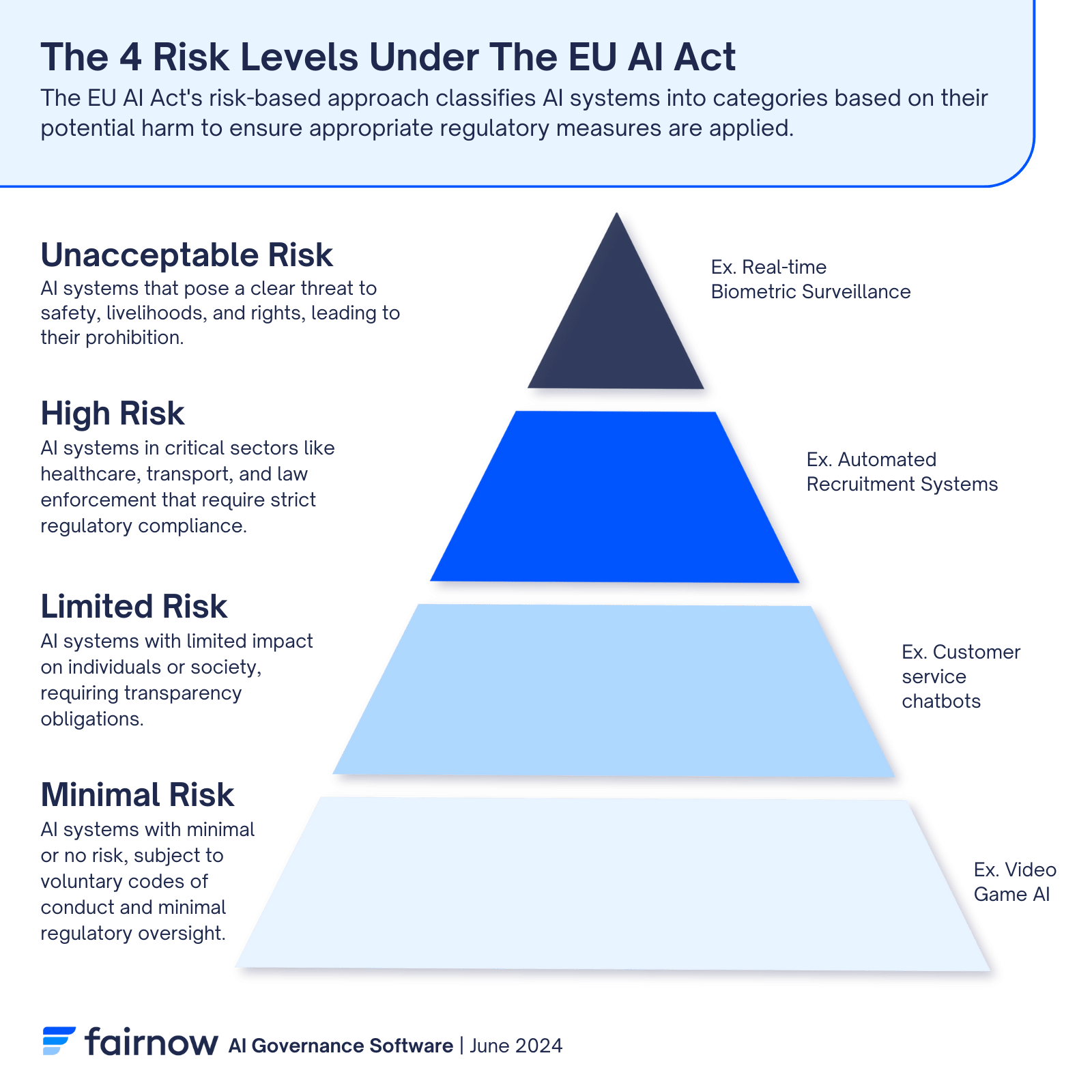
A cornerstone of the influential EU AI Act is its risk-based approach, which categorizes AI systems based on their potential to cause harm. This is a foundational concept in AI regulation that we will revisit throughout the course.
Conclusion
Today, we have connected the technical mechanics of AI to its real-world consequences. We've seen that AI is not a neutral tool; its design, the data it's trained on, and the context of its deployment create complex societal impacts.
Key Takeaways:
- Real-world AI applications in sectors like healthcare and governance offer transformative benefits but also pose significant risks.
- Common themes of risk across sectors include algorithmic bias, lack of transparency (the "black box" problem), challenges to legal accountability, and threats to privacy.
- In high-stakes domains like criminal justice, AI systems can amplify existing societal biases and undermine fundamental rights like due process.
- Understanding these concrete impacts is the essential first step to designing effective and responsible legal and regulatory frameworks for AI.
Preview of the Next Module:
This lesson concludes our module on the "Mechanics of Modern AI." You now have a solid foundation in both how modern AI works and the societal impact it can have.
In our next lesson, we will begin Module 3: AI Systems: Risks, Limitations, and Explainability. We will take the risks we identified today—like bias and opacity—and trace them back to their technical roots. We will ask: How exactly do choices about training data, features, and model parameters determine an AI's behavior and create legal risk? This will further sharpen your ability to analyze AI systems from both a technical and a legal perspective.