Introduction
Welcome back. In our previous lessons, we've dissected the EU AI Act's internal logic, examining its risk-based categories from prohibited practices to the detailed compliance obligations for high-risk systems and the transparency rules for technologies like chatbots and deepfakes. We've focused on what the rules are. Now, we turn to a critical question with global implications: who do these rules apply to?
Today's lesson directly addresses the learning outcome: to evaluate the extraterritorial application of the EU AI Act and its potential impact on Indian businesses. This is where the legal architecture of the Act intersects with international trade, corporate strategy, and global governance—a nexus that aligns perfectly with your background in international relations and your experience in cross-border digital transformation projects.
We will explore:
- The legal mechanisms that give the AI Act its global reach.
- The "Brussels Effect" and why EU regulations often become de facto international standards.
- The concrete challenges and strategic opportunities this creates for Indian companies operating in the global AI ecosystem.
The Global Reach: Understanding Extraterritoriality
The EU AI Act, much like the General Data Protection Regulation (GDPR) before it, was designed with a broad territorial scope. The EU's intent is to ensure that anyone within its borders is protected by the Act's rules, regardless of where the AI system was developed or is being operated from.
To understand the legal basis for this global reach, let's turn to a clear analysis.
Decoding the EU AI act: Compliance, Impact and Global ...
The article 'Decoding the EU AI act' provides a concise explanation of the Act's scope. Pay close attention to the list of actors and the conditions that trigger the Act's application.
Please read the 'INTRODUCTION' section. Focus on the sentence that describes the Act's application to providers, importers, distributors, and deployers.
As the reading highlights, the Act applies if you are:
- A provider placing an AI system on the EU market or putting it into service there.
- A deployer (user) of an AI system located within the EU.
- A provider or deployer located outside the EU, but the output produced by the AI system is used in the EU.
This last point is incredibly expansive. It means an Indian company with no physical presence or customers in the EU could still fall under the Act's jurisdiction if, for example, its AI-powered analytics are incorporated into a report that is then used by a client in the EU.
To further clarify who is responsible at each stage, the Act defines several key roles or "economic operators."
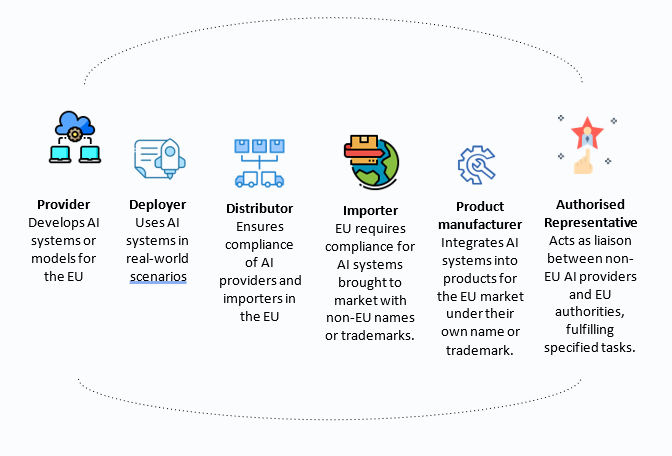
An Indian business developing its own AI software for the European market would be considered a Provider. If it integrates an AI component from another non-EU country into its product, it might also take on the obligations of an Importer. These roles are central to how the Act extends its authority beyond the EU's borders.
The following analysis from The Dialogue offers a sharp perspective on what this means for Indian developers specifically.
The EU AI Act, Stakeholder Perspectives, and India's Approach
The research paper 'The EU AI Act, Stakeholder Perspectives, and India's Approach' directly addresses the challenges posed by the Act's extraterritoriality for Indian innovators.
Please read the section '3.5. EXTRATERRITORIAL APPLICABILITY'. Focus on the practical examples given, such as a model shared on GitHub, and the potential 'regulatory friction' for Indian developers.
The "Brussels Effect": A De Facto Global Standard?
The AI Act's global impact isn't just a matter of direct legal obligation. It's also driven by a powerful market dynamic known as the "Brussels Effect." This term describes the process by which EU laws and standards become global benchmarks because it is economically and technically easier for multinational companies to adopt the EU's stringent rules across their entire operations rather than create different products for different markets.
Let's watch a brief video that explains this phenomenon in the context of the AI Act.
How the EU’s AI Act Impacts Your Business Model
This clip from 'How the EU’s AI Act Impacts Your Business Model' clearly explains the Brussels Effect and why companies outside the EU will feel the Act's influence.
Please watch from 02:13 to 02:38.
The key insight here is that regulation can create a "race to the top." For an Indian tech firm, designing an AI system to meet the EU's high-risk requirements from the outset may be a sound strategy, ensuring the product is marketable not only in the EU but also in other jurisdictions that may adopt similar standards in the future.
Impact on Indian Businesses: Challenge and Opportunity
The extraterritorial nature of the AI Act presents a dual reality for Indian businesses: significant compliance challenges and unique strategic opportunities.
1. The Challenge: Compliance Burden and Market Barriers
For any Indian company aiming to serve the EU market, compliance is not optional. This involves substantial investment.
- Costs and Resources: As detailed in the 'Decoding the EU AI act' paper (Section 3), companies must invest in compliance infrastructure, risk management systems (QMS), conformity assessments, post-market monitoring, and extensive technical documentation. These are not one-time costs; they are ongoing operational expenses.
- Risk of Exclusion: For smaller Indian startups or individual developers, these costs can be prohibitive. As noted in 'The EU AI Act, Stakeholder Perspectives, and India's Approach', the pragmatic choice for some may be to avoid the EU market entirely, stifling competition and limiting their global reach.
- Tight Timelines: Compliance is an urgent consideration. The timeline for implementation is phased but aggressive.
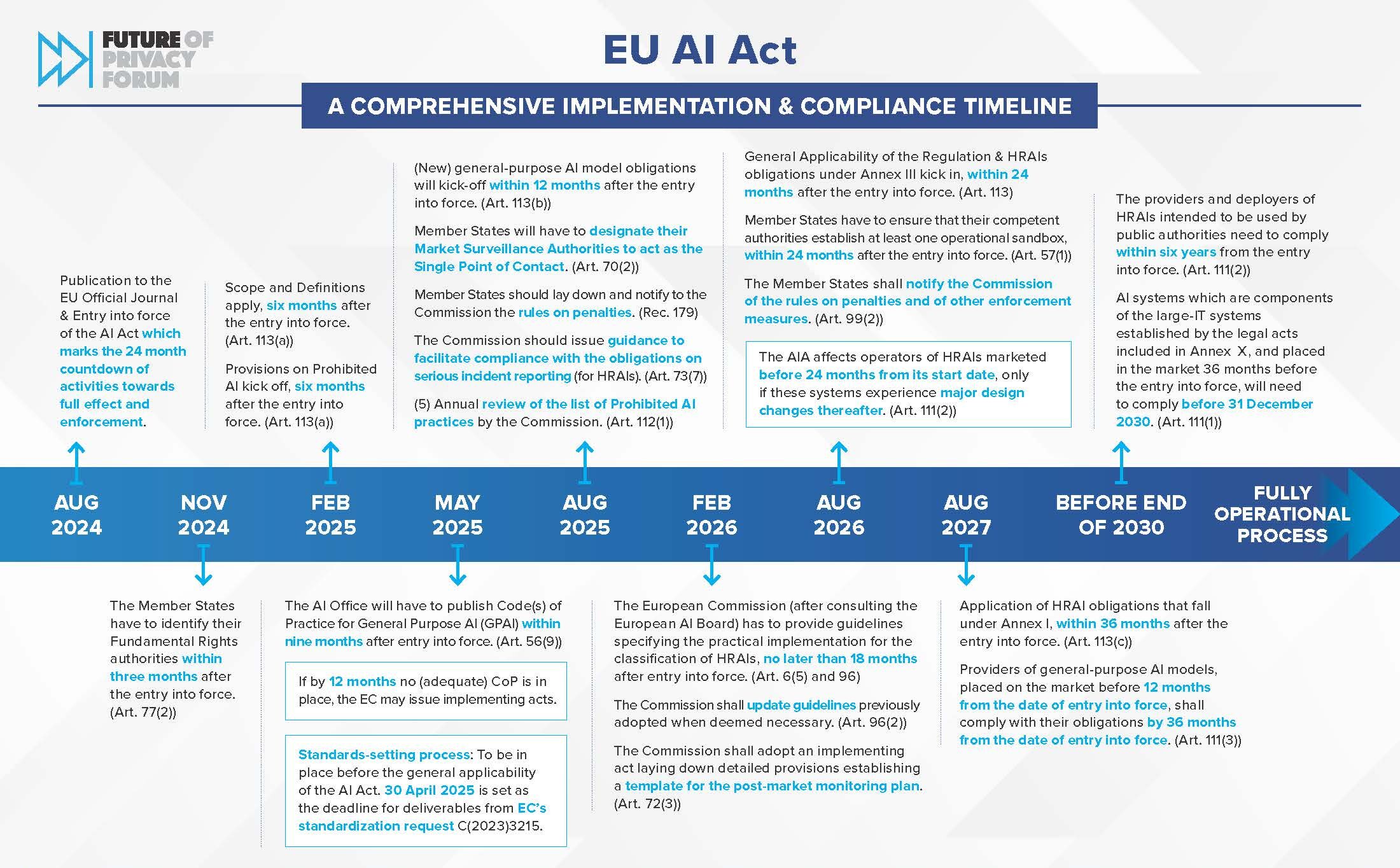
2. The Opportunity: A Competitive Advantage
Conversely, proactive compliance can become a powerful market differentiator. In a global marketplace increasingly concerned with "Trustworthy AI," demonstrating adherence to the world's most comprehensive AI regulation can be a significant asset.
The following clip frames this perspective perfectly.
How the EU’s AI Act Impacts Your Business Model
This segment discusses how smart businesses can leverage AI Act compliance as a 'badge of trust' and a competitive advantage.
Please watch from 01:51 to 02:38.
This leads to several strategic benefits for Indian firms:
- Building Trust: Achieving compliance signals to customers, investors, and partners that a company is committed to responsible and ethical AI.
- Future-Proofing: The AI Act is likely to influence future Indian legislation (such as the proposed Digital India Act). Companies that align with EU standards now will be well-positioned for future domestic regulations.
- Global Leadership: By embracing these standards, Indian companies can position themselves not just as service providers, but as global leaders in the development and deployment of safe and trustworthy AI systems.
Test your understanding!
Imagine you are advising an Indian MedTech startup that has developed a high-risk AI system for analyzing medical scans to detect early-stage diseases. The CEO wants to launch the product in India, the UK, and Germany simultaneously.
Based on what you've learned, what are the key regulatory and strategic factors related to the EU AI Act that you would advise the CEO to consider for their German market-entry strategy?
Show answer
You should advise the CEO to consider the following:
- Direct Legal Obligation: As a 'Provider' placing a 'high-risk' AI system on the German (EU) market, they are directly subject to the full scope of the EU AI Act. This is not optional.
- Compliance as a Prerequisite: They cannot legally sell the product in Germany without completing the conformity assessment and affixing a CE mark. This involves setting up a Quality Management System, creating extensive technical documentation, ensuring data governance, and implementing human oversight, as we covered in previous lessons.
- Appointing an Authorised Representative: Since the startup is based in India (outside the EU), they will likely need to appoint an Authorised Representative within the EU to act on their behalf for compliance matters.
- Strategic Choice: Brussels Effect: The CEO should consider adopting the EU AI Act's standards as the company's single, global standard. While this requires a significant upfront investment, it would streamline their entry into the UK (which has its own developing AI regulations) and other markets, giving them a competitive edge as a "trusted" global provider.
- Cost vs. Opportunity: You must present a clear picture of the high compliance costs versus the opportunity to access the large, lucrative EU market and build a global brand reputation based on safety and trustworthiness. Avoiding the German market to save on compliance costs would mean forgoing a major market.
Conclusion
In this lesson, we've explored the far-reaching implications of the EU AI Act beyond its own borders. We've seen how its broad definition of applicability and the market-driven "Brussels Effect" combine to create a powerful global force in AI regulation.
Key Takeaways:
- The AI Act is Extraterritorial: It applies to any organization, including Indian businesses, that places an AI system on the EU market, puts it into service there, or whose AI-generated outputs are used within the Union.
- The "Brussels Effect" Magnifies Impact: For global efficiency, many companies will adopt the AI Act's high standards across all their operations, making it a de facto global benchmark.
- A Dual Impact for India: For Indian businesses, the Act represents both a significant compliance hurdle (requiring substantial investment in processes and documentation) and a strategic opportunity to gain a competitive advantage by becoming a globally recognized provider of trustworthy AI.
Preview of the Next Lesson:
This lesson focused on the impact of the EU's approach on India. In our final lesson for this module, we will conduct a more direct comparison of the EU and Indian approaches to AI governance. We'll contrast the EU's comprehensive, precautionary model with India's more agile, innovation-focused strategy, identifying potential lessons that each jurisdiction can learn from the other. This will set the stage for our deep dive into India's specific legal frameworks in the modules to come.