Introduction
Welcome to the final lesson of this module on comparative AI governance. In our last session, we evaluated the EU AI Act's significant extraterritorial reach and its tangible impact on Indian businesses. We established that due to the "Brussels Effect," the Act sets a de facto global standard, presenting both compliance challenges and strategic opportunities for Indian firms.
Today, we will broaden our lens to directly address the learning outcome: Compare the EU and Indian approaches to AI governance, identifying potential lessons for Indian policymaking. We will move beyond the EU's impact on India to a head-to-head comparison of the two distinct regulatory philosophies. Your background in international relations and experience with cross-border digital transformation projects will be invaluable as we dissect these competing models for steering the future of technology.
We will explore:
- The core philosophies underpinning the EU's precautionary, rights-based model and India's innovation-led, agile strategy.
- The different legal and institutional mechanisms each jurisdiction uses to implement its vision.
- A direct comparison of the two approaches across key dimensions like risk management, enforcement, and economic goals.
- The strategic lessons India can draw from this comparison as it solidifies its own AI governance framework.
The Two Architectures of AI Governance
The EU and India represent two fundamentally different answers to the question of how to govern artificial intelligence. To understand their differences, we must first appreciate their distinct starting points and national priorities.
1. The EU Approach: The Guardian of Rights and Risks
The EU's strategy is built on a foundation of precaution and the protection of fundamental rights. It views AI's potential harms as systemic risks that must be contained before they manifest. This philosophy translates into a comprehensive, legally binding framework designed to create a single, trusted market for AI across all member states.

This model, which can be described as "Statutory / Risk-Based," prioritizes legal certainty and public trust over the raw speed of innovation.
To understand this framework in detail, let's turn to a research paper that unpacks the Act's structure.
The EU AI Act, Stakeholder Perspectives, and India's Approach
The research paper 'The EU AI Act, Stakeholder Perspectives, and India's Approach' offers an excellent, in-depth overview of the EU AI Act's structure. It will solidify your understanding of its key components before we compare it to India's model.
Please read section '3. WHAT IS THE EU-AI ACT?' (pages 3-11). Focus on the 'Scope of Application', the 'Risk-Based Categorisation' table, and the 'Obligations for GPAI Models'. This will provide a comprehensive summary of the EU's regulatory machinery.
As you've read, the EU's approach is characterized by:
- A single, horizontal law (the AI Act) that applies across all sectors.
- Ex-ante (before the fact) risk classification, with the heaviest burden on developers of "high-risk" systems.
- Extensive obligations on a wide range of actors in the supply chain (providers, deployers, importers, etc.).
- A centralized governance structure involving a new EU AI Office and national competent authorities.
2. The Indian Approach: The Architect of Innovation and Scale
India has deliberately chosen a different path. Its approach is not defined by a single, omnibus AI law but by a more dynamic, adaptive, and innovation-centric strategy. The core philosophy is to harness AI as a primary engine for economic growth and social development while managing risks in a flexible manner.
To hear this philosophy directly from the source, let's watch a discussion with the chairman of the committee that drafted India's AI governance guidelines.
Perspective: India AI Governance Guidelines | 07 November, 2025
In this Sansad TV panel discussion, Professor B. Ravindran of IIT Madras, who chaired the expert committee, explains the conscious decision to create 'governance guidelines' rather than a restrictive regulatory framework like the EU's.
Please watch the following two clips: From 02:22 to 04:19, where Prof. Ravindran explains the motivation to enable AI adoption and innovation. From 06:32 to 08:57, where he explicitly contrasts India's approach with the EU's, stating a desire to avoid heavy regulatory burdens that could stifle innovation, especially for smaller companies.
This approach is best understood as a "Hybrid / Strategic" model. It combines "soft law" (principles, guidelines, voluntary codes) to encourage private sector innovation with the use of existing "hard law" (like the DPDP Act) and sector-specific regulations to address harms.
A key report on global AI governance provides an excellent analytical framework for understanding this model.
Global AI Governance Frameworks A Comparative Study
The report 'Global AI Governance Frameworks A Comparative Study' categorizes national strategies. It defines the 'Hybrid/Strategic' model and places India within it, offering a powerful lens for our comparison.
Please read the following sections: 'Model 3: Hybrid / Strategic' (page 15). This defines the model that best describes India's approach. 'Insight B: The “Hybrid” Sweet Spot for Emerging Economies' (page 21). This explains why this model is attractive for countries like India. The profile on 'India' (page 67). This provides a concise summary of India's framework.
To summarize India's approach:
- No single, omnibus AI law. Instead, it relies on a combination of existing laws (DPDP Act, IT Act), new advisory guidelines, and future sector-specific rules.
- An innovation-first, "techno-legal" approach that uses tools like Digital Public Infrastructure (DPI) and regulatory sandboxes.
- An agile governance structure designed for continuous monitoring, with bodies like the AI Governance Group (AIGG) and the India AI Safety Institute (AISI) adapting to the rapidly evolving technology.
- A primary focus on enabling adoption and scale to achieve national economic and social goals.
A Head-to-Head Comparison
The philosophical differences manifest in every aspect of governance. The following paper provides a direct comparison, which we can build upon.
The EU AI Act, Stakeholder Perspectives, and India's Approach
Let's return to the Dialogue paper, which contains a section dedicated to directly comparing the two governance philosophies.
Please read section '6. GOVERNANCE PHILOSOPHIES: COMPARING THE EU AND INDIAN APPROACHES TO AI GOVERNANCE' (pages 22-23). This section succinctly summarizes the core distinctions and their economic implications.
Building on this analysis, here is a comparative table summarizing the two models:
| Feature | EU Approach (The Guardian) | Indian Approach (The Architect) |
|---|---|---|
| Core Philosophy | Precautionary, Rights-Based. Contain risk before scaling. | Innovation-Led, Impact-Driven. Maximize opportunity, manage risk. |
| Legal Instrument | Comprehensive, horizontal, binding law (The AI Act). | Existing laws (DPDP, IT Act) + advisory guidelines + sectoral rules. |
| Regulatory Model | Statutory / Risk-Based. | Hybrid / Strategic. |
| Approach to Risk | Ex-ante risk classification and strict conformity assessments. | Sector-specific risk assessment and agile, monitoring-based oversight. |
| Primary Goal | Ensure safety, protect fundamental rights, create legal certainty. | Drive economic growth, ensure social inclusion, build sovereign capacity. |
| Enforcement | Centralized EU AI Office and national authorities; heavy fines. | Sectoral regulators (e.g., RBI, SEBI) and the Data Protection Board. |
| Impact on Innovation | Potentially slower due to high compliance burdens ("red tape"). | Fosters rapid adoption and experimentation, with risk of regulatory gaps. |
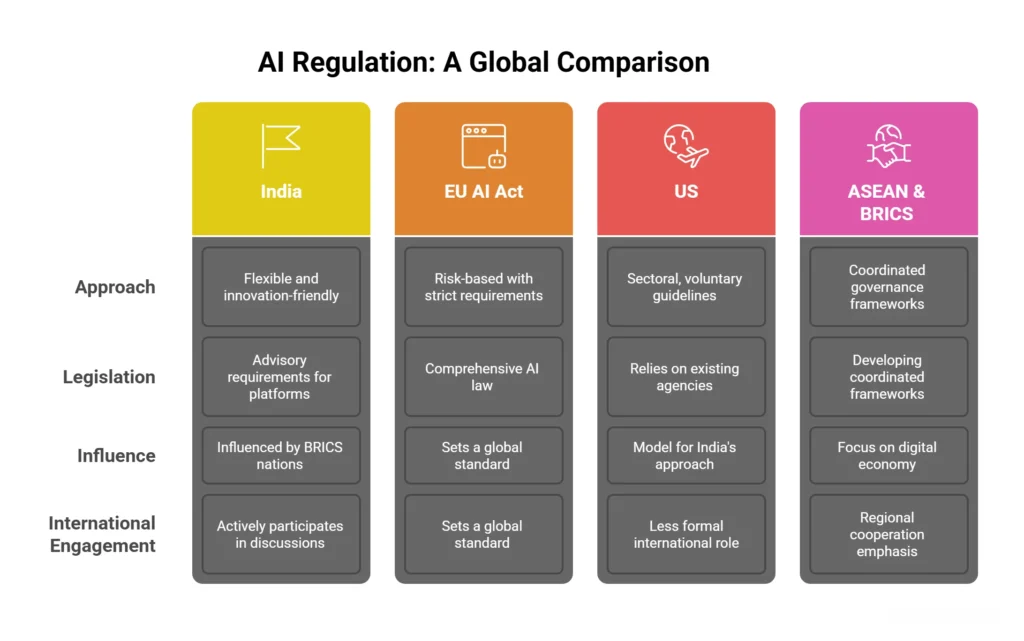
This infographic provides a high-level visual summary of the global landscape, situating the EU and India within it.
Lessons for Indian Policymaking
This comparative analysis reveals several key lessons for India as it continues to build its AI governance framework.
-
Affirming the Hybrid Model: India's decision to reject a direct copy of the EU's omnibus law appears strategically sound for its context. The "Hybrid/Strategic" model allows the flexibility needed to foster a burgeoning startup ecosystem, avoiding the premature imposition of high compliance costs that could stifle innovation. This path balances growth ambitions with targeted risk management.
-
Addressing the "Certainty Gap" in High-Risk Domains: While flexibility is a strength, the EU Act's clear, legally binding rules for high-risk AI provide a level of predictability that India's current framework lacks. A key lesson is the need to develop clear, harmonized, and robust regulations for specific high-risk applications (e.g., in healthcare, justice, and critical infrastructure) to build trust and provide legal certainty for both developers and citizens.
-
The Imperative of Interoperability: The "Brussels Effect" is a market reality. For India's AI industry to thrive globally, it cannot operate in a regulatory silo. Indian standards, particularly those developed by the India AI Safety Institute (AISI), should be designed with an eye toward interoperability with international benchmarks like those set by the EU and standards bodies like ISO. This will serve as a "trade passport" for Indian AI exports.
-
Operationalizing Rights Protection: The EU model explicitly integrates Fundamental Rights Impact Assessments (FRIAs) into the compliance process for high-risk systems. While India's Constitution provides a strong rights foundation, a lesson is to operationalize this protection more proactively. India could consider mandating similar ex-ante impact assessments for high-risk AI deployed by both public and private entities to move from a reactive judicial backstop to a proactive design principle.
Test your understanding!
A senior official at NITI Aayog is preparing a policy brief on the future of AI regulation in India. They argue that to be seen as a "responsible" global power, India should abandon its current approach and adopt an omnibus law nearly identical to the EU AI Act.
Based on this lesson, formulate two counter-arguments explaining why this might not be the optimal strategy for India.
Show answer
Here are two strong counter-arguments:
-
Mismatch with National Priorities and Economic Context: The EU AI Act is designed for a mature, single market focused on harmonization and consumer protection. Its heavy, ex-ante compliance burdens could disproportionately stifle India's dynamic and fast-growing AI ecosystem, which is a key pillar of its economic growth strategy. India's "Hybrid/Strategic" model is better tailored to its national priority of fostering innovation and scaling AI adoption to solve developmental challenges, while managing risks adaptively rather than preemptively restricting development.
-
Forfeiting the Advantage of Agility: The EU's legislative process is slow, and its comprehensive law may struggle to keep pace with rapid technological advancements in AI. By adopting a similar static law, India would lose the key advantage of its current agile framework. The Indian model, with its reliance on sectoral expertise and continuously monitoring bodies like the AISI, is designed to be more adaptive. It can address emerging risks as they become clear without locking the entire ecosystem into a rigid regulatory structure that might quickly become outdated.
Conclusion
In this lesson, we have conducted a thorough comparison of the EU and Indian approaches to AI governance, revealing two distinct worldviews.
Key Takeaways:
- Two Divergent Philosophies: The EU has adopted a precautionary, rights-based approach, using a comprehensive law to manage risks ex-ante. India has chosen an innovation-led, agile approach, using a hybrid of existing laws and new guidelines to maximize growth while managing risks adaptively.
- The "Hybrid/Strategic" Model: India is not simply lagging behind but is actively forging a distinct regulatory path suited to a high-growth emerging economy. This model prioritizes state-led strategic ambition, balancing market flexibility with sovereign control.
- A Balance of Lessons: While India's flexible approach is well-suited to its economic goals, it can learn from the EU's focus on legal certainty in high-risk areas and proactive rights-protection mechanisms. For global competitiveness, Indian standards must remain interoperable with international benchmarks.
Preview of the Next Module:
We have now concluded our high-level survey of comparative AI governance, focusing on the EU's landmark legislation. This has set the stage for a deep dive into the Indian legal context. In the next module, "Foundational Legal Principles for AI Governance," we will move from a comparative to a domestic focus. We will begin by examining the core building blocks of Indian law—including sources of law, Tort, Contract, and Constitutional principles—that form the "existing legal framework" upon which India's entire AI governance strategy is built.