Hello! Welcome to our final lesson in the module on Crafting High-Impact Scenes.
In our last session, we explored flashbacks as a sophisticated tool for weaving the past into the present to deepen character motivation. I had mentioned we would be moving on to the next module on mysteries and foreshadowing. However, before we do, there's one final, crucial skill we need to cover that will synthesize everything we've learned in this module. Today's lesson is about becoming a lifelong student of the craft.
Your goal is to learn how to analyze and deconstruct high-impact scenes from published novels or films. Throughout this module, we've looked at writing action, suspense, romance, and emotional intensity. Now, we will learn the process of taking apart the work of masters to see how they achieve their effects. This is the key to moving beyond formulas and developing your own instincts. For a writer who loves intricate, plot-driven stories like Harry Potter and Young Sherlock, this skill will empower you to learn directly from your favorite authors and filmmakers.
Why Deconstruct? The Writer as Apprentice
Artists in every field—painters, musicians, chefs—learn by studying the work of those who came before. They don't just passively consume it; they actively deconstruct it. A chef tastes a sauce and tries to identify the ingredients and techniques. A musician transcribes a solo to understand its harmonic and rhythmic structure. As a writer, you must do the same.
Deconstruction isn't about copying. It's about reverse-engineering a powerful scene to understand the author's choices. Why did they start the scene there? Why use a short, choppy sentence here and a long, flowing one there? Why reveal a piece of information at that exact moment? By answering these questions, you build a toolbox of techniques that you can adapt for your own unique stories.
A Framework for Deconstruction
To analyze a scene effectively, you need a consistent set of questions. Think of this as your diagnostic toolkit. When you read a chapter or watch a scene that truly captivates you, pause and ask:
- Purpose: What is this scene doing for the story? Is it advancing the plot, revealing character, establishing a theme, or raising the stakes? (Or all of the above?)
- Structure: What is the character's goal at the beginning of the scene? What conflict do they face? What is the outcome or disaster, and how does it force them into a new decision?
- Pacing & Rhythm: Where does the scene speed up or slow down? Look at sentence length, the balance of action/dialogue/description, and the use of summary versus moment-by-moment dramatization.
- Point of View (POV): Through whose eyes are we seeing the events? How close are we to their thoughts and feelings (narrative distance)? What information is withheld from the reader because of the chosen POV?
- Mechanics & Technique: What specific tools is the writer using? Look for powerful verbs, sensory details, figurative language, subtext in dialogue, and clear cause-and-effect logic.
- Entry & Exit: Where does the scene begin and end? The classic advice is to "arrive late and leave early." How does the author's choice of framing impact the scene's focus and energy?
Now, let's use this framework to deconstruct different types of high-impact scenes.
Case Study 1: The Anatomy of a Duel
Action scenes, especially duels and fights, are a staple of the genres you enjoy. They can be thrilling, but they can also be a confusing blur of motion if not handled carefully. Let's look at what makes a fight scene clear, tense, and meaningful.
On Writing: Fight Scenes! [ Sanderson | GoT | The Shining | Dragon Tattoo ]
The video "On Writing: Fight Scenes!" from the Hello Future Me channel is an excellent deconstruction of the building blocks of an effective fight scene, using examples from authors like J.K. Rowling, Brandon Sanderson, and George R.R. Martin.
Please watch the following segments to get a toolkit for analyzing action: Pacing and Action Beats: Watch from "long or short sentences" to understand that pacing comes from short action beats, not necessarily short sentences. Cause and Effect: The next section, "Cause and Effect," is crucial. It explains how to link actions logically using patterns like "React-Pause-Act" and "Goal-Conflict-Disaster." Selective Detail: Watch "where should you give detail?" This explains that you should focus detail on moments that shift power, are important to the character, or have narrative significance, while summarizing the rest. Clarity and Space: The segment on "making it easy to follow" highlights how vital it is to establish the physical space before the fight begins, using Rowling's Department of Mysteries scene as a prime example. Subjective Experience: Finally, watch from "playing to the strengths" to see how novels can surpass film by showing the character's internal thoughts, fears, and sensations during a fight.
When you next read a fight scene, use these concepts as your guide. Don't just see a punch; see a "Goal-Conflict-Disaster" sequence. Don't just read a description of a room; see it as Chekhov's Armory, where every object might become part of the fight. Notice how the author uses internal monologue to show the why behind the what.
Case Study 2: The Architecture of Suspense
Suspense is a different kind of high-impact scene. It’s not about fast action, but about stretching tension to its breaking point. Quentin Tarantino is a master of this, and analyzing his work can teach us a lot about creating suspense in prose.
Inglourious Basterds — The Elements of Suspense
The video "Inglourious Basterds — The Elements of Suspense" by Lessons from the Screenplay provides a brilliant deconstruction of the film's opening scene. It translates perfectly to writing novels.
Watch the video from the beginning to understand how conflict creates an instability that generates tension and how the characters' lack of control heightens it. Then, skip ahead to learn about two key concepts: Uncertainty & Mind Games: Watch from the introduction of uncertainty. See how Colonel Landa's polite "mind games" create immense tension by making the farmer (and the audience) uncertain of his intentions. The Bomb Under the Table: Watch from "the moment halfway through the scene". This explains Alfred Hitchcock's famous theory of suspense: giving the audience crucial information that the characters don't have (or that one character has over another). This shifts tension into true, nail-biting suspense. Pay attention to how Tarantino then stretches the rubber band of suspense to its absolute limit before the violent payoff.
This concept of managing information is central to authors like J.K. Rowling, who meticulously planned moments of suspense, surprise, and shock.
This article from The Friendly Editor analyzes how Rowling used her story outlines to create these different emotional effects. It provides clear, literary examples of the principles we saw in the film analysis.
Please read the three short sections defining and giving examples for each term: Creating Suspense (withholding information). Creating Surprise (reintroducing a plot point after a long pause). Creating Shock (a twist that seems to come from nowhere but is plausible in hindsight).
When you analyze a suspenseful scene, ask yourself: Where is the "bomb under the table"? What does the reader know that the characters don't? How is the author using uncertainty and withholding information to "stretch the rubber band"?
Case Study 3: Deep Deconstruction of a Prose Scene
Now let's apply this analytical mindset to a single, complex action scene from a novel. Writer Jeff VanderMeer provides a masterclass in this kind of deep deconstruction.
An Illustrated Guide to Writing Scenes and Stories
In his article for Electric Literature, Jeff VanderMeer breaks down a long, complex fight scene from Mervyn Peake's Gormenghast, showing how seemingly "unworkable" techniques can be incredibly effective.
Please find and read the section titled "A Break Down of an Action Scene." Don't worry if you don't know the novel. Focus on how VanderMeer analyzes the author's choices regarding pacing, POV, setting, character motivation, and scene structure.
VanderMeer’s analysis reveals several key authorial choices that make the scene work:
- Investment Through History: The scene isn't just a fight; it's the culmination of a long, convoluted relationship. The author uses the chase to recap this history in a new light, making us more invested in the outcome.
- Strategic Complications: The setting (the Hall of Spiders) and random events (a spider in the eye) are not just window dressing. They are functional parts of the conflict that level the playing field between a stronger and a smarter opponent.
- Clarity in Chaos: Despite the complex action, the author is always precise about the characters' physical locations and movements (the "blocking"). VanderMeer notes, "I always want to know where the light is in the room."
- Pacing for Climax: The scene is long and detailed because it's the climax. The author has earned the reader's patience and can now deliver a deep, satisfying confrontation rather than a short, rushed one.
This level of analysis—looking at character history, setting, blocking, and narrative function all at once—is what will elevate your understanding of the craft.
Exercise: Become the Deconstructionist
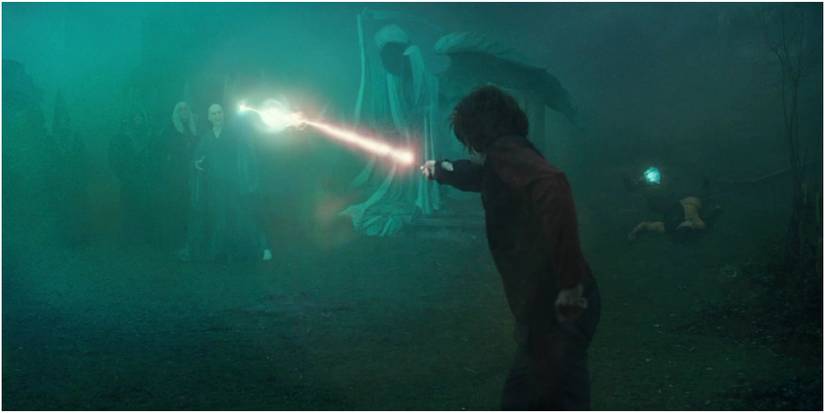
Now it's your turn. Choose a high-impact scene that you admire from a book or movie. It could be the duel in the graveyard from Harry Potter and the Goblet of Fire, the "Battle of the Bastards" from Game of Thrones, a tense interrogation from a spy film, or a quiet but emotionally devastating argument.
Once you have your scene, analyze it using the framework from this lesson. Write down your thoughts (300-500 words), focusing on these questions:
- Identify the Core: What is the scene's primary purpose? What are the character's goal, the conflict, and the scene's final outcome?
- Map the Beats: Break the scene down into its key moments or actions. If it's a fight, what are the major blows or shifts in power? If it's an argument, what are the key accusations and revelations?
- Isolate a Technique: Pick ONE specific technique the creator used that stood out to you. Was it the use of short, staccato sentences to speed up pacing? The reveal of a "bomb under the table"? The way the setting was used to complicate the conflict?
- Explain its Effectiveness: Why did this technique work so well? How did it contribute to the scene's tension, emotion, or clarity?
This exercise is not about finding the "right" answer. It's about training your brain to see the author's scaffolding behind the finished wall.
Conclusion
Learning to deconstruct masterful scenes is like gaining a superpower. It transforms you from a passive reader into an active apprentice. You will start to see the machinery of storytelling everywhere, and your own writing will become more intentional, precise, and powerful as a result.
Key Takeaways:
- Deconstruction is the active study of an author's or director's choices to understand their effects.
- A good deconstruction analyzes a scene's purpose, structure, pacing, POV, and specific techniques.
- Action scenes are built on clear cause-and-effect, selective detail, and spatial awareness.
- Suspense is often built on managing information—creating instability and uncertainty, and revealing a "bomb under the table" to hook the audience.
- The most powerful scenes integrate plot mechanics with character history, motivation, and emotion.
This lesson concludes our module on crafting high-impact scenes. Armed with this analytical ability, you are now perfectly prepared for our next module, Mystery, Puzzles, and Plot Twists. In our first lesson, we will explore foreshadowing and the art of embedding layered clues. You'll find that your ability to deconstruct a scene is essential for understanding how writers subtly plant the seeds of a future revelation.