Welcome back! In our previous lesson, we focused on weaving the factual research for your world into the narrative without resorting to clumsy info-dumps. You now know how to integrate information so it feels discovered rather than taught. Today, we take the next step: moving from the facts of a place to its feel.
This lesson is dedicated to making your settings truly believable and immersive by grounding them in vivid sensory details. This skill is the foundation for creating the mysterious and atmospheric worlds you're interested in writing, the kind that readers can not only picture but also hear, smell, and touch. By the end of our session, you will be able to establish a setting that feels rich, authentic, and alive.
Beyond the Visual: Immersing the Reader
When we describe a place, our first instinct is often to focus on what can be seen. But a truly immersive setting engages more than just the eyes. It pulls the reader into the character's physical experience through all five senses. This is the core of the principle "show, don't tell" as it applies to setting. Instead of telling the reader a forest is "eerie," you show them by describing the snap of a twig in the oppressive silence or the cloying smell of damp earth and decay.
This infographic provides a simple but powerful reminder of the questions we should ask when describing what a character is experiencing.
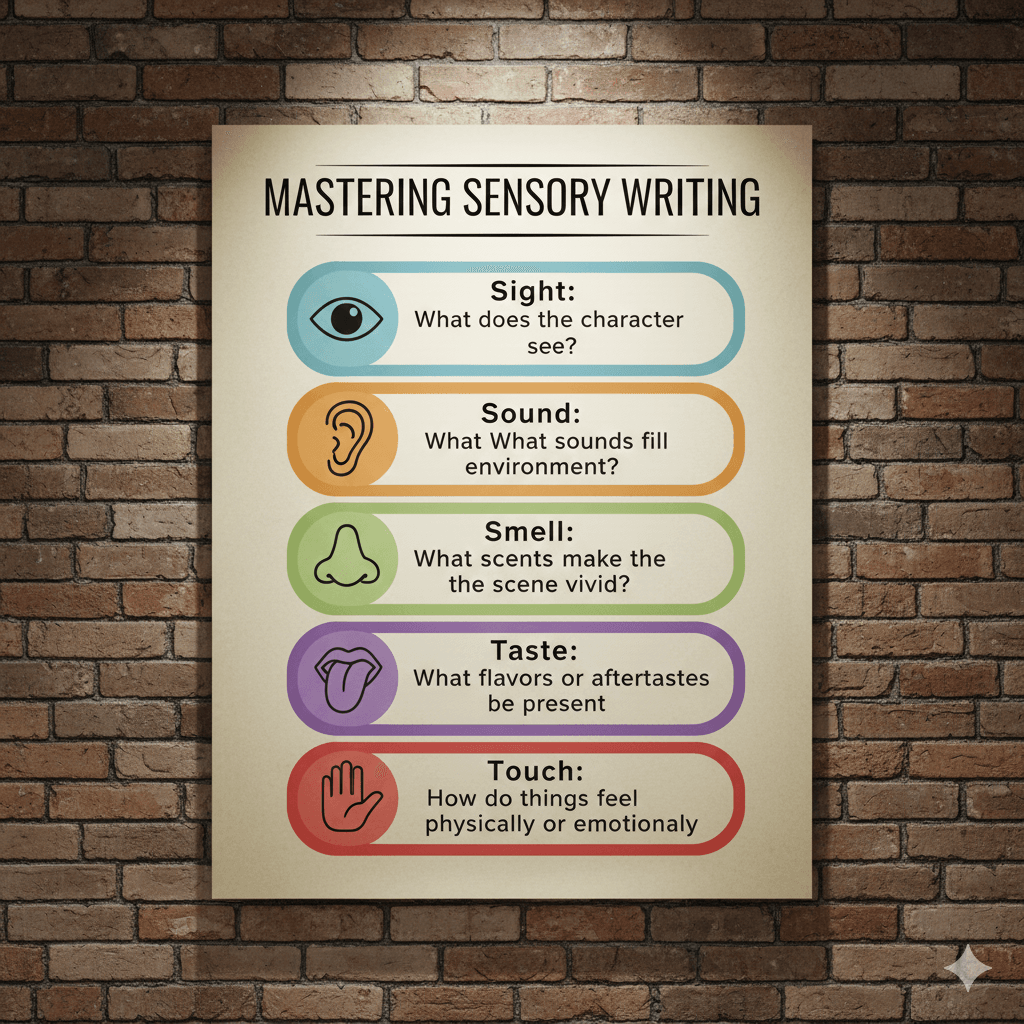
David Morrell, the author of First Blood (the novel that introduced Rambo), recommends anchoring every scene with details from at least three different senses. Let's explore a structured way to brainstorm these details.
A Practical Exercise in Sensory Observation
Before writing a scene, it's incredibly helpful to pause and step into your character's shoes. A great way to do this is to systematically consider what they would perceive through each sense.
Using Setting and Description in Creative, Yet Crucial Ways
This article by Darcy Pattison provides an excellent framework for brainstorming sensory details and choosing precise language. It demonstrates how to build a rich description from a simple list of sensory notes.
First, read the section titled "The Importance of Sensory Details." Pay close attention to the exercise where the author imagines being a young girl at the mouth of a cave and lists what she would see, hear, taste, smell, and touch. Next, read the following section. It explains how to evaluate your own writing for sensory variety and offers crucial advice on using specific language instead of generic terms and modifiers.
As the article demonstrates, you don't need to use every detail you brainstorm. The exercise is about generating a palette of sensory information from which you can select the most impactful details to paint your scene. Notice how "Water fell onto my head" becomes the much more evocative "Water plopped onto my head." Specificity is key.
Deconstructing the Senses for Deeper Impact
Now that you have a method for brainstorming, let's look at how to use each sense not just for description, but for deeper storytelling.
How to Unlock All 5 Senses in Your Writing
This article from The Write Practice offers practical tips for each of the five senses, pushing beyond surface-level description to find their narrative power.
Please read the article from the heading "Write With Sight" all the way to the end. For each sense, the author explains not only how to describe it but also prompts you to ask the crucial follow-up question: "What does this mean?" or "Why does it matter?"
The key takeaway from this article is that sensory details become powerful when they are connected to character, emotion, or story. A smell isn't just a smell; it's a trigger for a memory. A sound isn't just a noise; it's a source of fear or comfort. Always ask why this detail matters to the character experiencing it.
From a List of Details to a Living Atmosphere
A list of sensory details can make a setting tangible, but a carefully curated selection of details is what creates atmosphere—the dominant mood or feeling of a place. This is where you, the author, become a film director, choosing what the "camera" lingers on to make the audience feel a certain way.
Word choice is your primary tool here. The following video offers a fantastic illustration of this.
How to Write a Strong Atmosphere
In "How to Write a Strong Atmosphere," the Reedsy channel explains how diction and sensory engagement create mood.
First, watch the segment on choosing your word choice. Notice how describing the same tree with different words—"a spiderweb of gnarled branches" versus "a lace of fine branches"—creates two completely different feelings. Next, watch the section on using all the senses. This reinforces the idea that engaging senses beyond sight is the key to creating an immersive world for your reader.
The atmosphere is not objective; it's filtered through the character's emotional state. A character who is happy and in love will perceive a city street very differently from one who is being hunted. Your descriptions should reflect this.
This next video provides one of the clearest examples of how point of view transforms a setting.
How to Show, Not Tell: The Complete Writing Guide
This video from Quotidian Writer offers brilliant, practical advice on using specific details and character perspective to make descriptions come alive.
First, watch the segment that begins with an example of a market scene, from "Substitute vague descriptions with specific sensory details." This shows the evolution from a generic description to one rich with the smell of cinnamon, the feel of silken tassels, and the sight of golden saffron. Now, watch the section on filtering the world-building through the character's perspective. The side-by-side comparison of how a bland scene is described by a Navy SEAL versus a scared girl is a masterclass in atmospheric writing.
The Navy SEAL notices the rain beating "like rounds from an Uzi." The scared girl sees the rain "blurring the outside world." The setting is the same, but the experience—and therefore the atmosphere—is completely different. This is how you make a setting an active part of your story.
A Roadmap for Writing Setting
As we've seen, writing a compelling setting involves several steps. This infographic provides a helpful overview of the process.
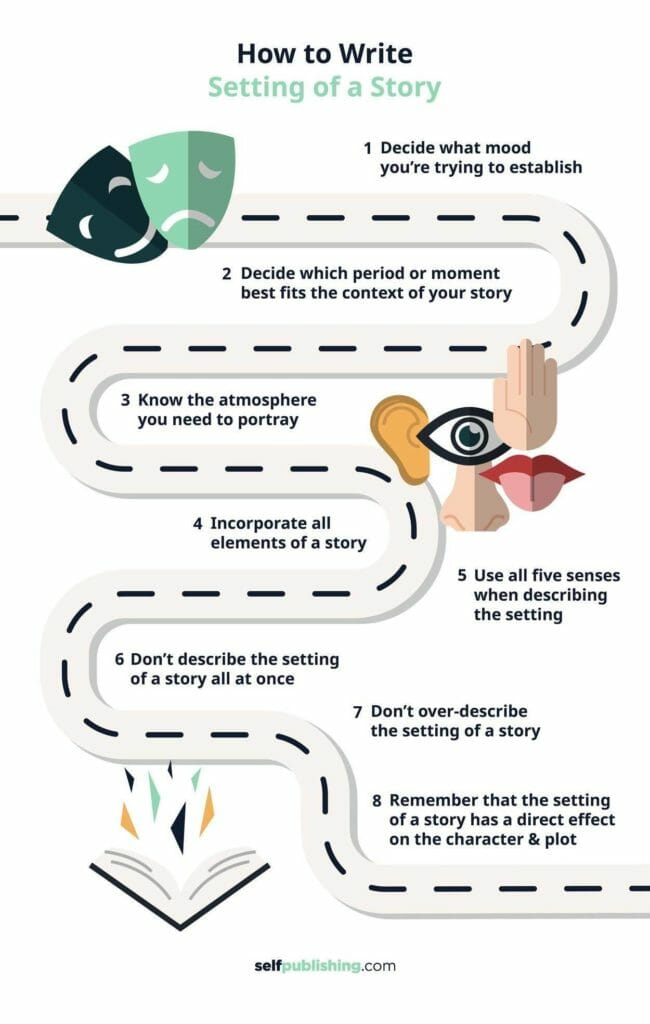
Pay special attention to points 5, 6, and 7: "Use all five senses," "Don't describe the setting of a story all at once," and "Don't over-describe." A few well-chosen, specific details woven into the action are far more effective than a long paragraph of static description. Overwriting, or "purple prose," can pull the reader out of the story just as easily as a lack of detail can.
Exercise: Bringing a Setting to Life
It's your turn to practice. Choose one of the following options:
- A familiar setting from a book you admire (e.g., the desolate moors in The Hound of the Baskervilles, the bustling Diagon Alley from Harry Potter).
- An original setting from a story idea of your own (e.g., the bridge of a silent starship, a sorcerer's chaotic workshop, a neon-lit futuristic city in the rain).
Write a single, descriptive paragraph (around 150 words). Your goal is to establish a clear mood or atmosphere (e.g., mysterious, awe-inspiring, menacing, peaceful).
To do this, you must:
- Use details from at least three of the five senses.
- Choose specific nouns and strong verbs.
- Filter the description through the implied emotional state of a character who is present in the scene.
Don't just list what's there; select the details that contribute to the feeling you want to evoke.
Conclusion
Today you've learned that a believable setting is a sensory one. By moving beyond simple visual description and engaging the full range of human senses, you can build worlds that are not just seen, but experienced. This is the bedrock of atmospheric writing.
Key Takeaways:
- Immerse the reader by appealing to sight, sound, smell, taste, and touch.
- Brainstorm sensory details before writing a scene to create a rich palette to draw from.
- Choose specific and precise language. "The torch sizzled" is more evocative than "the torch made a noise."
- Atmosphere is subjective. Use your character's emotional state to color their perception of the setting, which in turn creates the mood for the reader.
- Select details strategically. A few well-chosen sensory details are more powerful than a long, unfocused description.
In our next lesson, we will build directly on this foundation. You now have the tools to create sensory worlds; next, we will focus specifically on how to craft mysterious and atmospheric settings that evoke suspense, wonder, or unease, honing in on the exact techniques that bring those kinds of stories to life.