Hello! In our last lesson, we focused on making settings believable by grounding them in the five senses. You learned how to select specific, sensory details and filter them through a character's perspective to create a tangible world.
Today, we'll build directly on that foundation. Instead of just making a setting feel real, we're going to make it feel charged with emotion. This lesson is dedicated to the art of crafting mysterious and atmospheric settings that can evoke specific feelings in your reader, from suspense and unease to wonder and awe. This is a core skill for writing the kind of stories you love, where places like the Forbidden Forest or the Shrieking Shack are as much a part of the experience as the plot itself.
By the end of this lesson, you will have a toolkit of specific techniques to deliberately create and control the mood of your settings.
The Power of Atmosphere
Atmosphere is the dominant emotional quality of a setting. It's the difference between a forest that feels enchanting and one that feels menacing. As the great writer of weird fiction, H.P. Lovecraft, knew, getting the mood right is paramount.

Atmosphere works because it makes the reader feel the story, not just understand it. It's a crucial part of the "show, don't tell" principle, applied to the world itself.
The Essence of Mystery: Unanswered Questions
At its heart, a mysterious atmosphere is built on unanswered questions. The opposite of mystery is familiarity and complete understanding. If your characters (and by extension, your reader) know exactly what something is, how it works, and that it's normal, the mystery vanishes.
This is a delicate balance. You want to create intrigue without being confusing. The key is to control what information is revealed and what is withheld.
How to Create a Mysterious Atmosphere – Mythcreants
This article from Mythcreants breaks down the fundamental principle of mystery in fiction and how to preserve it.
Read the first two sections of the article, from the beginning down to the heading "Building Creep, Wonder, and Awe." As you read, focus on the core idea that mystery comes from unanswered questions and how familiarity can ruin it. Pay attention to the bulleted list of tips for preserving mystery.
The article makes a vital point: the less present something is, the bigger the impression it makes when it does appear. The monster glimpsed in shadow is always more frightening than the one standing in broad daylight.
The Flavors of Atmosphere: Creep, Wonder, and Awe
"Mysterious" isn't a single flavor. It's a spectrum of emotions. By carefully selecting your details, you can guide the reader toward a specific feeling. The same mysterious, ancient ruin could inspire wonder, creepiness, or awe, depending on how you describe it.
Let's explore these three key manifestations of mystery.
How to Create a Mysterious Atmosphere – Mythcreants
This next part of the Mythcreants article provides a clear framework for understanding and creating three distinct atmospheric effects.
Now, read the section titled "Building Creep, Wonder, and Awe." Note the different ingredients that contribute to each mood: Creep: Menacing characteristics like being out of place, hidden, or wrong. Wonder: Beautiful or welcoming characteristics, often with associations like light, music, or nature. Awe: Characteristics that suggest immense scale or power, like being ancient, vast, or unique.
Understanding this distinction is crucial. When you write a scene, you can now ask yourself: Am I trying to create wonder, unease, or awe? Then you can choose sensory details and descriptions that align with that specific goal.
A Toolkit for Crafting Atmosphere
Now that we understand the "what" (the different types of atmosphere), let's focus on the "how." Building atmosphere involves a combination of several techniques, many of which amplify the sensory writing skills you learned in the last lesson.
Mastering Atmosphere in Fiction
This article from Hire a Writer offers a fantastic, practical list of techniques you can use to build atmosphere. It serves as a great checklist for your writing toolbox.
Read the section titled "Practical Techniques for Crafting Atmosphere." You don't need to memorize all ten points, but pay close attention to the following concepts and the examples provided: Word Choice: Notice the difference between "The trees moved" and "The skeletal branches scraped at the sky." Weather as an Emotional Proxy: Using the environment to reflect internal states. Character Perception: How a setting's scariness depends on who is experiencing it. Sentence Structure: Using short, sharp sentences for tension and long, flowing ones for a dreamlike quality.
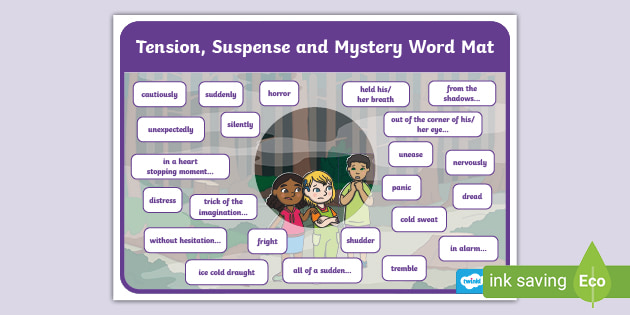
One of the most powerful tools mentioned is word choice. Your desire to move beyond "basic average English" is directly addressed here. The specific verbs, nouns, and adjectives you choose are the primary pigments you'll use to paint your atmospheric scenes.
This word mat gives a sense of the kind of vocabulary that can instantly create a particular mood.
The Art of Suspense
Suspense is a particularly potent flavor of atmosphere that relies heavily on a sense of anticipation and uncertainty. It's the feeling that something is about to happen. The key, as master of suspense Alfred Hitchcock often noted, is to give the audience information that the characters might not have, or to delay the resolution of a threat.
This short animated video from TED-Ed provides an excellent summary of the core techniques for creating suspense.
How to make your writing suspenseful - Victoria Smith
This TED-Ed video, "How to make your writing suspenseful," quickly breaks down the key ingredients for building tension and keeping your readers on edge.
Watch the entire video, paying special attention to these four techniques: The core principle of setting up a question and delaying the answer. Limiting the point of view so the reader only knows as much as the character. Using setting and imagery (like fog, storms, or sinister descriptions) to create unease. Manipulating style and pacing with sentence structure.
Notice how these techniques overlap with the general principles of atmospheric writing but are sharpened to a fine point with the specific goal of making the reader feel anxious about what comes next.
Deepening the Immersion
To truly master atmosphere, it helps to think like an artist or a filmmaker. You're not just describing a place; you are composing an experience.
The following video offers a more nuanced, artistic perspective on building atmosphere, touching on elements like color, sound, and the very rhythm of your prose.
WRITING ATMOSPHERE AND MOOD🌙 how to write an immersive story
In "WRITING ATMOSPHERE AND MOOD," ShaelinWrites delves into the subtle components that create an immersive story. We'll look at a few key clips that offer advanced, practical insights.
First, watch the segment on emotion and viewpoint. The key takeaway here is that atmosphere is not just about what a place looks like, but what it feels like to be a specific character in that place. Next, watch her tip on the color palette. This is a powerful visualization technique. Thinking of your scene or novel in terms of a specific palette (e.g., muted grays and blues for a gloomy story, vibrant neons for a futuristic one) can guide your descriptive choices. Pay close attention to her idea of a "language ecosystem." This is a fantastic way to think about word choice. For a mysterious, ancient setting, words like "lichen-spotted," "hoarfrost," and "ossuary" feel at home, while modern slang would feel jarring. Finally, watch the tip on using imperfect, "off-kilter" details. A pristine, perfect room is often boring. A room where one picture frame is slightly crooked, or a single floorboard creaks, feels more real and can introduce a subtle sense of unease.
Exercise: Transforming the Mood
Now it's time to put these techniques into practice. Below is a short, neutral paragraph describing a simple scene. Your task is to rewrite it twice.
Neutral Scene:
The man walked down the hallway. The walls were painted white and the floor was made of wood. He passed several closed doors. At the end of the hall was a window. It was nighttime.
Your Task:
- Rewrite 1 (Wonder): Rewrite the paragraph (approx. 100-150 words) to evoke a sense of wonder or magic. Use techniques like specific sensory details, evocative word choice, figurative language (similes/metaphors), and a focus on light or sound.
- Rewrite 2 (Suspense/Unease): Rewrite the same paragraph (approx. 100-150 words) to evoke suspense or unease. Use techniques like focusing on darkness, strange sounds or smells, unsettling details ("off-kilter" things), and short, tense sentence structures.
The goal is not just to add more words, but to select words and details that are specifically engineered to create two completely different emotional experiences for the reader in the exact same physical space.
Conclusion
In this lesson, we moved from creating believable settings to creating emotionally resonant ones. You now have a framework for understanding and building atmosphere to achieve specific effects like mystery, wonder, and suspense.
Key Takeaways:
- Atmosphere is Emotion: It's the dominant mood of a setting, designed to make the reader feel something specific.
- Mystery Thrives on the Unknown: To create mystery, you must strategically withhold information and use suggestion rather than explicit description.
- Choose Your Flavor: Atmosphere isn't one-size-fits-all. Decide if you're aiming for creep, wonder, or awe, and select your details accordingly.
- Your Toolkit is Diverse: Masterful atmosphere comes from a combination of sensory detail, specific word choice, sentence rhythm, character perception, and even the weather.
- Embrace Imperfection: Small, "off-kilter" details often make a setting feel more real and can be a powerful tool for creating unease.
In our next lesson, we will continue our exploration of world-building, turning our attention to the systems that govern speculative fiction worlds. You will learn how to design a consistent system, such as magic or technology, with clear rules, costs, and limitations—the logical backbone that makes a fantastical world feel believable.