Welcome to the final module of our course! You have journeyed from the initial spark of an idea through character creation, plot construction, and thematic development. In our last two lessons, we explored how to find your story's central theme and then weave it subtly into the narrative using symbols and motifs. Now, you've theoretically reached a monumental milestone: finishing a first draft.
The journey from a completed first draft to a polished novel is a craft in itself, often as challenging and creative as the initial writing. This lesson will equip you with a strategy to navigate it. Our goal is to develop a systematic plan for revising a complete manuscript, from large-scale structure to line-level prose.
Many writers feel overwhelmed by revision, staring at a massive manuscript and not knowing where to begin. The key is to avoid tackling everything at once. Instead, we'll break the process down into logical, manageable stages. This structured approach will turn a daunting task into an organized and even exciting part of the creative process.
Part 1: Preparing for the Revision
Before you change a single word, the most critical step is to create distance. You've been living inside your story for months, and you're too close to see it objectively. The first step in any professional revision plan is to step away.
How to REVISE a Novel (My Step-By-Step Revision Guide) ✏️
In this video, "How to REVISE a Novel," author Abbie Emmons explains why this "cooling-off" period is non-negotiable for effective revision.
Watch the section from the beginning of "Step 1: Forget about your story." She makes a compelling case for why you need to regain the perspective of a reader, not the writer.
As Abbie Emmons suggests, setting your manuscript aside for a few weeks, or even a few months, allows you to return with fresh eyes. It's the difference between proofreading your own email immediately after writing it (and missing obvious typos) and reading it a day later.
Once your break is over, don't just dive in and start fixing things randomly. Your first task is to diagnose the manuscript and create a roadmap. This involves asking yourself a series of high-level questions to rediscover your intentions for the story and identify potential problem areas.
How to REVISE a Novel (My Step-By-Step Revision Guide) ✏️
The next part of the video provides an excellent "self-interview" framework for creating a revision guide before you start editing.
Watch the section from "Step 2: Make a revision guide." Pay close attention to the six specific questions she asks. These are designed to reconnect you with your story's core purpose and to anticipate the work ahead.
Let's summarize those crucial diagnostic questions:
- What do I love about this story? (This list will be your motivation when the work gets difficult.)
- What scenes am I most looking forward to revisiting? (This helps you identify the story's strengths.)
- What exactly are the problems I'm afraid I'll encounter? (Be specific: "The pacing in the middle sags," not "The story is bad.")
- How do I want my reader to feel when they finish? (This re-establishes your emotional goal.)
- What is the very clear message (theme) I want to teach? (This connects back to our previous lessons on theme.)
- Protagonist at the beginning vs. protagonist at the end? (This is a quick test of your main character's arc.)
Answering these questions before you start line-by-line editing creates your revision plan. It sets your priorities and ensures you're working toward a clear vision.
Part 2: The Level-Down Revision Method
Now that you have a high-level diagnosis, how do you structure the actual work? The most common mistake writers make is trying to fix everything at once—correcting typos, rewriting dialogue, and fixing plot holes simultaneously as they read from page one. This approach is inefficient and leads to burnout.
A professional workflow moves from the biggest problems to the smallest, in distinct passes. Think of it like building a house: you must ensure the foundation is solid before you paint the walls. Author Jessica Brody calls this the "Level-Down Revision Method."
The Most Organized Way to Revise a Novel
This video, "The Most Organized Way to Revise a Novel," provides a clear and structured alternative to chaotic, linear editing.
First, watch from this section, where she explains why revising from page one is the "least efficient way" to work. Next, watch from this point to understand the three levels of her method: the Story Level, the Scene Level, and the Page Level.
This tiered approach is the cornerstone of a systematic revision plan. It ensures you don't waste time polishing sentences in a chapter that might be cut entirely during a structural edit.
Here are the three levels, which correspond to distinct editing passes through your manuscript:
-
Level 1: Story-Level Revision (Developmental Edit): This is the macro view. You're looking at the big picture: plot, structure, character arcs, theme, world-building, and overall pacing. Are there plot holes? Is the character's motivation clear? Does the ending satisfy the promises of the beginning? You will spend most of your time here.
-
Level 2: Scene-Level Revision (Detailed Edit): Once the overall story is solid, you zoom in. In this pass, you analyze each scene as a mini-story with its own goal, conflict, and outcome. Does every scene advance the plot or develop a character? Is the pacing within the scene effective? Is the balance of dialogue, action, and description working?
-
Level 3: Page-Level Revision (Line Edit): This is the micro view. Only after the story and scenes are working do you focus on the prose itself. You polish sentences, refine word choice, improve rhythm and flow, and strengthen your narrative voice. This is where you work to elevate your writing beyond "basic average English."
Once you have a list of changes from your initial diagnostic read-through, you can organize them into these three levels. Jessica Brody's article provides a simple test for this.
Jessica Brody | The Most Organized Way to Revise a Novel (+ Free Revision Kickstart Guide)
This article, which complements the video, gives you a practical method for sorting your revision tasks.
Read the section "How to Organize Your Revision Into Levels." Focus on the three key questions that help you determine whether a task belongs to the Story, Scene, or Page level.
By categorizing your "to-do" list in this way, you create a concrete, step-by-step project plan for your revision.
Part 3: The Complete Editing Workflow
The "Level-Down" method provides a fantastic framework for your self-edit. As you approach a finished manuscript, it's also helpful to understand the full professional editing workflow. This clarifies the terminology and shows how your self-edit fits into the broader process of publishing.
The image below shows a practical workflow that many authors and publishers follow.
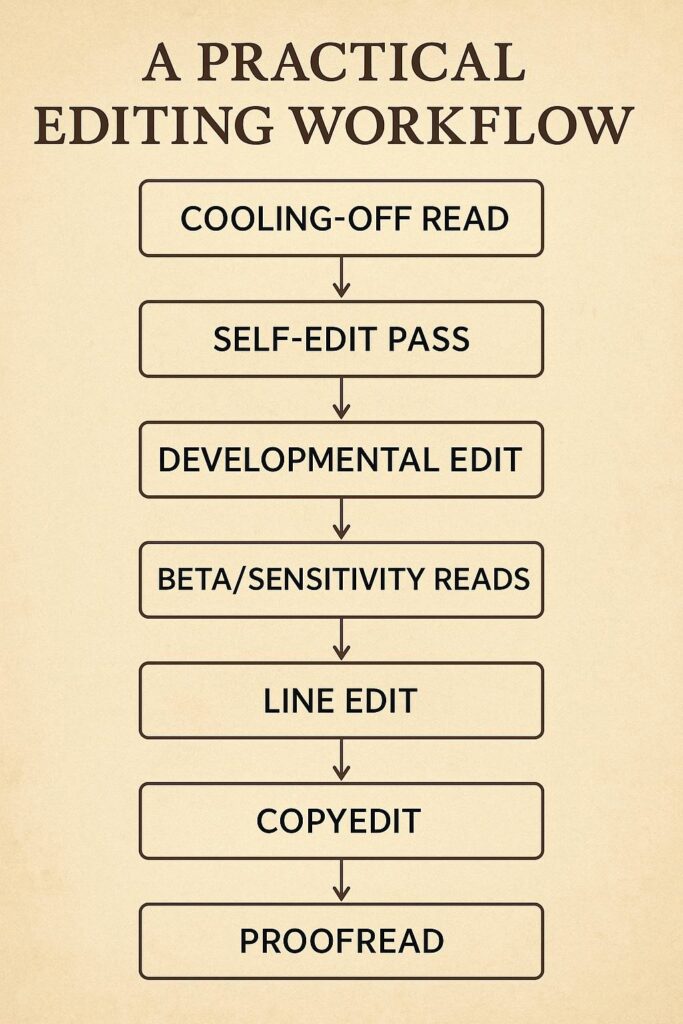
Notice how the major stages—Developmental Edit, Line Edit, Copyedit, Proofread—follow a similar macro-to-micro progression. Let's define these terms clearly, as they are often confused.
The Four Levels of Editing: A Professional Editor's Secret to ...
This article from Inkbot Editing gives precise, professional definitions for each stage of the editing process.
Read the sections that define each of the four levels: Level 1: Developmental Editing (your Story-Level pass). Level 2: Line Editing (your Page-Level pass). Level 3: Copyediting (this is a more technical pass). Level 4: Proofreading (the final quality control step). Focus on how each level addresses a different set of concerns and why their order is crucial.
To summarize the complete workflow:
- Developmental Editing (Structural Edit): The "foundation." This is your Story-Level pass, fixing plot, character, and structure. This must come first.
- Line Editing (Stylistic Edit): The "flow and voice." This is your Page-Level pass, focusing on the art of the prose.
- Copyediting: The "polish and correctness." This is a technical check for grammar, punctuation, spelling, and consistency (e.g., did a character's eye color change midway through the book?). While you can do a basic pass yourself, this is a specialized skill and is often performed by a professional.
- Proofreading: The "final check." This happens after the book has been designed and formatted for printing. The proofreader looks for typos and formatting errors (e.g., weird page breaks, missing page numbers) on the final PDF.
By understanding this entire process, you can plan your own work more effectively, knowing which tasks to focus on at which stage, and when you might need to seek outside help from beta readers or professional editors.
Conclusion
Revising a novel can seem like an insurmountable mountain, but with a systematic plan, it becomes a series of manageable hills. By starting with a cooling-off period and a high-level diagnosis, you create a clear vision. By adopting a "level-down" approach, you ensure you're solving the biggest problems first and not wasting effort on details that may change.
Key Takeaways:
- Cool Down and Diagnose: Always start by taking a break from your manuscript to gain objectivity. Then, "interview yourself" to create a revision guide based on your story's core goals.
- Revise from Macro to Micro: Structure your revision in distinct passes. Don't try to fix everything at once.
- The Three Levels of Self-Editing:
- Story-Level: Big-picture issues like plot, character arcs, and structure.
- Scene-Level: The effectiveness of individual scenes.
- Page-Level: The quality of the prose—word choice, rhythm, and style.
- Know the Workflow: Understand the difference between developmental editing, line editing, copyediting, and proofreading to plan your work and know when to seek help.
Exercise:
Imagine you've just finished the first draft of a story. Create a 'pre-revision' plan.
- How long would you let the manuscript 'cool off'?
- List the six diagnostic questions you would ask yourself to create your revision guide.
- Create a fictional 'revision to-do list' with 5 items (e.g., "The villain's motivation is weak," "The chase scene in Chapter 10 feels slow," "I use the word 'suddenly' too often"). For each item, categorize it as a Story-Level, Scene-Level, or Page-Level task.
This lesson has given you the map for your revision journey. In our next lesson, we will take the first, most important step on that path: performing a structural edit to identify and resolve plot holes, pacing issues, and inconsistent character arcs.