In our last lesson, we explored the concept of theme—the central argument or message that gives your story its soul. We learned how theme is born from the dynamic interplay between your character's internal journey and the external plot. Now, we will delve into the techniques you can use to weave that theme into the very fabric of your narrative, making it felt rather than just stated.
This lesson is dedicated to helping you use symbolism and motif to reinforce themes throughout a novel. These are the tools that allow you to communicate complex ideas and emotions with subtlety and power. Think of theme as the deep undercurrent of your story; symbols and motifs are the recurring ripples on the surface that hint at the power moving below.
Part 1: What is a Symbol?
At its most basic, a symbol is anything—an object, a color, a person, an action—that represents something more than its literal self. A wilting rose isn't just a dying flower; it can symbolize fading love or mortality. This is a foundational technique for "showing, not telling." Instead of telling the reader a kingdom is failing, you can show them its symbolic national animal, once majestic, now sick and struggling.
This short video from Reedsy provides an excellent introduction to how writers use symbols to express ideas through imagery and connect them to a story's central themes.
Using Symbolism in Your Writing
This video, "Using Symbolism in Your Writing," clearly explains the concept and its role in storytelling.
Watch from the beginning to this point. Pay close attention to the definition of symbolism as the pairing of a striking image with an idea, and the example of the horse representing a kingdom's prosperity.
As the video explains, symbols can be powerful because they can work on both an intellectual and an emotional level. They can be broadly understood (universal symbols) or gain their meaning specifically from the context of your story (contextual symbols).
To explore this further, let's turn to an article that breaks down these types of symbols.
What is Symbolism? A Writer's Guide to Using Symbols in Fiction
This article from The Novelry will help you understand the different categories of symbols you can use.
First, read the section "The role of symbolism in literature." It reinforces how symbols allow you to communicate complex ideas without explicit statements. Next, read the subsection "Types of symbols." Focus on the distinction between contextual symbols (like the green light in The Great Gatsby) and universal symbols (like a bird representing freedom).
For a concrete example you'll recognize, think of Harry Potter's scar. As the article "A Writer's Guide to Using Symbols in Fiction" later points out, the lightning-bolt scar is a brilliant symbol.
- Literally, it's a mark on his forehead.
- Symbolically, it represents his traumatic past, his unwanted connection to Voldemort, the source of his pain, and his unique destiny. It’s a physical manifestation of the story's central conflict.
Part 2: What is a Motif? (And How is it Different?)
This brings us to the closely related concept of a motif. The terms are often confused, but the distinction is crucial for a writer.
The simplest way to differentiate them is by frequency and function.
- A symbol can appear just once to make a point.
- A motif is a recurring element—an image, sound, action, or idea—that is woven throughout the story to reinforce a central theme.
This infographic provides a quick visual summary of the key differences.
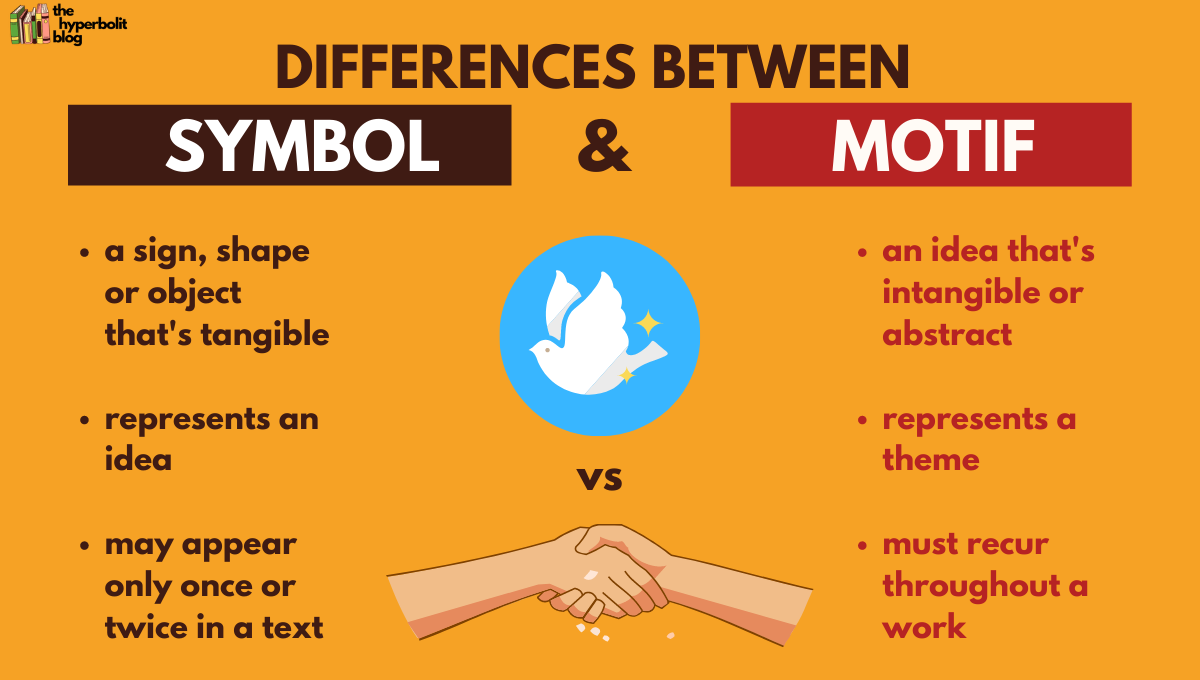
A recurring symbol can, and often does, become a motif. If Harry's scar were only mentioned once, it would be a symbol. Because it aches and bleeds and is referenced repeatedly at key moments, it functions as a motif, constantly reminding the reader of the themes of fate, connection, and the lingering presence of evil.
This short video explains the distinction very clearly.
How are symbol and motif different?
In "How are symbol and motif different?", the presenter uses Shakespeare's Macbeth to make the difference crystal clear.
Watch the section from this timestamp. The key takeaway is that a symbol can appear once or twice, but a motif must recur.
To solidify this, let's examine the relationship between theme, motif, and symbol more formally.
What Is a Motif? Motifs Defined + 10 Illuminating Examples
This Reedsy article provides excellent definitions and clarifies the hierarchy between these concepts.
Read the section "Motif vs. theme." It explains that a motif is a tool used to reinforce the theme. Next, read "Motif vs. symbol." This section shows how a specific symbol (the Valley of Ashes) can be part of a larger motif (wealth and finance) that points to a theme (the corruption of the American Dream).
Let's use an example from a genre you enjoy. In The Lord of the Rings:
- Theme: The struggle between good and evil.
- Motif: The recurring contrast between light and darkness.
- Symbols: The light of Galadriel's phial (hope), the darkness of Mordor (corruption), the fire of Mount Doom (destruction).
Notice how the repeated appearance of light and dark imagery (the motif) constantly reinforces the central theme.
Part 3: Weaving Symbols and Motifs into Your Story
Understanding these concepts is one thing; using them effectively is another. The goal is to be deliberate but subtle. You want your reader to feel the thematic weight of a symbol, not to be hit over the head with it.
Here is a practical, step-by-step approach to developing symbolism in your own writing.
What is Symbolism? A Writer's Guide to Using Symbols in Fiction
We'll return to this article for its excellent practical advice.
Read the entire section titled "Five ways to choose and create symbols in your writing." It provides a five-step process that is perfect for planning your work.
Let's summarize and expand on those five steps:
- Start with Your Theme: As we discussed in the last lesson, you should have a clear idea of your story's thematic question or "Truth." What is your story about? Freedom vs. control? Community vs. isolation? Once you know this, you can brainstorm images that connect to it.
- Use Everyday Objects: Some of the most powerful symbols are mundane. A locked door, a wilting plant, a ringing phone that no one answers. These can be charged with meaning within your story's context.
- Tie Symbols to Characters: Give a character a symbolic possession, a recurring mannerism, or even a piece of clothing that reflects their internal state. Maybe a character who feels trapped is constantly drawing birds in a cage.
- Create Recurring Symbolism (Develop a Motif): A symbol gains power through repetition. But don't just repeat it—develop it. How does the symbol change as the character and plot change? Let's revisit the conch shell from Lord of the Flies.
- Beginning: The conch is discovered, whole and beautiful. It symbolizes order, democracy, and hope.
- Midpoint: It begins to lose its power. The boys start ignoring it. It becomes a symbol of failing civilization.
- Climax: The conch is shattered. This is the moment civilization is completely destroyed, and savagery takes over. The symbol's destruction mirrors the thematic resolution.
- Be Subtle (Don't Explain): Trust your reader. A character should never say, "Ah, this broken mirror! It symbolizes my fractured psyche!" The power is in the unspoken connection. Show the character looking into a cracked mirror; the reader will make the connection.
Exercise: Brainstorming Your Thematic Toolkit
Let's apply these ideas to the thematic outline you created in the last lesson.
- Review the Truth and Lie that form the basis of your protagonist's arc.
- Brainstorm one central symbol that connects to this theme. It should be a tangible object, color, or image.
- Brainstorm one recurring motif (this could be a repeated action, a type of weather, a recurring sound, or your central symbol appearing again and again).
- In a few sentences, describe how your central symbol could appear or change at three key stages of the story to reflect the character's journey:
- The Beginning (when the character believes the Lie).
- The Midpoint (when the character is questioning the Lie).
- The Climax (when the character embraces the Truth).
This exercise will help you think not just about what to use, but how to use it dynamically across your narrative.
Conclusion
Symbols and motifs are the secret language of your story. They are the tools you use to communicate your theme without resorting to lectures, adding layers of meaning that enrich the reader's experience. They allow a story to resonate on a subconscious level, creating a more profound and lasting impact.
Key Takeaways:
- A symbol is a tangible thing representing an abstract idea.
- A motif is a recurring element (image, idea, phrase) that reinforces a theme.
- A symbol repeated throughout a story becomes a motif.
- The most effective symbols are developed over the course of the narrative, changing as the plot and characters evolve.
- Subtlety is key. Show the symbol; don't explain its meaning.
You have now learned how to construct a theme and how to reinforce it with symbols and motifs. The next step in our final module is to look at the big picture of the manuscript. Our next lesson will be on how to develop a systematic plan for revising a complete manuscript, from large-scale structure to line-level prose.