Welcome back. In our last two lessons, we explored two powerful models for understanding story: the foundational Three-Act Structure and the character-centric Hero's Journey. We've seen how these frameworks provide the blueprint for countless satisfying narratives, including action-driven stories like Harry Potter.
Today, we move from analysis to creation. This lesson is about translating those theoretical models into a practical tool you can use to build your own novel: the plot outline. Your goal is to construct a plot outline with rising action, a climactic sequence, and a satisfying resolution. An outline is your story's architectural plan. It ensures your narrative has a solid foundation, a compelling escalation of conflict, and a conclusion that feels both surprising and inevitable.
From Broad Strokes to a Solid Skeleton
Before we build, let's review the basic shape of a story. Most narratives follow a simple, intuitive arc of tension and release.
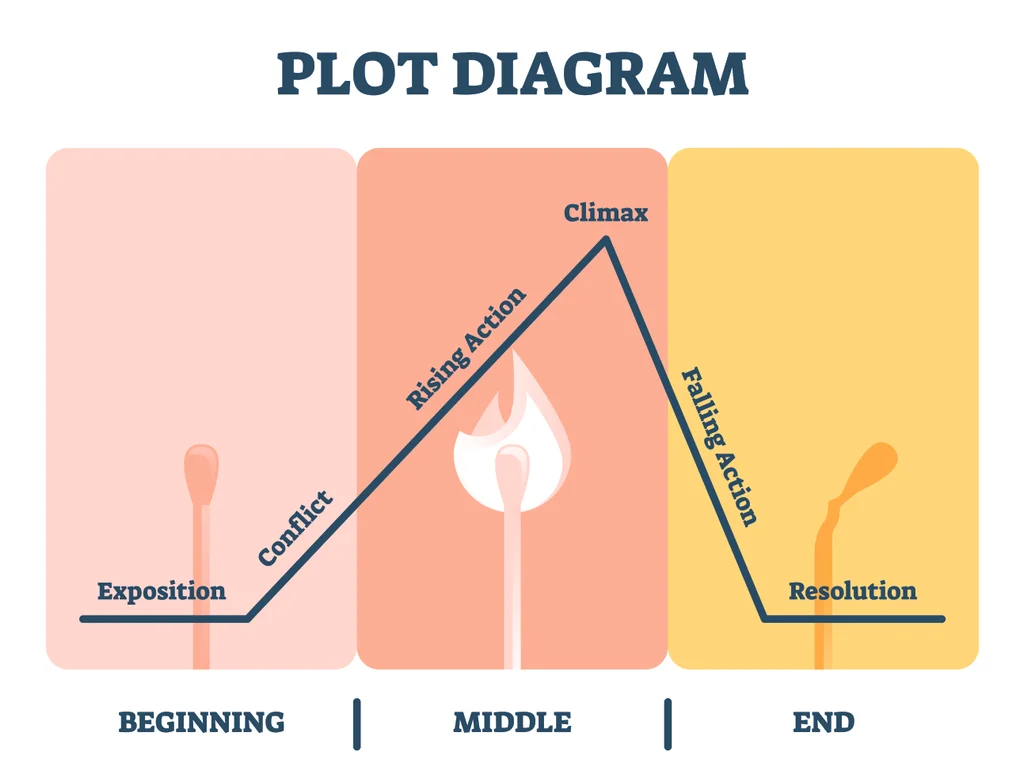
To start building our outline, we'll use this fundamental shape, known as the three-act structure, as our primary scaffold.
The ultimate guide to plotting a novel: A step-by-step approach - RB Kelly
This article by R.B. Kelly provides a concise refresher on the three acts.
Please read the first section, "Understanding narrative structure." Focus on the role and typical length of each act: Exposition (Setup), Rising Action (Confrontation), and Resolution.
As you just read, these three acts form the macro-structure of your story. The next step is to identify the key pillars that support this structure. These are the turning points, moments that pivot the narrative in a new direction.
Let's get a clear definition of what constitutes a turning point.
The 12% Rule of Story Structure
Writer and editor September C. Fawkes offers a precise definition of turning points and their function.
Read the introduction to this article, from the beginning down to the end of the paragraph that states the purpose of turning points. The railroad track analogy is particularly useful for visualizing how these moments shift the story's trajectory.
Finding the Rhythm: The 12% Rule of Thumb
Knowing you need turning points is one thing; knowing where to place them is another. This is where a rhythmic approach can be incredibly helpful. The "12% Rule" described in the same article by September C. Fawkes provides a fantastic guide for pacing your story's major events.
Think of it like a drumbeat that keeps the story moving forward at a compelling pace. It's a "rule of thumb," not an unbreakable law, giving you a reliable structure without stifling creativity.
Here are the key beats, which serve as the skeleton for your outline:
- ~12% Mark: The Inciting Incident. This is the first major shake-up, the call to adventure that disrupts the protagonist's ordinary world. We've discussed this as part of the Hero's Journey. In The Hunger Games, it's when Prim's name is called.
- ~25% Mark: Plot Point 1. This is the climax of Act I. The protagonist makes a definitive choice to engage with the plot, and there's no going back. In the Hero's Journey, this is "Crossing the Threshold." For Harry Potter, it's choosing to go with Hagrid to the Wizarding World.
- ~50% Mark: The Midpoint. A major revelation or event at the story's center that changes the protagonist's understanding of the conflict. They often shift from being reactive to proactive. In Star Wars: A New Hope, this is when the heroes are pulled into the Death Star and discover Leia is aboard, shifting their goal from delivery to rescue.
- ~75% Mark: Plot Point 2. This is the climax of Act II, often an "All is Lost" moment. The protagonist faces a major confrontation with the antagonist and suffers a significant setback or a costly, hollow victory. This defeat forces them to re-evaluate everything before the final showdown.
- ~90%+ Mark: The Climax. The final, decisive confrontation where the central conflict is resolved. This is Harry facing Voldemort for the stone, or Luke destroying the Death Star.
This structure inherently creates the rising action—the series of escalating challenges and turns that occur between Plot Point 1 (25%) and the Climax (90%).

To solidify your understanding of these key structural milestones, let's dive back into the article.
The 12% Rule of Story Structure
This article breaks down each of the major turning points with clear examples.
Read the descriptions for each of the main turning points we've discussed: The 12% Turn Plot Point 1 The Midpoint Plot Point 2 The Climax
Fleshing Out the Skeleton: The 3-Act, 9-Block Method
The 12% rule gives you a strong, five-point skeleton for your plot. But what happens in the spaces between these major turns? How do you fill out the 25% of the story that constitutes the rising action in the first half of Act II?
A highly effective, step-by-step method for this is the 3-Act, 9-Block, 27-Chapter approach, popularized by author Katytastic. This method breaks each of the three acts into its own "beginning, middle, and end," giving you nine manageable "blocks" to build your story.
HOW TO OUTLINE | 3 act 9 block 27 chapter example
This video introduces a granular method for outlining, breaking a novel down into nine distinct blocks.
First, watch the overview of the structure from the introduction of the three acts to the end of the word count discussion. Then, watch the high-level summary of all nine blocks, from the start of Block 1 to the end of the overview.
As you just saw, this method provides a logical flow for the entire narrative:
- Act I (Blocks 1-3): Moves from the introduction and Inciting Incident (Block 1) through the protagonist's reaction and resistance (Block 2) to the pressure that forces them into Plot Point 1 (end of Block 3).
- Act II (Blocks 4-6): Represents the rising action. The protagonist explores the new world (Block 4), builds toward the Midpoint (Block 5), and reacts to its consequences, leading to new trials (Block 6).
- Act II Continued (Blocks 7-8): Tension builds again (Block 7) towards the major setback of Plot Point 2 and the "dark night of the soul" (end of Block 7). The protagonist then finds new resolve (Block 8) to head into the finale.
- Act III (Block 9): Contains the Climax and Resolution.
This framework gives you a concrete structure for planning the rising action and ensuring each part of your story builds logically toward the next major turning point.
Your Turn: Constructing a Foundational Outline
Now it's time to put these tools into practice. A great outline starts not with plot, but with character and purpose. Before you map out events, you need to know who the story is about, what happens to them, and why it matters.
How to Write a Book from Start to Finish *BEGINNER FRIENDLY*
In this video, author Abbie Emmons introduces the "Who, What, Why" rule as the three pillars of a story.
Watch from the introduction of the rule to the end of the question prompts. These questions will help you clarify your core story idea before you start plotting.
Exercise: Build Your Outline
Take a story idea you have—it can be brand new or one you've been thinking about. Using a simple document or a notebook, answer the following questions. This will form the first draft of your plot outline.
-
The Core Idea (Who, What, Why):
- Who is your protagonist? What is their core misbelief about the world or themselves?
- What do they want, and what external goal will they pursue?
- Why does this story matter? What is the central theme or message?
-
The Skeleton (Based on the 12% Rule):
- Inciting Incident (~12%): What event happens that disrupts the protagonist's normal life and launches the story?
- Plot Point 1 (~25%): What irreversible choice does the protagonist make that locks them into the main conflict?
- Midpoint (~50%): What major revelation or event changes the game and shifts the protagonist's approach from reactive to proactive?
- Plot Point 2 (~75%): What is the "All is Lost" moment? Describe the major setback that makes their goal seem impossible.
-
The Finale (Climactic Sequence & Resolution):
- Climax (~90%): How does the protagonist use what they've learned (their new belief) to face the final antagonist or obstacle? What is the outcome?
- Resolution: What does the "new normal" look like after the climax? Briefly describe the final state of the protagonist and their world.
When thinking about your climax and resolution, remember this key advice: the solution must feel earned.
The ultimate guide to plotting a novel: A step-by-step approach - RB Kelly
This section gives crucial advice on crafting a satisfying ending.
Read the section titled "Creating a satisfying climax and resolution." Pay close attention to the warning against deus ex machina—using coincidence to get your character out of trouble.
Take your time with this exercise. Don't worry about getting it perfect. The goal is to create a simple, one-page roadmap that captures the essential journey of your story.
Conclusion
Today you've learned how to move from abstract story theory to the practical construction of a plot outline. By combining the broad shape of the three-act structure with the rhythmic pacing of the 12% rule and the granular detail of the 9-block method, you now have a powerful, step-by-step toolkit for plotting a compelling novel.
Key Takeaways:
- A plot outline is a roadmap built around key turning points that change the story's direction.
- The 12% Rule provides a reliable rhythm for placing your major plot points: the Inciting Incident (~12%), Plot Point 1 (~25%), the Midpoint (~50%), Plot Point 2 (~75%), and the Climax (~90%).
- This structure naturally builds the rising action, the escalating series of conflicts and revelations that form the bulk of your story.
- A satisfying resolution feels earned; the hero must solve their own problems without a coincidental rescue.
- An outline is a flexible guide, not a rigid prison. Its purpose is to give you creative freedom by providing a solid structure.
In our next lesson, we will enrich this main plot structure by learning how to design subplots that reinforce and enrich the main plot and theme. These secondary storylines add depth, complexity, and emotional resonance to your novel.