Welcome back! In our last session, we explored how subplots add layers and richness to a story, ensuring they are always connected to the protagonist's journey. We established that these subplots, like the main plot, are driven by their own goals and obstacles. Today, we delve into the heart of what makes any plot compelling: conflict.
This lesson is dedicated to defining and developing the main types of conflict, both internal and external. Conflict is the engine of fiction; it's the fundamental struggle that creates tension, raises stakes, and forces characters to act and change. By understanding its different forms and how they work together, you'll gain a crucial tool for building the kind of gripping, plot-heavy stories you enjoy.
The Engine of Fiction
Why is conflict so essential? A story where a character wants something and gets it immediately isn't much of a story at all. It lacks drama and suspense. The pleasure of reading comes from watching characters face challenges and struggle to overcome them.
Internal and External Conflict: The Engine of Fiction
To begin, watch this brief introduction from author Jerry B. Jenkins's video, "Internal and External Conflict." He explains with great clarity why conflict is the non-negotiable core of any engaging narrative.
Watch the opening section, from the start of the video until he says, "...boring readers is the cardinal sin of writing." Pay attention to his example of the happy marriage—a wonderful life, but a boring story.
As Jenkins argues, a lack of conflict is the primary reason a story can feel flat. It is the force that powers your plot and keeps the reader invested.
The Two Faces of Conflict: Internal and External
All story conflicts can be sorted into two primary categories.
- External Conflict: A struggle between a character and an outside force. This is the visible, tangible opposition in your story.
- Internal Conflict: A struggle within a character's own mind. This is a battle with their own conscience, fears, beliefs, or desires.
This next short video provides a quick, clear visualization of this fundamental distinction.
Types of Conflict in Literature
The video "Types of Conflict in Literature" by The ELA Connection offers a simple, animated overview of the main conflict types.
Watch from this point to understand the basic definition of conflict and the difference between internal (Man vs. Self) and external challenges. Note that the term "Man vs." is a traditional literary convention for "Character vs." and is inclusive of all characters.
A Closer Look at External Conflict
External conflict is the force your protagonist must physically confront. It creates the action and plot events of your story. The popular action and adventure stories you admire, like Harry Potter and the Young Samurai series, are built on powerful external conflicts.
There are several common types of external conflict, each offering a different kind of challenge.
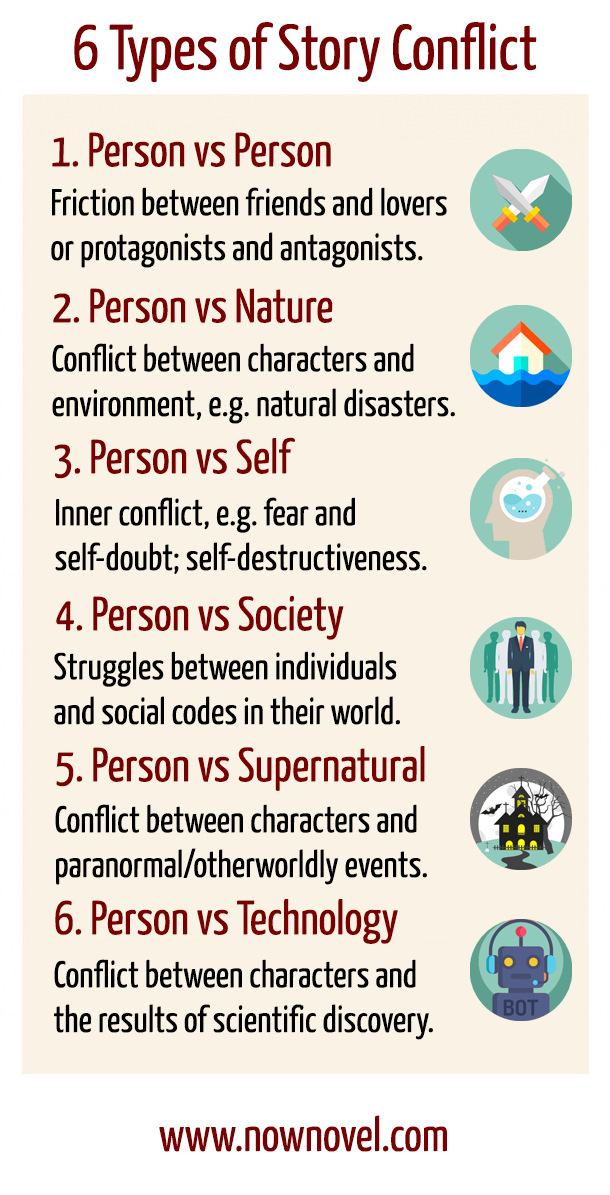
As you can see, beyond the classic "Person vs. Person" (like Harry Potter vs. Lord Voldemort), characters can face a variety of external threats:
- Person vs. Nature: A struggle for survival against the natural world, such as a storm, a wild animal, or a harsh environment. Think of Katniss Everdeen's fight for survival in the arena in The Hunger Games.
- Person vs. Society: A character's struggle against the laws, traditions, or beliefs of a group or government. This is the core conflict of many dystopian stories, including The Hunger Games.
- Person vs. Technology: A conflict against machines or artificial intelligence, common in science fiction. This could be a rebellious robot or a computer system gone rogue.
- Person vs. Supernatural: A battle against forces that defy scientific explanation, such as ghosts, gods, demons, or magic. This is a staple of the fantasy genre.
Essentially, external conflict is any obstacle outside your character's mind that stands between them and their goal.
The Power of Internal Conflict
If external conflict is the body of your story, internal conflict is its heart. It’s the psychological, emotional, or moral struggle that gives a character's journey depth and meaning. This is what makes us care about the outcome beyond just the action. A character who is wrestling with a difficult choice or a personal flaw is infinitely more relatable and complex.
The Reedsy article "Internal Conflict Explained" provides an excellent breakdown of this concept.
Internal Conflict Explained: Definition, Types, & Examples - Reedsy
First, let's establish a solid definition. This article clearly explains what internal conflict is and why it's so important for character development.
Please read the introduction and the section titled "What is internal conflict?"
As the article notes, internal conflict gives depth to the story by showing how external challenges impact a character personally. This inner struggle is what drives character development. To create it, you must give your character a difficult inner battle to fight.
The article goes on to classify internal conflict into five powerful types.
Internal Conflict Explained: Definition, Types, & Examples - Reedsy
Now, let's explore the different forms this inner struggle can take. Understanding these types will give you a toolbox for creating compelling character psychology.
Read the section "5 types and examples of internal conflict." Pay close attention to the examples provided for each type, especially the breakdown of Severus Snape, which illustrates "Contradictory Attributes" perfectly.
To summarize the key types you just read about:
- Moral Choice: The character faces a dilemma where no option is clearly right, forcing them to navigate ethical gray areas.
- Life Decision: The character is at a crossroads, and their choice will fundamentally alter their future.
- Personal Fear: The character must confront a deep-seated fear or phobia to achieve their goal.
- Limiting Belief: The character is held back by a false, negative belief about themselves or the world.
- Contradictory Attributes: The character has opposing traits (e.g., cruelty and devotion, courage and cowardice) that are in constant tension. This is a fantastic way to create complex, unpredictable characters like Snape.
Weaving It All Together: The Magic Formula
The most powerful stories don't just have external and internal conflict; they link them. The external conflict forces the protagonist to confront their internal conflict. To achieve their outer goal, they must first overcome their inner flaw.
This next article uses the movie Legally Blonde to walk through a simple, brilliant series of questions that help you build this link.
How to Create Conflict in a Story (with 6 Simple Questions)
This article provides a character-led process for developing integrated conflict.
Read through the sections for Question 1 (The Goal), Question 2 (The Obstacle), and Question 4 (The Internal Change). Notice how the first two questions establish the external conflict, while the fourth question introduces the necessary internal one.
The external plot should act as a crucible, a trial by fire that tests the character's internal weakness. By the end, they either overcome that weakness and succeed, or they fail to overcome it and are defeated. This is the essence of a character arc.
Jerry Jenkins powerfully reinforces this idea, explaining how to challenge your characters and make their internal struggles as dire as their external ones.
Internal and External Conflict: The Engine of Fiction
Let's return to Jerry Jenkins's video to see how to intertwine these two conflict types to create maximum impact and drive character transformation.
Watch the section from this point, where he explains how a character's internal state makes an external problem even more critical. Then, continue watching the crucial section on character arcs and transformation, where he advises you to "challenge your hero at every turn" and expose their flaws.
Exercise: Design a Conflict Scenario
Now it's your turn to be the architect of a compelling struggle. Take one of your story ideas (or invent a new one for this exercise) and develop a conflict scenario in your notebook. Follow these four steps.
- The Goal: What does your protagonist want more than anything? Make it something concrete and external (e.g., "to find a lost artifact," "to win the space race," "to protect their family from a threat").
- The External Conflict: What or who is the primary obstacle standing in their way? Define its type (Person vs. Person, Person vs. Society, etc.). What makes this force a difficult opponent?
- The Internal Conflict: What is your protagonist's key flaw, fear, or limiting belief? What inner demon are they wrestling with? Define its type (Moral Dilemma, Personal Fear, etc.). This should be the very thing that makes this specific external conflict especially hard for them.
- The Connection: In a few sentences, explain how the external conflict will force your character to confront their internal conflict. How must they change internally to overcome the external obstacle? What are the stakes if they fail—both externally and internally?
Example:
- Goal: A rookie detective wants to solve her first major case to prove she belongs.
- External Conflict (Person vs. Person): She is hunting a brilliant, manipulative serial killer who leaves cryptic riddles at crime scenes.
- Internal Conflict (Limiting Belief): The detective secretly believes she isn't smart enough and got her job through luck. She has a deep-seated fear of being exposed as an impostor.
- Connection: The killer's riddles directly attack her insecurity, making her doubt her own intellect. To catch him, she can't just be a good detective; she must overcome her impostor syndrome and learn to trust her own mind, even when the killer is trying to convince her she's a fool.
Take about 15 minutes for this exercise. The goal is to build a scenario where the plot and character journey are fundamentally intertwined.
Conclusion
Today we've established that conflict is the lifeblood of your story. It's not just about fights and chases; it's about a fundamental opposition between what a character wants and what stands in their way.
Key Takeaways:
- Conflict is the engine of fiction, creating the tension and stakes that keep readers engaged.
- External conflict is the struggle against an outside force (another person, nature, society). It drives the plot.
- Internal conflict is the struggle within a character's own mind (fear, flaws, morality). It drives character development and emotional depth.
- The most compelling stories tightly link these two types: the external journey forces the character to undergo an internal transformation.
You've now learned how to outline a plot, enrich it with subplots, and power it with conflict. In our next lesson, we will build directly on this foundation. We will map a character's internal transformation across the key beats of a story's plot, connecting the internal conflict you designed today to the plot structure you built earlier.