Welcome to the second lesson in our journey through the history of tea.
In our last lesson, we explored tea's origins in ancient China and saw how it became a sophisticated cultural practice during the Tang Dynasty, centered on preparing powdered tea from compressed cakes. Today, we leap forward to the Ming Dynasty (1368–1644) to examine a series of revolutionary changes that transformed tea into a global commodity. We will explore how new processing methods made tea suitable for long-distance sea travel, paving the way for its spread to Europe and the Americas.
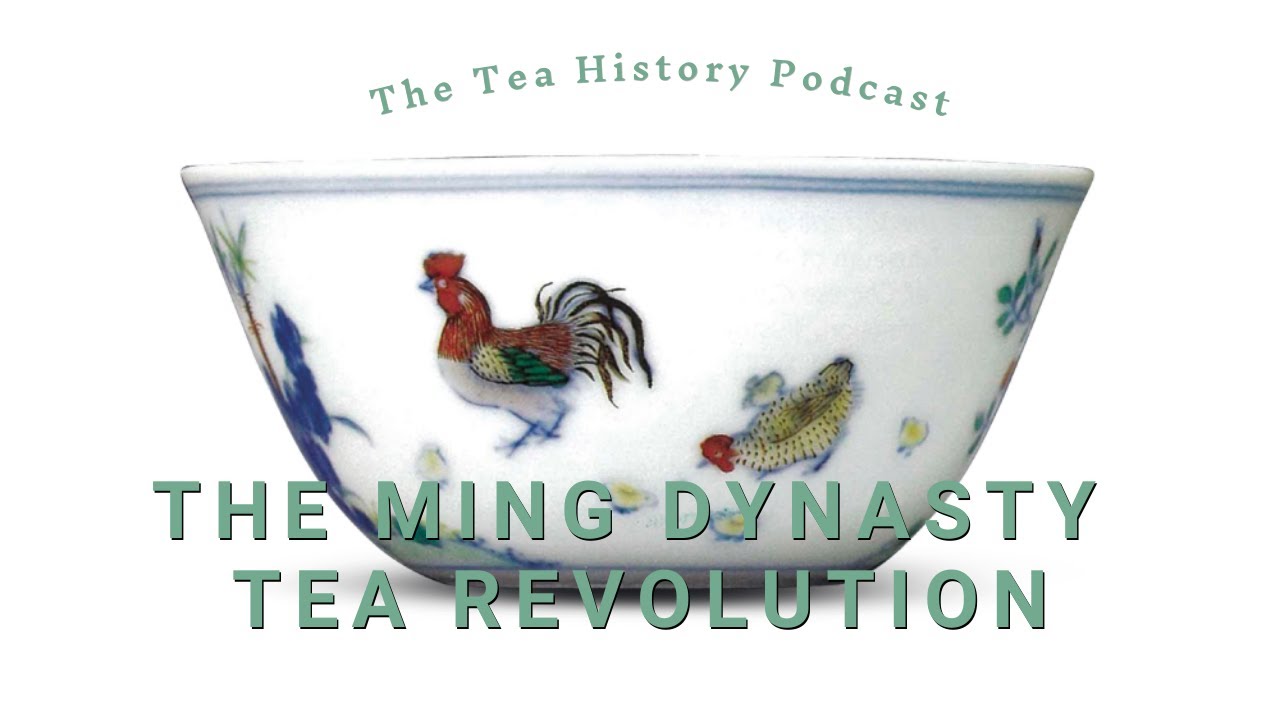
The Ming Dynasty Tea Revolution
The refined, ritualistic preparation of powdered tea that characterized the Tang and Song dynasties underwent a dramatic simplification during the Ming Dynasty. This wasn't just a change in taste; it was a fundamental shift in production and consumption that would have global consequences.
From Bricks to Loose Leaves
The first major change was an official one. In 1391, the Hongwu Emperor, founder of the Ming Dynasty, issued a decree that abolished the production of compressed tea bricks or cakes for the imperial court.

To understand the emperor's motivations and the impact of this change, please read the following sections from the Wikipedia article on "Chinese tea culture."
This article explains the imperial decree that initiated the shift to loose-leaf tea and how this simplified the entire process of tea consumption.
Please read the section 'Ming era', which begins with the Hongwu Emperor's decree. Then, scroll down to the subsection 'Ming dynasty tea brewing method'. Focus on why the emperor made this change and how it made tea culture more accessible.
As you read, the emperor's reasons were twofold:
- Practical: Making tea cakes was "overtaxing the people's strength." Shifting to loose-leaf tea eased the burden on farmers.
- Philosophical: The emperor, and later his son, believed that brewing loose leaves preserved the true, natural flavor of the tea, which was lost in the complex processing of cakes.
This shift naturally led to new, simpler brewing methods and new kinds of teaware, like teapots and small cups, which are very similar to those we use today. This simplified approach was, as the article notes, "more conducive to the spread of tea culture."
The Key to Global Trade: Oxidation
While the move to loose-leaf tea was significant within China, another, more subtle innovation was the true key that unlocked tea's global potential: oxidation.
Up until the mid-17th century, most tea in China was green tea. Green tea is "fixed"—heated shortly after picking (by steaming or wok-roasting)—to prevent the leaves from oxidizing, thus preserving their green color and fresh flavor. However, green tea is delicate and does not travel well, especially on long, damp sea voyages.
Chinese tea producers, driven by the demands of new foreign trade, discovered that allowing the tea leaves to wither and oxidize before drying them fundamentally changed their properties.
To understand this crucial development, please read the following brief article and watch the short video clip.
Etiquette and Empire: The Story of Tea
The article 'Etiquette and Empire: The Story of Tea' from History Hit explicitly connects the development of black tea to the needs of foreign trade.
Read the subsection 'Tea varieties and production methods evolved'. Pay close attention to the reason given for the development of black tea.
Global Tea HISTORY: Ancient Origins to Today's Tea RENAISSANCE | Tea Masterclass Ch. 7
This clip from Wu Mountain Tea's 'Global Tea HISTORY' video summarizes the key innovations of the Ming period, including the development of new tea types.
Watch the clip from 12:03 to 13:11. It highlights the emergence of oolong and black teas and the use of whole leaves, which would have been what Europeans first encountered.
The process began with oolong tea, a partially oxidized tea developed by monks in the Wuyi Mountains. As European traders began seeking more of this new, fragrant tea, producers learned to let the oxidation process continue fully, resulting in black tea.
The key takeaway is that oxidized black tea was far more robust. It could be stored for longer periods and, most importantly, could withstand the months-long journey from China to Europe, retaining its flavor and quality. This technological innovation in processing transformed tea from a perishable good into a durable, long-distance commodity.
Test your understanding!
Why was the development of black tea, through oxidation, more significant for facilitating global trade than the initial switch to loose-leaf green tea?
Show answer
While switching to loose-leaf tea made production easier and brewing simpler, it was the oxidation process that created black tea. Black tea's robust chemical nature allowed it to survive the long, humid sea voyages to Europe without spoiling or losing its flavor, unlike the more delicate green teas. This durability is what made tea a viable and profitable commodity for long-distance maritime trade.
Tea Spreads West
With a stable product ready for export, tea began its journey to the West. The stage was set for tea to conquer a new continent.
Portuguese and Dutch traders were the first to bring tea to Europe in the early 1600s, where it was initially treated as an exotic novelty. Its ascent into a cultural staple, particularly in Britain, was famously spurred by royalty.
The following video segment tells this story, explaining how tea went from a curiosity to a craze that swept through European society and eventually crossed the Atlantic to the Americas.
Global Tea HISTORY: Ancient Origins to Today's Tea RENAISSANCE | Tea Masterclass Ch. 7
This segment of the 'Global Tea HISTORY' video vividly narrates tea's arrival in Europe and its rapid popularization.
Please watch from 13:11 to 15:38. Focus on the key figures and social dynamics that drove tea's popularity in England and its subsequent spread to the American colonies.
As the video details, the spread of tea followed a clear pattern:
- Introduction: Portuguese and Dutch traders bring tea to Europe from China.
- Royal Endorsement: The Portuguese princess, Catherine of Braganza, marries King Charles II of England in 1662 and makes tea the fashionable drink at court.
- Social Diffusion: The trend trickles down from the aristocracy to the upper-middle class, and then to all levels of society.
- Commercial Expansion: As demand skyrockets, trading companies establish robust sea routes to China to ensure a steady supply.
- Arrival in the Americas: By the 1700s, this trade extends to the North American colonies, where tea houses begin to appear in cities like New York and Philadelphia.
The combination of a new, durable product (black tea) and a simple, accessible brewing method (steeping loose leaves) created the perfect conditions for tea to become a beloved beverage worldwide.
Conclusion
In this lesson, we have seen how a confluence of factors during the Ming Dynasty set tea on its path to global prominence.
Key Takeaways:
- An imperial decree in Ming China shifted tea production from compressed cakes to loose-leaf tea, simplifying its production and preparation.
- The invention of oxidation created oolong and, crucially, black teas. Black tea's durability made it the first tea that could survive long sea voyages, making it a viable export.
- Portuguese and Dutch traders introduced tea to Europe, but it was Catherine of Braganza who popularized it in the influential English court.
- Demand for tea spread throughout European society and to the American colonies, supported by newly established global trade routes.
The stage is now set. Britain's demand for tea has become immense, and a global trade network has been built around it. In our final lesson, we will examine the dark side of this trade and explore how tea's popularity directly fueled some of the most pivotal events in modern history, including the Boston Tea Party and the Opium Wars.