Welcome to the final lesson of our course on the history of tea.
In our previous lessons, we traced tea's journey from its origins in ancient China to its transformation into a global commodity during the Ming Dynasty. We saw how the development of black tea made long-distance trade possible, leading to an explosion in demand, especially in Britain. This insatiable appetite for tea set the stage for profound global conflicts.
Today, we will examine how this seemingly simple beverage became a catalyst for war and revolution. We will focus on two pivotal historical events where tea played a central role: the Opium Wars between Britain and China, and the Boston Tea Party in the American colonies. By the end of this lesson, you will be able to summarize the complex economic and political forces that turned a cup of tea into a motive for conflict.
The Opium Wars: A Trade Imbalance Boils Over
By the early 19th century, Britain was importing tea from China on a colossal scale. The problem was that this was a one-way trade. China, being a largely self-sufficient empire, had little interest in British goods and demanded payment in silver. This created a severe trade deficit that was draining Britain's wealth.
Something had to be done to balance the books. The solution, devised by the powerful British East India Company, was as cynical as it was effective: opium.
To understand how this strategy unfolded and its devastating consequences, please watch the following video. It clearly explains the economic desperation that drove Britain to create what was essentially a state-sponsored drug cartel.
This segment from 'The Violent History of Tea' by Big Systems explains the trade imbalance Britain faced with China and the creation of the opium trade triangle as a 'solution'.
Watch from 00:57 to 09:38. Focus on why Britain had a trade deficit with China and how the East India Company used its power in India to cultivate and smuggle opium into China to reverse this flow of silver.
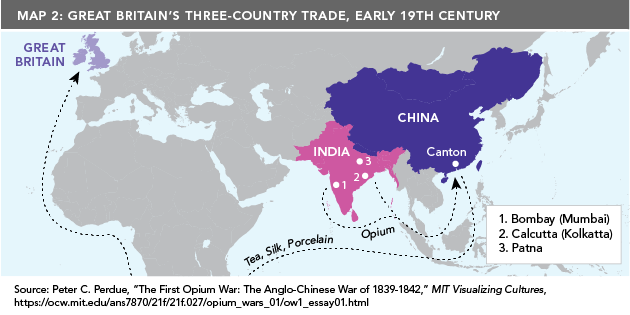
As the video explains, the East India Company established a triangular trade route:
- British goods were sold in India.
- The company used its control over Bengal, India, to force local farmers to grow opium poppies.
- This opium was then smuggled into China, where it was sold for silver.
- The silver, now "laundered," was used to legally purchase tea from Chinese merchants in Canton (modern-day Guangzhou).
The social cost in China was catastrophic. Opium addiction became rampant, debilitating large segments of the population and causing a massive outflow of silver, which crippled the Chinese economy.
China Fights Back
In 1839, the Daoguang Emperor appointed a high-ranking official, Lin Zexu, to eradicate the opium trade. Lin was determined and incorruptible. He confiscated and destroyed vast quantities of opium belonging to British traders. This decisive action, however, would lead directly to war.
The next segment of the video details China's attempt to stop the trade and Britain's aggressive military response.
This part of 'The Violent History of Tea' covers Commissioner Lin Zexu's actions to stop the opium trade and Britain's justification for starting the First Opium War.
Please watch from 09:38 to 13:40. Note Lin Zexu's appeal to Queen Victoria and the shocking rationale Britain used to declare war.
Britain, claiming its traders had been wronged and its property destroyed, declared war. This was "gunboat diplomacy" in its most blatant form. Britain's superior naval technology and modern weaponry quickly overwhelmed China's outdated forces. The First Opium War (1839–1842) was a humiliating defeat for China.
The resulting Treaty of Nanking was the first of many "unequal treaties." China was forced to:
- Cede the island of Hong Kong to Britain.
- Open five "treaty ports" to foreign trade.
- Pay a large indemnity (reparations) to Britain for the destroyed opium and the cost of the war.
The opium trade continued, and the war marked the beginning of what is known in China as the "Century of Humiliation"—a long period of foreign intervention and colonial domination.
Test your understanding!
In the context of the Opium Wars, was tea the cause of the conflict or a motive behind Britain's actions? Explain your reasoning.
Show answer
Tea was the primary motive. The direct cause of the war was Britain's illegal opium trade and China's attempt to stop it. However, the entire reason Britain engaged in the opium trade was to finance its immense and unsustainable demand for tea. Without this national obsession with tea, the economic pressure that led Britain to push opium on China would not have existed on such a scale.
The Boston Tea Party: A Tempest in a Teapot
Across the Atlantic, tea was also stirring up trouble. By the mid-18th century, tea was a beloved beverage in Britain's North American colonies. However, the colonies' relationship with the mother country was becoming strained over the issue of taxation.
The British government, deeply in debt from the French and Indian War, believed the colonies should help pay for their own defense. Parliament passed a series of taxes on imported goods, including the Townshend Acts, which levied a duty on tea. For the colonists, the issue was not the cost, but the principle: "no taxation without representation." They argued that since they had no elected representatives in the British Parliament, Parliament had no right to tax them.
To understand how this dispute over a tea tax escalated into a revolutionary act, please watch the following video from the HISTORY channel.
What Was the Tea Act of 1773? | History
This video, 'What Was the Tea Act of 1773?', clearly explains the economic and political background that led to the Boston Tea Party.
Watch the entire video (around 3.5 minutes). It will walk you through the Tea Act, the colonists' angry reaction, the Tea Party itself, and Britain's punitive response.
As the video explains, the situation came to a head with the Tea Act of 1773. This act was not a new tax. Instead, it was a bailout for the financially troubled British East India Company. It gave the company a monopoly on the American tea trade, allowing it to bypass colonial merchants and sell tea directly to consumers at a price lower than even that of smuggled tea.
Colonists were furious.
- Merchants were angry because the act would put them out of business.
- Patriots were angry because they saw it as a Trojan horse—a sly attempt to make colonists accept Parliament's right to tax them by enticing them with cheap tea.
On the night of December 16, 1773, a group of colonists known as the Sons of Liberty, disguised as Native Americans, boarded three East India Company ships in Boston Harbor and dumped 342 chests of tea into the water. This event became known as the Boston Tea Party.
Britain's response was swift and harsh. Parliament passed a series of punitive measures known as the Intolerable Acts, which included closing Boston Harbor to all trade. Rather than isolating Boston, these acts united the colonies in opposition to British rule, setting them on the path to the American Revolutionary War.

Conclusion
In this final lesson, we've seen the powerful and often destructive role tea played on the world stage. What began as a simple beverage became an engine of global economics and a flashpoint for conflict.
Key Takeaways:
- Britain's insatiable demand for Chinese tea led to a massive trade deficit, which it sought to correct by illegally trafficking opium from India into China.
- China's attempt to halt the drug trade resulted in the Opium Wars, a humiliating defeat that forced China to cede territory, pay reparations, and marked the beginning of a "Century of Humiliation."
- In North America, British attempts to tax tea and control its trade through the Tea Act of 1773 were seen as an infringement on colonial rights.
- The colonists' protest, the Boston Tea Party, prompted a harsh British retaliation that united the colonies and led directly to the American Revolution.
Over these three lessons, we have journeyed from the legendary discovery of tea in ancient China, to the innovations that allowed it to circle the globe, and finally, to its role as a catalyst in two major conflicts that reshaped the modern world. The history of tea is a perfect example of how an everyday object can be deeply entangled with the grand forces of culture, economics, and politics.