Welcome back! In our previous lesson, we established a solid foundation in vector calculus, exploring the physical interpretations of the gradient, divergence, and curl. You learned how these operators describe the local behavior of physical fields, such as their sources, sinks, and rotational properties.
Now, we'll put that mathematical language to work. This lesson moves from the abstract language of vector operators to the concrete physical laws they describe. Our goal is to state Maxwell's equations in their differential form and understand the physical meaning of each one. These four equations are the cornerstone of classical electromagnetism and are absolutely fundamental to your project, as they govern the behavior of the electromagnetic waves used in radar.
The Architecture of Electromagnetism
James Clerk Maxwell's great achievement was not in inventing all four equations from scratch, but in unifying the existing laws of electricity and magnetism, correcting one, and combining them into a single, comprehensive theory. These equations, expressed using divergence and curl, provide a complete description of how electric () and magnetic () fields are generated and how they interact with each other, with electric charges, and with currents.
The image below presents the four equations in their differential form, each paired with a diagram that hints at its physical meaning. We will be dissecting each one in detail.
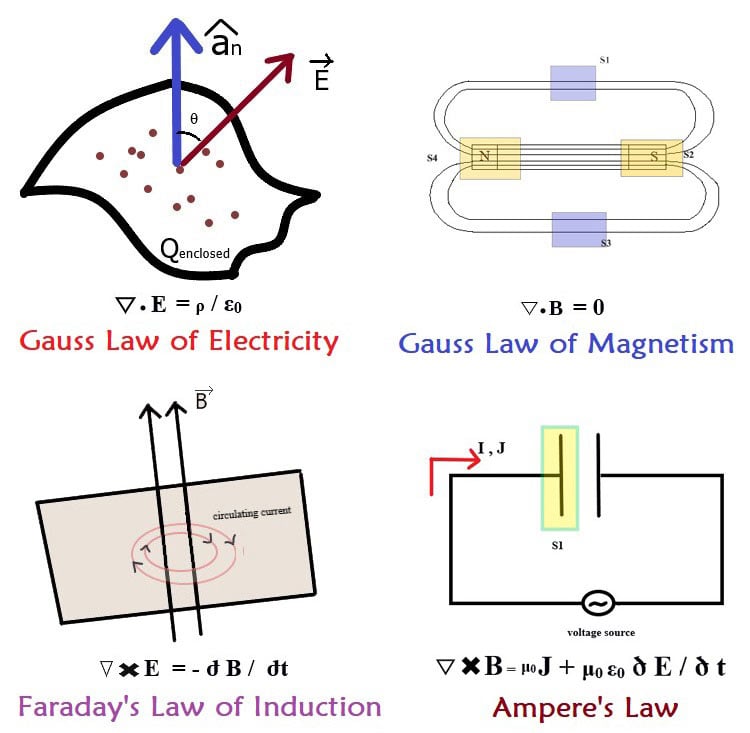
To begin, let's get a high-level overview of what each equation represents.
A Plain Explanation of Maxwell's Equations
This article from Fosco Connect provides a very clear and straightforward introduction to the physical meaning behind each of Maxwell's equations.
Please read the introductory section, Physical Meanings. This will give you a brief, non-mathematical summary of the role each equation plays in the grand scheme of electromagnetism.
With that overview in mind, let's now dive into the mathematical form and physical significance of each equation one by one. The following video offers an excellent, intuitive walkthrough of how the differential forms arise from more familiar integral concepts, reinforcing the meaning of divergence and curl. We will watch it in segments as we discuss each equation.
The 4 Maxwell Equations. Get the Deepest Intuition!
This video, "The 4 Maxwell Equations. Get the Deepest Intuition!" by the channel Alexander, is exceptional at building a conceptual understanding. We'll start by reviewing the core concepts of E and B fields and the mathematical tools we'll be using.
First, watch the introduction to the E and B fields to solidify these foundational concepts. Then, watch the explanation of the integral and differential forms, which provides a fantastic refresher on the divergence and curl theorems. This context is crucial for what follows.
1. Gauss's Law for Electric Fields
Equation:
Here, is the electric displacement field, which is related to the electric field by , where is the permittivity of the material. In a vacuum, this is . The symbol represents the electric charge density.
Physical Meaning: This equation tells us that electric charges are the sources and sinks of the electric field.
- The divergence of the electric field at a point is directly proportional to the amount of electric charge at that point.
- Where you have positive charge (), you have a positive divergence, meaning electric field lines "diverge" or originate from that point. It is a source.
- Where you have negative charge (), you have a negative divergence, meaning electric field lines "converge" or terminate at that point. It is a sink.
This is the mathematical embodiment of the "source" concept we discussed in the last lesson.
A Plain Explanation of Maxwell's Equations
Let's now read the detailed explanation for the first equation from the same article.
Read the section titled "Gauss's Law for Static Electric Field". Focus on how divergence relates to charge volume density.
The 4 Maxwell Equations. Get the Deepest Intuition!
Now, watch the segment from the video that explains the first Maxwell equation.
Watch the section explaining Gauss's Law for electricity. Pay close attention to how the divergence of E is linked to the charge density \rho.
2. Gauss's Law for Magnetic Fields
Equation:
Physical Meaning: This equation is a concise statement that there are no magnetic monopoles.
- The divergence of the magnetic field is always zero, everywhere.
- This means there are no "sources" or "sinks" for the magnetic field. Magnetic field lines never start or end at a point; they always form continuous, closed loops. If you follow a magnetic field line, you will always end up back where you started.
A Plain Explanation of Maxwell's Equations
The explanation for the second law is quite direct.
Read the short section titled "Gauss's Law for Static Magnetic Fields".
The 4 Maxwell Equations. Get the Deepest Intuition!
The video provides a clear analogy for the absence of magnetic monopoles.
Watch the segment on the second Maxwell equation. It clearly explains why the divergence of the B-field is zero.
3. Faraday's Law of Induction
Equation:
Physical Meaning: A changing magnetic field creates a circulating electric field.
- The curl of the electric field at a point is proportional to the rate of change of the magnetic field at that same point.
- If the magnetic field is static (), the curl of the electric field is zero. This corresponds to the simple electrostatic fields created by charges, which do not circulate.
- However, if the magnetic field is changing in time, it induces an electric field that has a non-zero curl—it swirls or circulates. This is the principle behind electric generators and transformers.
A Plain Explanation of Maxwell's Equations
This law introduces the beautiful interplay between E and B fields.
Read the section titled "Faraday's Law of Induction". Focus on the distinction between charge-based fields (zero curl) and induced fields (non-zero curl).
The 4 Maxwell Equations. Get the Deepest Intuition!
This part of the video explains how a changing magnetic flux leads to a curling electric field.
Watch the explanation of the third Maxwell equation.
4. Ampere-Maxwell Law
Equation:
Here, is the magnetic field intensity, related to by (where is the magnetic permeability). is the electric current density (the flow of charge).
Physical Meaning: A circulating magnetic field is produced by two phenomena:
- An electric current (). This was Ampere's original law. A steady current flowing through a wire creates a circulating magnetic field around it.
- A time-varying electric field (). This was Maxwell's crucial addition, which he called the "displacement current." This term means that even in a vacuum with no moving charges, a changing electric field can create a circulating magnetic field.
This second term is the key that unlocks the door to electromagnetic waves. It means a changing E-field can create a B-field, which, by Faraday's Law, can in turn create an E-field, and so on.
A Plain Explanation of Maxwell's Equations
This is the final piece of the puzzle, and arguably the most important for our goal.
Read the section on the "Ampere-Maxwell's Law". Pay special attention to the explanation of the Displacement Current Density, as this was Maxwell's groundbreaking contribution.
The 4 Maxwell Equations. Get the Deepest Intuition!
The video explains both sources of the magnetic field curl.
Watch the segment covering the fourth Maxwell equation.
Summary of Maxwell's Equations
You have now examined all four of Maxwell's equations in their differential form. They provide a complete, local description of the behavior of electromagnetic fields. Let's look at them all together in one place.
Maxwell's Equations in Differential Form, and Uniform ...
This PDF provides a formal, textbook-level summary of the equations we've just discussed.
Please review the "SUMMARY" section of the document, starting on page 191. Read from the beginning of the summary down to the list of the four equations in mathematical form. This serves as a concise and formal consolidation of today's learning outcome.
Conclusion
In this lesson, you have used the vector calculus operators from our previous session to state and understand the four fundamental laws of electromagnetism. These local, point-by-point rules govern the entire universe of classical electric and magnetic phenomena.
Here are the key takeaways:
- Gauss's Law for (): Electric charges create diverging electric fields.
- Gauss's Law for (): There are no magnetic monopoles, so magnetic fields never diverge.
- Faraday's Law (): A changing magnetic field induces a curling (circulating) electric field.
- Ampere-Maxwell Law (): Electric currents and changing electric fields create a curling (circulating) magnetic field.
The true predictive power of these equations becomes apparent when they are combined. The symmetric nature of Faraday's Law and the Ampere-Maxwell Law—where a changing creates an , and a changing creates a —is what gives rise to self-sustaining electromagnetic waves. In our next lesson, we will mathematically combine these equations to derive the wave equation, proving that light and radar signals are simply traveling disturbances in the electromagnetic field.