Welcome to the first lesson of our deep dive into the Clang frontend. In the previous module, we mastered the complete workflow for contributing to LLVM, from finding a bug to submitting a fix. Now, we shift our focus from the how of contributing to the what—the internal architecture of the compiler itself. This knowledge is what separates a good contributor from a great one, as it allows you to understand the root cause of bugs, not just the symptoms.
Our goal in this lesson is to identify the distinct roles of the Lexer, Preprocessor, Parser, and Sema in Clang. These four components work in a sequential pipeline to transform your raw C++ source code from a simple string of text into a structured, meaningful representation that the compiler can analyze and optimize. Understanding this initial transformation is the foundation for navigating and debugging almost any issue in the Clang frontend.
From Source Code to Intermediate Representation
Before a compiler can optimize code or generate machine instructions, it must first understand the source program. This process of understanding is handled by the frontend. In a modern compiler like Clang, the frontend is responsible for everything from reading the text file to producing an intermediate representation (IR) that the middle-end optimizer can work with.
The frontend's job can be broken down into a series of distinct phases.
Inside a Compiler: Source Code to Assembly | CompilerSutra
The article "Inside a Compiler" on CompilerSutra provides a classic overview of the compiler's architectural stages. This will help frame our discussion of Clang's components.
First, read the brief overview that defines the responsibilities of the frontend, middle-end, and backend. Then, jump to the conclusion and read the summary of the Front-End stage, which lists the specific analyses we'll cover in this lesson.
As the article highlights, the frontend's journey involves lexical, syntax, and semantic analysis. In Clang, these responsibilities are handled by a pipeline of components. We'll now explore each one.
The Clang Frontend Pipeline
Let's begin with a high-level overview of the entire process. The following video from an LLVM Developers' Meeting gives a concise tour of the Clang frontend.
2019 LLVM Developers’ Meeting: S. Haastregt & A. Stulova “An overview of Clang ”
This video, "An overview of Clang," provides an excellent introduction directly from developers who work on the project. We'll watch it in segments as we discuss each component.
For now, watch the introductory segment from Clang driver vs. frontend. This section distinguishes between Clang as a tool that drives the whole compilation process (clang) and the frontend component (clang -cc1) that we are interested in. It also shows the classic compilation pipeline that these tools execute.
The video introduces the key stages: Preprocessing, Compiling (Frontend), Backend, Assembling, and Linking. Our focus is squarely on the "Compiling" part, which itself consists of several sub-stages.
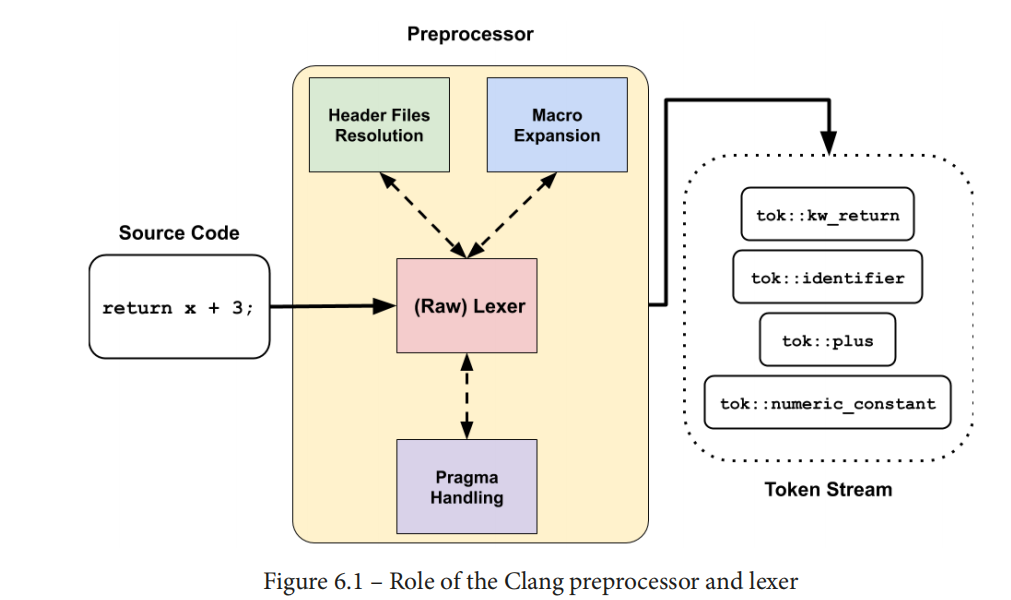
Phase 1: Preprocessing and Lexical Analysis
The first step in understanding source code is to break it down into its fundamental units, or tokens. This is the combined responsibility of the Preprocessor and the Lexer.
-
The Preprocessor: You're likely familiar with C preprocessor directives like
#include <vector>or#define PI 3.14159. The preprocessor's job is purely textual: it processes these directives, pastes in header files, expands macros, and handles conditional compilation (#ifdef). The result is a single, often massive, stream of source code called a translation unit. -
The Lexer (or Scanner): The lexer takes this translation unit—a simple stream of characters—and converts it into a stream of tokens. A token is a categorized piece of the source code. For example, the character sequence
returnbecomes a token of typetok::kw_return, the sequencemy_varbecomestok::identifier, and+becomestok::plus.
In Clang, the preprocessor and lexer are tightly integrated for performance. Instead of the preprocessor writing a huge temporary file for the lexer to read, the lexer pulls characters from the source files and handles preprocessor directives on the fly.
2019 LLVM Developers’ Meeting: S. Haastregt & A. Stulova “An overview of Clang ”
Let's return to the "An overview of Clang" video to see how the lexer and preprocessor work in practice.
Watch the segment on the Lexer. It explains how the lexer is performance-critical, its integration with the preprocessor, and demonstrates the -dump-tokens flag to see the token stream for a piece of code.
To solidify this concept, let's review a textual explanation and see how you can try this yourself.
Inside a Compiler: Source Code to Assembly | CompilerSutra
The "Lexical Analysis" section of the CompilerSutra article provides a great written summary of this stage.
Read the section titled Lexical Analysis for a clear definition of lexemes and tokens. Then, follow the instructions in the section Viewing Lexical Tokens to run clang -Xclang -dump-tokens on a simple C++ file of your own. Observe how keywords, identifiers, literals, and operators are categorized.
Phase 2: Syntactic Analysis (Parsing)
After the lexer has produced a flat stream of tokens, the compiler needs to understand the program's grammatical structure. This is the job of the Parser.
The parser consumes the token stream and organizes it into a hierarchical data structure called an Abstract Syntax Tree (AST). The AST represents the syntactic structure of the code, capturing relationships like which statements are inside a function body, what the left and right sides of an addition are, and which arguments are passed to a function call. It discards syntactically-unimportant details like semicolons or the exact placement of parentheses, focusing only on the code's structure.
Clang uses a handwritten recursive-descent parser. This means it has a set of functions, one for each grammar rule (e.g., ParseIfStatement, ParseExpression), that call each other recursively to match the token stream to the language's grammar.
2019 LLVM Developers’ Meeting: S. Haastregt & A. Stulova “An overview of Clang ”
The next segment of the "An overview of Clang" video walks through the parsing process.
Watch the section on the Parser. It explains the recursive-descent approach and shows an amazing call-stack visualization of the parser descending through the grammar rules to parse a simple if statement. This gives you a real sense of how the AST is built.
The AST is arguably the most important data structure in the entire frontend. We will dedicate the next lesson to exploring it in detail.
Phase 3: Semantic Analysis (Sema)
The parser ensures your code is syntactically correct, but it doesn't know if it makes sense. For example, the statement int x = "hello" + my_func; is syntactically valid (it looks like a variable declaration), but it is semantically nonsense. Checking for these kinds of errors is the job of Sema (short for Semantic Analysis).
Sema traverses the AST built by the parser and performs a variety of crucial checks:
- Type Checking: It enforces the language's type rules. Can you add these two types? Can you assign this value to that variable?
- Name Lookup: It resolves identifiers to their declarations. When you use a variable
x, Sema finds wherexwas declared to get its type and other properties. This involves managing scopes to handle shadowing and lifetime. - Access Control: In C++, it checks
public,protected, andprivateaccess specifiers. - Error Reporting: Sema is the biggest client of Clang's Diagnostics Engine. Most of the compiler errors and warnings you see are generated during semantic analysis.
The parser and Sema work in very close collaboration. As the parser builds a piece of the AST, it often immediately calls a corresponding ActOn... method in Sema to perform semantic checks and "bless" the new AST node with semantic information like resolved types.
2019 LLVM Developers’ Meeting: S. Haastregt & A. Stulova “An overview of Clang ”
The final segments of our video explain the role of Sema and the diagnostics it produces.
First, watch the section on Sema. It describes the tight coupling between the Parser and Sema and shows an example of a semantic check for a binary operator. Then, watch the brief follow-up on the Diagnostics subsystem, which explains how errors identified by Sema are reported to the user.
Given your experience with programming, you can think of the data structures Sema builds (like symbol tables for name lookup) as being analogous to the "context" objects used in interpreters or other language processors to track the state of variable definitions and scopes.
Conclusion
You have now surveyed the entire Clang frontend pipeline, from raw source code to a semantically-validated Abstract Syntax Tree. Each component has a clear and distinct responsibility in this transformation.
Key Takeaways:
- Preprocessor: A text-processing stage that handles
#include,#define, and other directives to produce a single translation unit. - Lexer: Converts the character stream of the translation unit into a flat stream of categorized tokens (e.g., keyword, identifier, operator).
- Parser: Consumes the token stream and builds a hierarchical Abstract Syntax Tree (AST) that represents the code's grammatical structure.
- Sema: Traverses the AST to perform semantic analysis, including type checking and name lookup, and annotates the AST with this information. It is the primary source of compiler errors and warnings.
This journey from text to a meaningful, structured representation is the essential first step of any compilation. In our next lesson, we will focus on the most important output of this process: the AST. You'll learn how to explore its structure using Clang's built-in tools, which is a critical skill for writing Clang-based tools and for debugging the compiler itself.