Hello! Welcome to the first lesson in our module on Deadlock Avoidance.
In the previous lesson, we analyzed GATE-level problems involving deadlock conditions and Resource Allocation Graphs (RAGs). A key insight from that session was the subtle but crucial difference between an unsafe state (where a deadlock might occur) and a deadlocked state (where a deadlock is occurring). Today, we will formalize this distinction.
Your learning outcome for this lesson is to distinguish between safe, unsafe, and deadlocked states in resource allocation. Mastering this is fundamental for understanding deadlock avoidance and is a concept frequently tested in the GATE exam, often through conceptual multiple-choice questions.
Let's begin by establishing clear definitions for these states.
Part 1: Defining Safe and Unsafe States
Deadlock avoidance algorithms work by ensuring the system never enters an unsafe state. To do this, the system needs a priori information about the maximum resources each process might request. The central idea is to check, before granting any resource request, whether doing so would move the system from a safe state to an unsafe one.
So, what exactly are these states? The following video provides a clear and formal definition.
OS38 - Deadlock Avoidance | Safe State
The video 'OS38 - Deadlock Avoidance | Safe State' from the EZCSE channel offers excellent definitions for these core concepts.
Watch the segment from 00:00 to 10:21. Focus on: The formal definition of a safe state and a safe sequence (02:14). The numerical example that demonstrates how a safe sequence is found and what it means for the system to be in a safe state (05:33).
Summary of Definitions
-
Resource Allocation State: A snapshot of the system defined by the number of available resources, the resources currently allocated to processes, and the maximum resources each process might still need.
-
Safe State: A state is considered safe if there exists at least one sequence of process executions, called a safe sequence, that allows all processes to run to completion without causing a deadlock. In a safe state, the OS can guarantee that deadlock will be avoided.
-
Unsafe State: A state is unsafe if no such safe sequence exists. In an unsafe state, the OS cannot guarantee that deadlock will be avoided. There is a possibility that processes making "worst-case" requests could lead to a deadlock.
Part 2: The Critical Distinction: Unsafe vs. Deadlocked
This brings us to the most important and frequently misunderstood concept in this topic. As we touched on in the last lesson: an unsafe state is not necessarily a deadlocked state.
Think of it as a hierarchy:
- A deadlocked state is one where a circular wait has actually occurred, and processes are permanently blocked.
- An unsafe state is a broader category. It includes all deadlocked states, but also includes non-deadlocked states where there is simply a potential for deadlock.
The following diagram provides a perfect visual summary of this relationship.
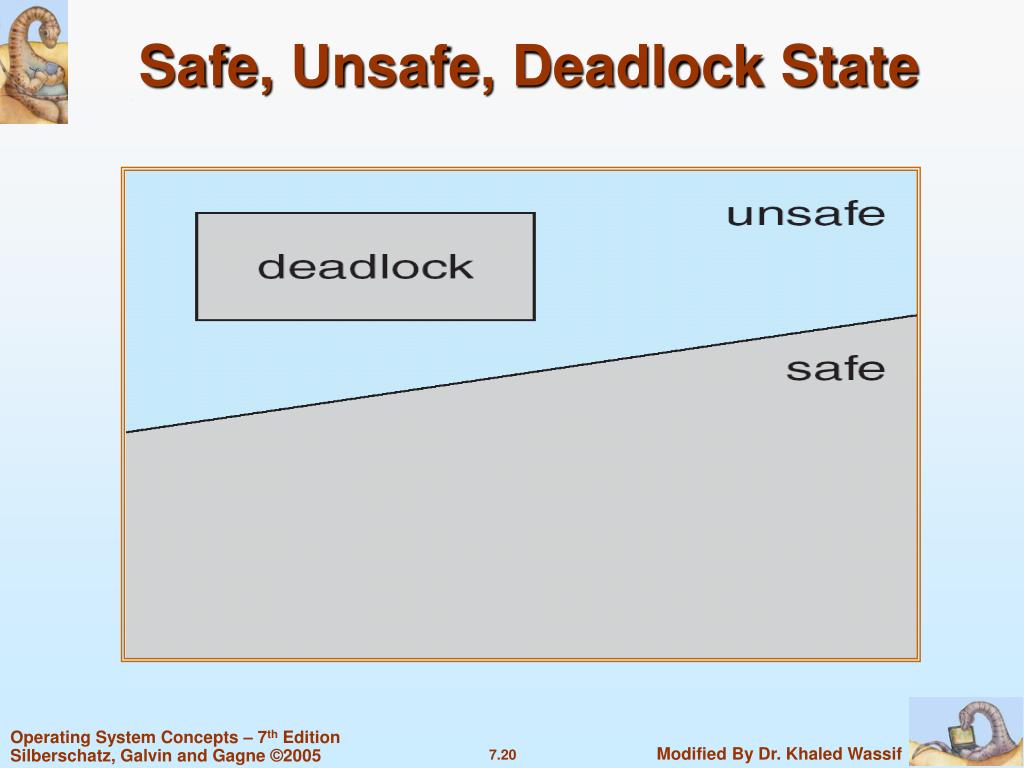
As the diagram shows, a system can be in an unsafe state but not yet be deadlocked. Why? Because the "worst-case scenario" that the OS models might not happen. A process might finish its execution using fewer resources than its declared maximum, or it might release some resources before requesting others. In such cases, the system can escape the unsafe state without ever hitting a deadlock.
This exact point was part of a GATE CSE 2022 question. Let's look at the community discussion around it.
Operating System: GATE CSE 2022 | Question: 16
The GATE Overflow discussion for 'GATE CSE 2022 | Question: 16' provides an expert breakdown of why an unsafe state doesn't guarantee a deadlock.
Read the explanations for statement #3 ('If the current allocation of resources to processes leads the system to unsafe state, then deadlock will necessarily occur.') in the provided answers. Pay close attention to the Cornell University example cited in the third answer block, as it perfectly illustrates how a system in an unsafe state can still avoid deadlock.
The key takeaway is simple but vital for your GATE preparation: All deadlocked states are unsafe, but not all unsafe states are deadlocked or will inevitably lead to one.
Part 3: State Analysis with Resource Allocation Graphs
Let's connect these new state definitions to the Resource Allocation Graphs (RAGs) you're already familiar with. The rules for interpreting a RAG depend on whether the resources have single or multiple instances.
Resource Allocation Graph | Deadlock Detection
The article 'Resource Allocation Graph | Deadlock Detection' from GateVidyalay clearly summarizes the rules for detecting deadlocks from a RAG.
Read the introductory section up to and including 'Rule-02'. Focus on the different implications of a cycle in single-instance versus multi-instance resource systems.
Here's a summary of the rules:
-
For Single-Instance Resources:
- No cycle in RAG Safe State.
- Cycle in RAG Deadlocked State.
- Here, the situation is clear-cut. A cycle is a necessary and sufficient condition for deadlock.
-
For Multi-Instance Resources:
- No cycle in RAG Safe State.
- Cycle in RAG Unsafe State.
- In this case, a cycle is a necessary but not sufficient condition for deadlock. The system may be deadlocked, or it may just be in a non-deadlocked unsafe state. We need to check for a safe sequence to know for sure. If one exists, it's safe; if not, it's unsafe (and could be deadlocked).
Test your understanding!
Consider the following Resource Allocation Graph. The system has three resource types: R1 (1 instance), R2 (2 instances), and R3 (1 instance).
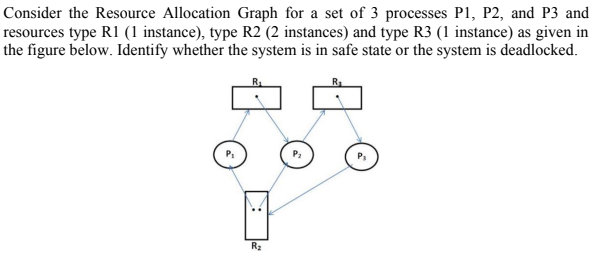
The graph clearly contains a cycle (e.g., P1 requests an instance of R2, which is held by P2, which in turn requests R1, which is held by P1). Based on this, is the system in a safe state or an unsafe state? If it is safe, provide a safe sequence.
Show answer
The presence of a cycle in a multi-instance RAG indicates the system is in an unsafe state. However, this does not automatically mean it's deadlocked. We must check if a safe sequence exists.
System Snapshot:
- Total Resources:
R1=1, R2=2, R3=1 - Allocated:
- P1 holds
{R1:1, R2:0, R3:0} - P2 holds
{R1:0, R2:1, R3:0} - P3 holds
{R1:0, R2:0, R3:1}
- P1 holds
- Total Allocated:
{R1:1, R2:1, R3:1} - Currently Available:
Total - Allocated={1,2,1} - {1,1,1}={R1:0, R2:1, R3:0} - Need (Requests from the graph):
- P1 needs
{R1:0, R2:1, R3:0} - P2 needs
{R1:1, R2:0, R3:1} - P3 needs
{R1:0, R2:1, R3:0}
- P1 needs
Finding a Safe Sequence:
- Check P1: Can its need
{0,1,0}be satisfied by Available{0,1,0}? Yes. Let's assume P1 runs. - P1 finishes and releases its resources
{1,0,0}. New Available ={0,1,0}+{1,0,0}={1,1,0}. - Check remaining processes (P2, P3):
- Can P2's need
{1,0,1}be satisfied by Available{1,1,0}? No (needs R3). - Can P3's need
{0,1,0}be satisfied by Available{1,1,0}? Yes. Let's assume P3 runs.
- Can P2's need
- P3 finishes and releases its resources
{0,0,1}. New Available ={1,1,0}+{0,0,1}={1,1,1}. - Check remaining process (P2):
- Can P2's need
{1,0,1}be satisfied by Available{1,1,1}? Yes. P2 runs.
- Can P2's need
- P2 finishes, releasing its resources. All processes have completed.
Since we found a safe sequence, <P1, P3, P2>, the system is in a safe state, even though the RAG contains a cycle. This is a perfect example of why a cycle is not a sufficient condition for deadlock in a multi-instance system.
Conclusion
In this lesson, we have formally defined and explored the differences between safe, unsafe, and deadlocked states. Understanding this is not just an academic exercise; it is the theoretical foundation upon which deadlock avoidance algorithms, like the Banker's Algorithm, are built.
Key Takeaways:
- A safe state is one from which the OS can guarantee deadlock-free execution for all processes by finding at least one safe sequence.
- An unsafe state is one where no safe sequence can be found, meaning there is a potential for deadlock.
- A deadlocked state is a specific type of unsafe state where a circular wait has actually occurred and processes are blocked indefinitely.
- Crucially for GATE: All deadlocked states are unsafe, but not all unsafe states are deadlocked.
- The implication of a cycle in a Resource Allocation Graph depends on the resource types: it implies deadlock for single-instance resources but only an unsafe state (potential for deadlock) for multi-instance resources.
Preview of the Next Lesson:
Now that you can confidently distinguish between these states, we are ready to tackle the main algorithm for deadlock avoidance. In the next lesson, you will learn to apply the Banker's algorithm to determine if a system is in a safe state and to make decisions about resource allocation. This is a classic, high-yield algorithm that frequently appears in GATE problems.