Hello! Welcome to the final lesson in our module on Deadlock Characterization and Prevention.
In the previous lessons, you learned to identify the four necessary conditions for deadlock, model system states with Resource Allocation Graphs (RAGs), and apply various prevention strategies. Today, we will consolidate this knowledge by focusing on the primary goal: solving GATE-style problems that integrate these concepts. This lesson is all about application and sharpening the analytical skills you'll need for the exam.
By the end of this session, you will be able to solve problems related to deadlock conditions, RAG analysis, and prevention techniques, mirroring the format and complexity of the GATE exam.
A Quick Recap
Before we dive into problems, let's briefly recall the key concepts from this module:
- The Four Necessary Conditions: Mutual Exclusion, Hold and Wait, No Preemption, Circular Wait. A deadlock can only occur if all four are present.
- Resource Allocation Graphs (RAGs): A visual tool to represent the state of resource allocations and requests. For resources with a single instance, a cycle in the RAG is a necessary and sufficient condition for deadlock.
- Deadlock Prevention: Strategies that negate one of the four conditions to make deadlock structurally impossible. The most practical method is negating Circular Wait by enforcing a resource ordering.
Let's begin by sharpening our core skill: analyzing RAGs.
Part 1: Analyzing Resource Allocation Graphs
Being able to look at a system's state, represent it as a RAG, and determine if a deadlock exists is a fundamental skill. The following video provides an excellent, systematic method for doing this, particularly for single-instance resources which are common in GATE questions.
L-4.2: Resource Allocation Graph in Deadlock | Single Instance with example | Operating System
Let's revisit the 'Resource Allocation Graph in Deadlock' video from Gate Smashers. It explains how to build and analyze a RAG, and most importantly, establishes the critical rule for single-instance resource systems.
Watch the segment from 03:14 to 26:06. Pay close attention to two things: The rule: For single-instance resources, a cycle in the RAG always implies a deadlock. The systematic, tabular method for checking the system state, which is very useful for complex graphs.
The key takeaway from the video is powerful: for single-instance resources, finding a cycle is equivalent to finding a deadlock. Let's test this.
Test your understanding!
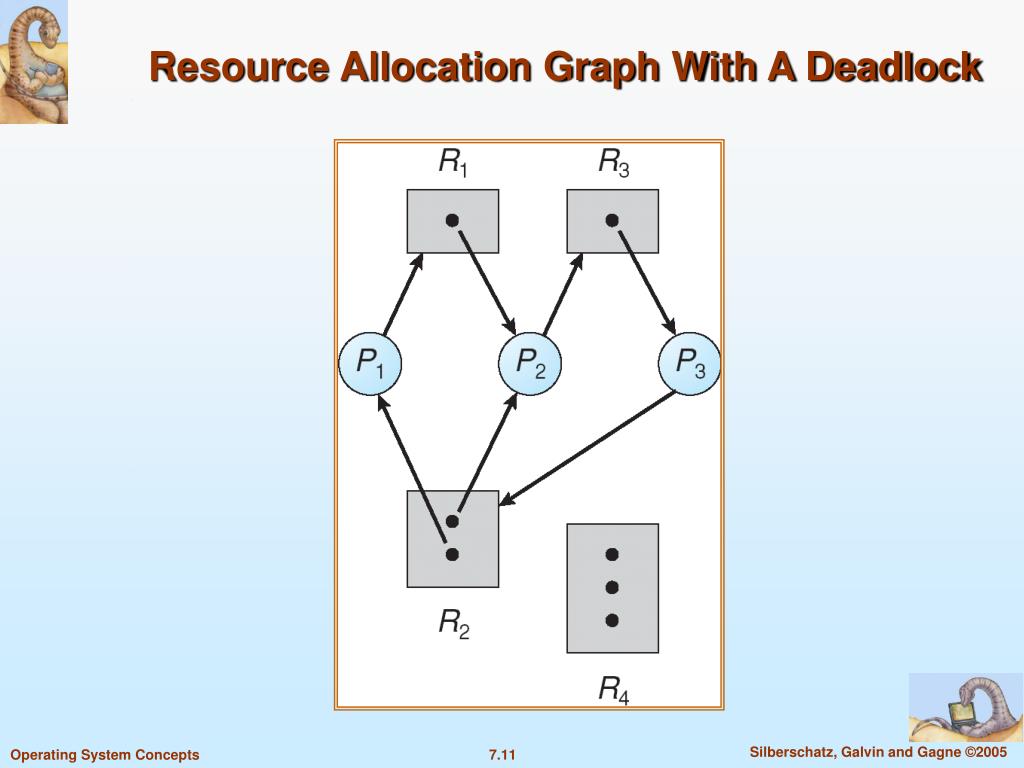
Consider the Resource Allocation Graph below. Does a deadlock exist? If so, identify the processes and resources involved in the cycle.
Show answer
Yes, a deadlock exists. The graph contains a cycle involving processes P1, P2, and P3 and resources R1, R2, and R3.
- P1 is holding R1 and requesting R2.
- P3 is holding R2 and requesting R3.
- P2 is holding R3 and requesting R1.
This forms the circular wait condition: . Since these are single-instance resources, this cycle guarantees a deadlock.
Part 2: Dissecting a GATE-Level Question
GATE questions often test nuanced understanding rather than simple definitions. They use formats like Multiple Select Questions (MSQs) to check if you can differentiate between related but distinct concepts. Let's analyze a real GATE question and its discussion.
The following resource is a community discussion of a GATE CSE 2022 question. It provides deep insights into how these concepts are tested.
Operating System: GATE CSE 2022 | Question: 16
This GATE Overflow page discusses a question with multiple true/false statements about deadlocks. The detailed answers and comments are invaluable for understanding the subtleties required for the exam.
Read through the question and the provided answers. Focus on understanding the reasoning for why each statement is true or false. Pay special attention to the explanations distinguishing an 'unsafe state' from a 'deadlock' and the discussion on what a RAG with only 'assignment edges' implies.
Let's break down the key points from that discussion, as they are crucial for your preparation.
Key Insights from the GATE Problem
-
Unsafe State vs. Deadlock: An unsafe state does not guarantee a deadlock.
- An unsafe state means the OS cannot guarantee a safe sequence of execution. It's a state where a deadlock might occur if processes make worst-case resource requests.
- A deadlock is a state where processes are actually, currently, and infinitely blocked.
- All deadlocked states are unsafe, but not all unsafe states lead to a deadlock. A process might finish using fewer resources than its declared maximum, releasing them for others and resolving the potential deadlock.
-
RAG with Only Assignment Edges: If a RAG has only assignment edges (R → P) and no request edges (P → R), the system is deadlock-free.
- Why? Because the "Hold and Wait" condition is violated. No process is holding a resource while waiting for another. All processes can either run with the resources they have or they are not holding any resources at all.
-
Wait-for Graph: This is a simplified version of a RAG used for single-instance resource types. An edge P1 → P2 means P1 is waiting for a resource held by P2. A cycle in a wait-for graph implies a deadlock. The concept is not applicable to multi-instance resource scenarios.
Part 3: Applying Prevention Strategies to Problems
In the previous lesson, you learned about deadlock prevention. The most testable prevention technique is violating the Circular Wait condition.
The Strategy: Impose a total ordering on all resource types. Processes must request resources in increasing order of this enumeration.
Let's see how this plays out in a problem.
Problem:
A system has resources . A global ordering is defined as . Processes must request resources in increasing order of their value.
Consider two processes with the following request patterns:
- Process P_A:
request(R1); request(R3); - Process P_B:
request(R2); request(R3);
Can a deadlock occur between P_A and P_B? What if P_B's pattern was request(R3); request(R1);?
Solution:
-
Original Scenario (P_A and P_B):
- P_A requests in order (1, 3). This is valid.
- P_B requests in order (2, 3). This is also valid.
- No deadlock can occur. For a deadlock, P_A would need to hold a resource that P_B wants, while P_B holds a resource P_A wants. Here, both eventually want R3, but there's no circular dependency. For example, if P_A gets R1 and P_B gets R2, one will get R3 and finish, releasing its resources for the other.
-
Modified Scenario (P_A and modified P_B):
- P_A's pattern is
request(R1); request(R3);(valid). - P_B's modified pattern is
request(R3); request(R1);(invalid, since F(R1) < F(R3)). - Because the system allows this invalid request pattern, a deadlock is now possible.
- Worst Case: P_A gets R1 and waits for R3. P_B gets R3 and waits for R1. This is a classic deadlock caused by violating the resource ordering rule.
- P_A's pattern is
This demonstrates that strictly enforcing the resource ordering protocol is essential for this prevention method to work.
Conclusion
Today's lesson was a practical workout, applying the theoretical concepts from this module to the kinds of problems you'll face in the GATE exam. We didn't introduce new theory but instead focused on how existing theory is tested.
Key Takeaways:
- RAG Analysis is Key: For single-instance resources, a cycle in the RAG is a definitive sign of deadlock. Use systematic methods (like the tabular approach) to analyze complex graphs.
- Know the Nuances: Understand the critical difference between an unsafe state (potential for deadlock) and a deadlocked state (actual infinite waiting). This is a common point of confusion and a frequent topic for MSQs.
- Prevention in Practice: Violating the four necessary conditions is the core of prevention. For problems, focus on how resource ordering (violating Circular Wait) and quantitative constraints (violating Hold and Wait, from the previous lesson) can guarantee a deadlock-free system.
- Deconstruct the Question: Break down GATE questions into their constituent parts. Identify which of the four conditions or which deadlock-handling strategy is being tested by each statement.
You have now completed the module on deadlock characterization, detection, and prevention. You are well-equipped to handle a significant portion of deadlock-related questions on the exam.
Preview of the Next Lesson:
We will begin the final module on deadlocks by looking at Deadlock Avoidance. Unlike prevention, which sets strict rules to make deadlocks impossible, avoidance uses a more dynamic approach. You will learn about safe states and the famous Banker's Algorithm, which allows the system to make allocation decisions on the fly to "steer around" potential deadlocks. This is another high-yield topic for the GATE exam.