Hello! Welcome to the third module of our course. In the previous module, we explored synchronization mechanisms like semaphores and mutexes to coordinate concurrent processes. We concluded by solving several GATE-level problems, where you saw how complex interactions can lead to issues like starvation.
Today, we shift our focus to one of the most critical problems in concurrent systems: deadlock. We'll build upon our understanding of processes competing for resources. This lesson is foundational for the entire module. Our goal is to identify the four necessary conditions for deadlock: Mutual Exclusion, Hold and Wait, No Preemption, and Circular Wait. Mastering these conditions is essential for diagnosing, preventing, and avoiding deadlocks—topics we will cover in subsequent lessons and which are frequently tested in the GATE exam.
1. What is a Deadlock?
At a high level, a deadlock is a state where a set of two or more processes are permanently blocked, each waiting for a resource that is held by another process in the same set. This results in a standstill where no process can make progress.
To build your intuition, let's start with a short video that uses simple, real-world analogies to explain the concept of deadlock before moving to a technical context.
L-4.1: DEADLOCK concept | Example | Necessary condition | Operating System
Watch this video from Gate Smashers to get a feel for what deadlock means through analogies like a traffic jam or a bank transaction standoff.
Watch the first 3 minutes of the video (00:00 to 03:00). Focus on how the everyday examples illustrate the core idea of a set of entities waiting for each other in a way that none can proceed.
As the video explains, the key feature of a deadlock is this indefinite waiting loop where no progress is possible. This is different from starvation, where a process might wait indefinitely but other processes in the system are still making progress. In a deadlock, a whole group of processes is stuck.
2. The Four Necessary Conditions for Deadlock
For a deadlock to occur in a system, four specific conditions, sometimes called the Coffman conditions, must all hold simultaneously. If even one of these conditions is not met, a deadlock cannot happen.
This is a critical point for the GATE exam: you must know these four conditions by heart and understand that they are all necessary.
Here they are:
- Mutual Exclusion
- Hold and Wait
- No Preemption
- Circular Wait
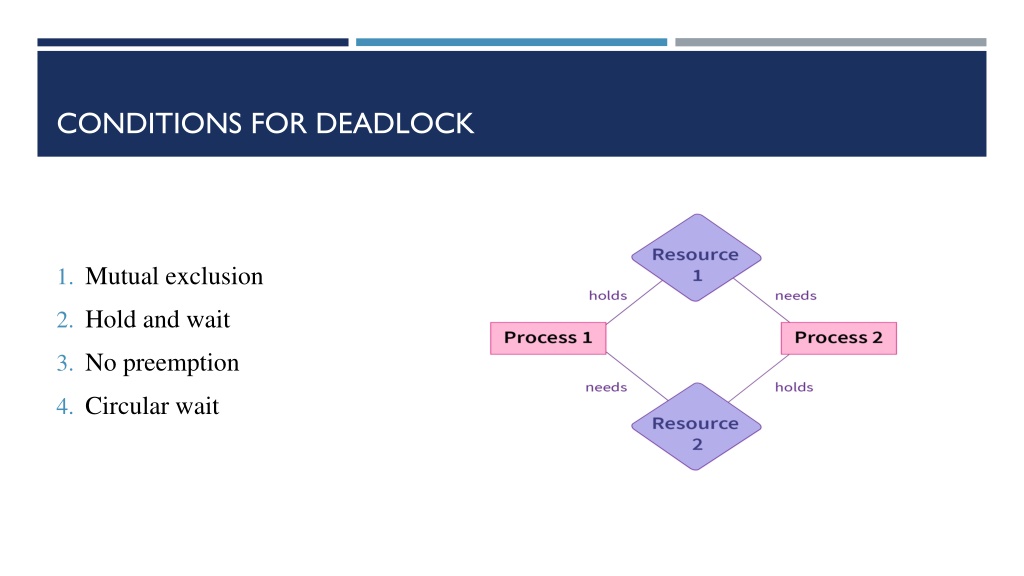
The following image provides a great visual summary. It lists the four conditions and shows a simple diagram of two processes and two resources stuck in a classic deadlock.
Let's break down each condition.
3. A Closer Look at Each Condition
To truly understand how deadlocks form, we need to examine each of the four conditions individually.
a. Mutual Exclusion
This condition states that at least one resource in the system must be non-shareable. A non-shareable resource is one that can only be used by one process at a time.
- Example: A printer is a classic example. If one process is printing, another process that wants to print must wait. A tape drive is another.
- Contrast: A read-only file is a shareable resource. Multiple processes can read from it simultaneously without issue. If all resources in a system were shareable, mutual exclusion would not hold, and deadlocks over those resources would be impossible.
b. Hold and Wait
This condition requires that a process must be holding at least one resource while waiting to acquire additional resources that are currently held by other processes.
- Example: In the diagram above, Process 1 is holding Resource 2 and is waiting for Resource 1. At the same time, Process 2 is holding Resource 1 and waiting for Resource 2. This is a perfect illustration of the Hold and Wait condition.
c. No Preemption
This means that a resource can only be released voluntarily by the process holding it, typically after it has completed its task. Resources cannot be forcibly taken away (preempted) from a process.
- Example: If a process is using the CPU and its time slice expires, the OS preempts the CPU. However, if a process is holding a lock on a file, the OS cannot just take the lock away; the process must release it. This "no preemption" rule applies to resources like locks, files, and printers.
d. Circular Wait
This condition implies that there exists a set of waiting processes such that:
- is waiting for a resource held by .
- is waiting for a resource held by .
- ...
- is waiting for a resource held by .
This creates a circular chain of dependencies. The diagram with two processes is the simplest form of a circular wait.
To solidify your understanding, the following resources provide clear, structured explanations of these four conditions.
Lec19 Deadlock | Necessary conditions for Deadlock | Operating Systems
This video from Jenny's Lectures CS IT offers a concise and methodical explanation of each of the four necessary conditions.
Watch from 08:58 to 13:06. The presenter clearly defines each condition and emphasizes that all four must occur simultaneously for a deadlock to arise.
For a textual reference that you can review quickly, the following article is excellent. It lays out each condition in its own section.
Conditions for Deadlock in Operating System
The GeeksforGeeks article 'Conditions for Deadlock in Operating System' provides a solid written summary of the concepts we've just discussed.
Read the sections titled '1. Mutual Exclusion', '2. Hold and Wait', '3. No Preemption', and '4. Circular Wait'. This will reinforce the definitions and provide simple examples.
Test your understanding!
Imagine a system where processes are designed such that whenever a process requests a resource, it must first release all other resources it is currently holding. Which of the four necessary conditions for deadlock does this rule prevent?
Show answer
This rule prevents the Hold and Wait condition. A process can either be holding resources or waiting for a new one, but not both at the same time. By releasing all held resources before requesting a new one, the "hold" part is negated while "waiting".
4. Application to GATE Problems
Your goal is to excel in the GATE exam, so let's connect this theory directly to a past question. The following question from GATE CSE 2022 tests your understanding of these fundamental concepts.
Question:
Which of the following statements is/are TRUE with respect to deadlocks? [GATE CSE 2022]
(A) The circular wait is a necessary condition for the formation of deadlock.
(B) In a system where each resource has more than one instance, a cycle in its wait-for graph indicates the presence of a deadlock.
(C) If the current allocation of resources to processes leads the system to an unsafe state, then deadlock will necessarily occur.
(D) In the resource-allocation graph of a system, if every edge is an assignment edge, then the system is not in a deadlock state.
Think about what we've learned today. Based on that, which statement(s) can you confidently evaluate?
Show analysis
Based on today's lesson, you should immediately recognize that statement (A) is TRUE. We've established that Circular Wait is one of the four necessary conditions for deadlock.
Statements (B), (C), and (D) involve concepts we will cover in the upcoming lessons (multi-instance resources, safe states, and resource-allocation graphs). For now, it's important that you can identify (A) as unequivocally correct. The actual answer to the question is that (A) and (D) are true. We will revisit this question later in the module!
Conclusion
In this lesson, we established the groundwork for our study of deadlocks. You learned to define a deadlock and, most importantly, identify the four conditions that are collectively necessary for one to occur.
Key Takeaways:
- Deadlock: A state where a set of processes is stuck in a circular waiting pattern for resources held by each other.
- Four Necessary Conditions: A deadlock can only arise if all four conditions hold simultaneously:
- Mutual Exclusion: At least one resource is non-shareable.
- Hold and Wait: A process holds resources while waiting for others.
- No Preemption: Resources cannot be forcibly taken away.
- Circular Wait: A closed chain of processes exists, where each waits for a resource held by the next.
In our next lesson, we will formalize the way we represent processes and resources. You will learn to model resource allocation states using Resource Allocation Graphs (RAGs). This graphical method will be our primary tool for visualizing system states and detecting potential deadlocks.