Hello! Welcome back. In our last lesson, we explored Peterson's solution, an elegant way to solve the critical section problem for two processes. We saw how it masterfully combines a turn variable and a flag array to ensure mutual exclusion, progress, and bounded waiting.
However, the real world of computing involves many more than two processes competing for resources. Peterson's solution, in its classic form, doesn't scale. Today, we tackle this challenge head-on by studying the Bakery Algorithm. This powerful software-based solution, invented by Leslie Lamport, extends the concept of orderly waiting to n processes.
Your goal for this lesson is to understand and apply the Bakery algorithm. We'll build it up from a simple idea to the complete, correct version, focusing on why each component is necessary. This step-by-step deconstruction is crucial for GATE, as questions often test your understanding of what happens when parts of an algorithm are modified or removed.
1. The Bakery Analogy: Taking a Number
The intuition behind the algorithm is wonderfully simple and comes from a common real-world scenario: a bakery or a bank where customers take a numbered token upon entry. The customer with the lowest number gets served next. In our case, "processes" are the customers, and "being served" means entering the critical section.
A process wanting to enter the critical section will:
- Take a number: This number will be higher than anyone else's current number.
- Wait its turn: It waits until its number is the lowest among all processes waiting to enter.
Let's watch a video that introduces this concept and walks through a simplified version of the algorithm.
Bakery Algorithm- N Process Solution Tutorial-8
This video from TechGuiders provides an excellent step-by-step introduction to the Bakery algorithm. We'll start with the basic concept.
Watch from the beginning to 05:24. The video first introduces the bakery analogy and then demonstrates a simplified version of the algorithm. Pay attention to how processes calculate their token numbers and how a first-come, first-served order is established.
This simplified version seems to work, but it relies on a critical assumption: that the process of picking a number (max(...) + 1) is atomic. In a concurrent system, this is not a safe assumption. What if two processes read the maximum value at the same time, before either has a chance to update it?
2. Refining the Algorithm: Handling Concurrent Access
The real challenge, and the genius of the algorithm, lies in handling the race conditions that occur when the process of choosing a number is not atomic. Let's break down the problems and their solutions.
Problem 1: Two Processes Get the Same Number
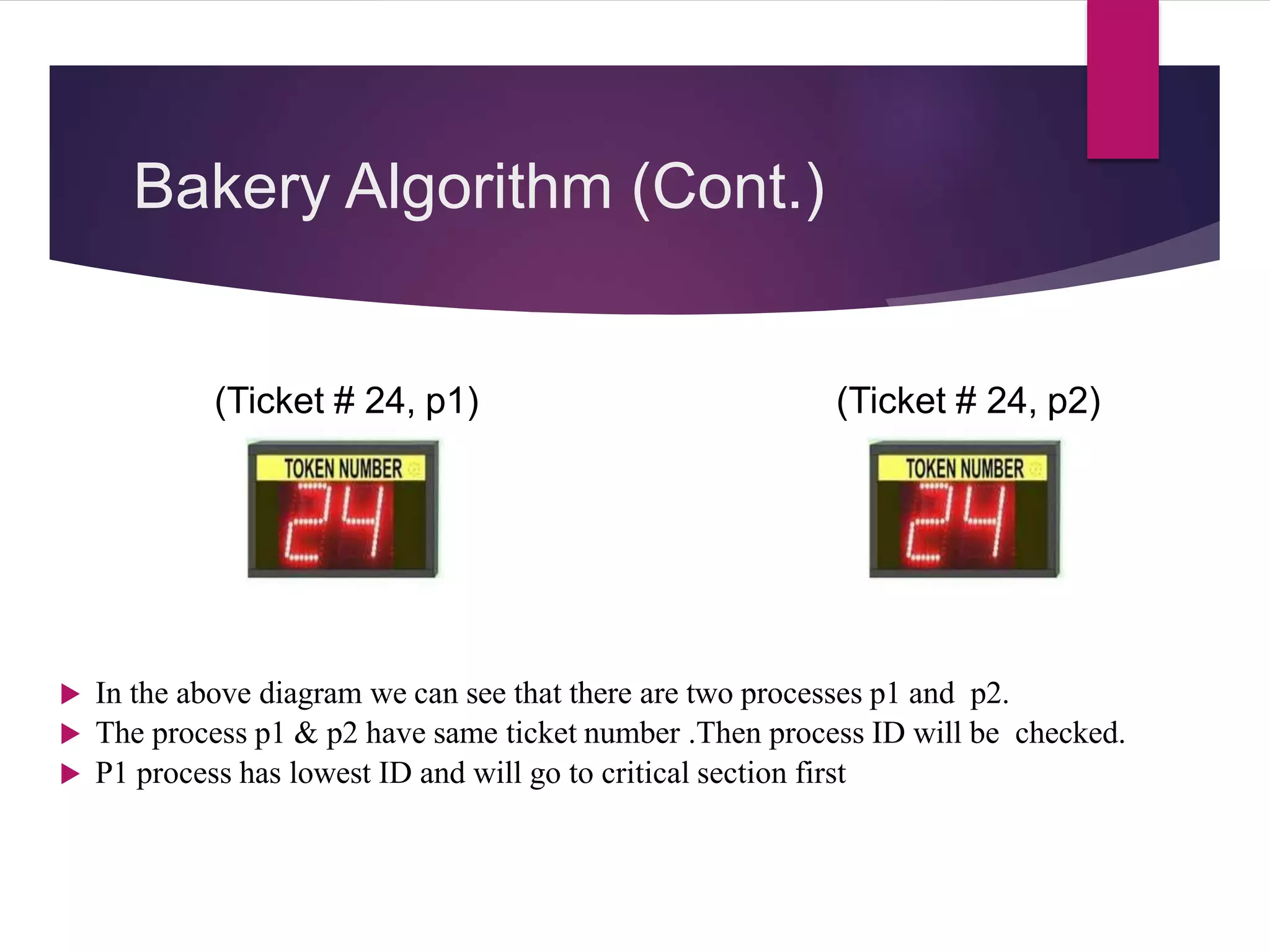
If two processes, say Pi and Pj, read the same max value concurrently, they will both calculate the exact same token number. If they then try to enter the critical section, which one goes first? If both see that their number is the "lowest," they might both enter, violating mutual exclusion.
The Solution: A Tie-Breaker
The algorithm resolves this by using the process ID (e.g., i and j) as a tie-breaker. If two processes have the same token number, the process with the lower process ID gets priority. This is a form of lexicographical comparison on the pair (number, process_id).
(a, b) < (c, d) is true if a < c, or if a == c and b < d.
So, (number[i], i) < (number[j], j) means process i has a smaller number, OR the numbers are the same and i has a smaller process ID.
Problem 2: Reading Stale Numbers
Even with the tie-breaker, there's a more subtle race condition. Imagine this sequence:
Pistarts choosing a number but is preempted after it has read all the current numbers but before it calculates its own new number.Pjruns, quickly chooses its number (which is still low), and enters the critical section.Piresumes, calculates its number based on the stale values it read earlier, and also gets a low number.Pimight then incorrectly decide it can also enter the critical section, violating mutual exclusion.
The Solution: The choosing Array
To prevent this, the algorithm introduces a shared boolean array, choosing.
choosing[i] = true;indicates that processiis currently in the middle of picking its token number.- Before any process
PjchecksPi's token number, it must first wait untilchoosing[i]isfalse. This ensures thatPjonly compares its number against a stable, fully-chosen number fromPi.
Let's see how these refinements come together in the complete algorithm.
Bakery Algorithm- N Process Solution Tutorial-8
Continuing with the TechGuiders video, let's see how it identifies these race conditions and introduces the final components of the algorithm.
Watch from 06:08 to the end (17:26). The video first demonstrates the failure due to non-atomic number generation, introduces the process ID tie-breaker, shows another subtle failure, and finally presents the complete algorithm with the 'choosing' flag. This walkthrough is key to understanding why the algorithm is designed this way.
3. The Complete Bakery Algorithm
You've now seen all the pieces and why they exist. Let's put it all together by looking at the formal pseudocode.
This handout provides a concise summary of the algorithm's pseudocode and explains each line's purpose. It's a great reference to consolidate your understanding.
Read the entire one-page PDF. Pay close attention to the pseudocode from line 5 to line 12, which represents the complete entry section we've just discussed. Note how the two while loops correspond to the two problems we identified.
The entry section can be summarized as:
choosing[i] = true;— Announce that I'm picking a number.number[i] = max(...) + 1;— Pick the next available number.choosing[i] = false;— I'm done picking.- Loop through all other processes
j:
a.while (choosing[j]);— Wait forPjto finish picking its number.
b.while ((number[j] != 0) && (number[j], j) < (number[i], i));— Wait ifPjis interested (number[j] != 0) and has a better priority (lower number, or same number with a lower ID).
This structure guarantees all three properties: Mutual Exclusion, Progress, and Bounded Waiting.
Test your understanding!
In the Bakery algorithm, suppose process Pi is waiting in the second while loop because of process Pj. This means the condition (number[j] != 0) && ((number[j], j) < (number[i], i)) is true. Can Pi be forced to wait forever by Pj continuously leaving and re-entering the critical section? Why or why not?
Show answer
No, Pi cannot wait forever. When Pj re-enters, it must take a new number. This new number will be greater than all existing numbers, including Pi's current number. Therefore, on its next attempt, Pj's number will be greater than Pi's number, giving Pi priority. This ensures bounded waiting.
4. Application: Analyzing a GATE Problem
GATE questions love to test your understanding of synchronization algorithms by presenting a slightly incorrect version and asking you to identify the consequences. Let's tackle a question from GATE 2016.
Operating System: GATE CSE 2016 Set 1 | Question: 50
This GATE Overflow page discusses a question based on a modified Bakery algorithm. First, read the question itself carefully and try to spot the difference between this code and the correct algorithm.
Just read the question part, which presents the pseudocode and the multiple-choice options. The core of the problem is in this line: while (t[j] != 0 && t[j] <=t[i]);. How does this differ from the correct Bakery algorithm's waiting condition?
The critical difference is the condition t[j] <= t[i]. The correct algorithm uses a strict less-than comparison for the numbers and a process ID tie-breaker: (t[j], j) < (t[i], i). This modified version uses less-than-or-equal-to and has no tie-breaker.
What happens if two processes, Pi and Pj, happen to get the same token number, so t[i] == t[j]?
Piwill executewhile (t[j] != 0 && t[j] <= t[i]). This is true, soPiwaits.Pjwill executewhile (t[i] != 0 && t[i] <= t[j]). This is also true, soPjwaits.
Both processes are waiting for the other to finish, but neither can proceed. This is a classic deadlock.
Now, let's analyze the properties based on this flaw:
- Mutual Exclusion: This is still satisfied. For two processes
PiandPjto be in the critical section simultaneously,Pimust have passed its check onPj(meaningt[j] > t[i]) andPjmust have passed its check onPi(meaningt[i] > t[j]). This is a contradiction. So, at most one process can enter. Option (A) is TRUE. - Progress: Not satisfied. As we saw, if two processes get the same token number, they can deadlock. This means interested processes are unable to decide who enters next, violating the progress condition.
- Bounded Waiting: Not satisfied. A deadlock means a process waits forever, which is the definition of unbounded waiting.
- Cannot cause a deadlock: False. We just demonstrated a deadlock scenario.
Operating System: GATE CSE 2016 Set 1 | Question: 50
Now, read the analysis in the answers on the same GATE Overflow page. They provide excellent, detailed explanations of why mutual exclusion holds but progress and deadlock freedom fail.
Read the answers by users 'Arjun', 'samarpita', and 'Arindam'. They provide different angles on the same problem, showing the deadlock scenario and explaining the impact on each property. This is a perfect example of the reasoning required for the GATE exam.
This exercise demonstrates a vital skill for your exam: don't just memorize algorithms, understand the purpose of each line of code so you can predict the consequences of changing it.
Conclusion
In this lesson, we scaled up our approach to the critical section problem from two processes to n processes using the Bakery Algorithm. We saw how a simple analogy of taking a number is refined with a process ID tie-breaker and a choosing flag to handle the complexities of concurrent execution.
Key Takeaways:
- The Bakery Algorithm provides a solution to the critical section problem for n processes.
- It uses a shared
numberarray for token values and a sharedchoosingarray to prevent race conditions during token selection. - Mutual exclusion is ensured by a lexicographical comparison of
(number, process_id)pairs, which acts as a tie-breaker. - The algorithm guarantees Mutual Exclusion, Progress, and Bounded Waiting.
- Like Peterson's solution, it is a software-only solution that relies on busy-waiting.
While theoretically sound, the busy-waiting nature of software solutions like Peterson's and Bakery makes them inefficient. In our next lesson, we will begin exploring more practical and efficient solutions that leverage special hardware instructions. We'll start by looking at atomic operations like Test-and-Set and how they form the basis for higher-level synchronization tools like mutex locks.