Introduction
In our last lesson, we engineered strapless support for a bandeau top by focusing on anatomical contouring and the structural use of side boning. We learned how to defy gravity using horizontal tension and internal reinforcement. Today, we elevate that principle to its highest form by bridging the worlds of lingerie and swimwear.
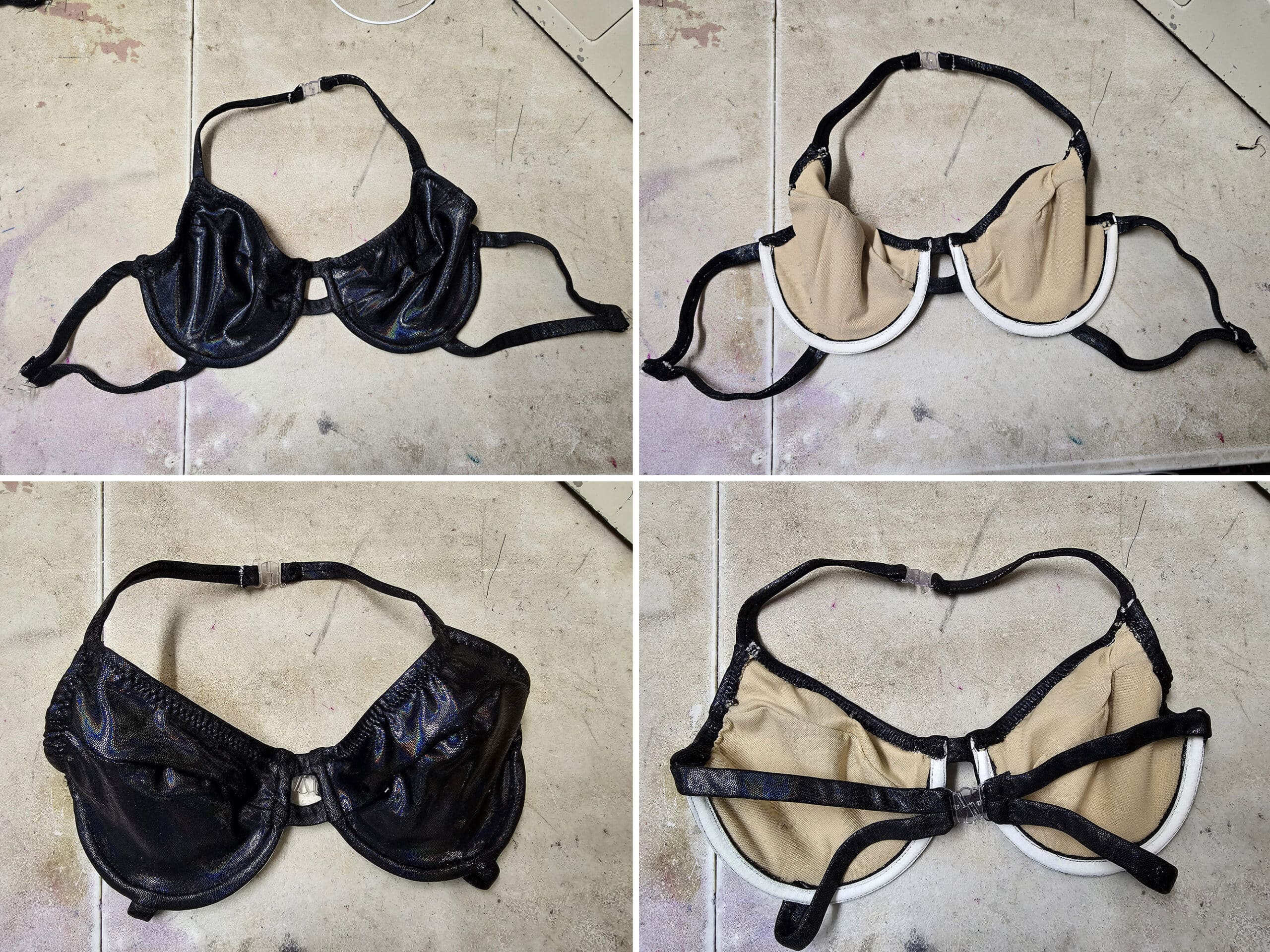
This lesson addresses a core challenge in performance swimwear design: achieving the unparalleled support and shaping of an underwire bra within the demanding context of an aquatic environment. You will learn how to adapt a standard bra block pattern—a familiar foundation from your hobby—into a structured, underwired bikini top suitable for a Bollywood beach setting. This involves a systematic process of material substitution and pattern modification, moving beyond simple fabric tension to provide true structural engineering for the bust.
The Rationale: Why Adapt a Bra Block?
A standard bikini top, even a well-designed one, primarily relies on the stretch and recovery of its fabric (negative ease) to provide support. For high-glamour cinematic scenes or any activity beyond simple lounging, this may not be sufficient. Adapting a bra pattern brings several critical engineering advantages:
- Structural Support: The underwire and channeling create a rigid-but-flexible foundation that lifts and supports the breast tissue from below, independent of fabric tension.
- Shaping and Separation: Multi-part cups, a hallmark of bra design, allow for precise shaping and projection. The stable bridge (gore) ensures separation, preventing the "uniboob" effect and creating a more defined silhouette.
- Load Distribution: The combination of a structured frame and straps distributes the weight of the bust more effectively across the torso, enhancing comfort and stability during movement.
This approach transforms the bikini top from a simple covering into a piece of precision engineering. The article below discusses the rationale for integrating bra structures into swimwear, touching upon the technical and safety considerations.
Pattern School Online - Swimwear Bras
This article from Pattern School Online provides essential background on why and how bra structures are used in swimwear. It frames the design choice as a balance of function, aesthetics, and cost.
Please read the first part of the article, from the beginning down to the end of the discussion on foam inserts. Pay close attention to the arguments for support and separation for larger busts and the critical safety warning about using proper, coated underwires to prevent injury from rust and degradation.
The Anatomy of an Underwire Bikini Top
Before we can adapt a pattern, we must be fluent in its components. An underwire bikini top shares its fundamental anatomy with a bra. The video below provides a quick, clear overview of the essential pattern pieces and materials.
𝗕𝗔𝗦𝗜𝗖𝗦 for Underwire pattern by BDC * DIY BIKINI
This video from Bikini Design Club breaks down the components of an underwire bikini top. It will help us establish a shared vocabulary for the pieces we'll be adapting.
Please watch the first two main segments: First, watch the section on pattern piece names. This will familiarize you with the standard terminology: upper/lower cup, cradle, bridge, and wing. Next, watch the segment on supplies. This provides a visual tour of the specialized materials we'll be discussing, such as power mesh, stabilizer, cut-and-sew foam, and channeling.
As you can see, the pieces are identical in name and function to what you'd find in a standard bra pattern.

The Conversion Process: A Systematic Adaptation
Converting a bra pattern to swimwear is not a simple fabric swap. It is a systematic process of modifying the pattern and substituting every component with a water-safe, durable alternative. The following video tutorial is an excellent guide, as it demonstrates the thought process behind each necessary alteration.
DIY Swimsuit from Bra Pattern: Day 1
In this video, "DIY Swimsuit from Bra Pattern," LizSews walks through the conversion of the popular Emerald Erin Black Beauty bra pattern into a swim top. We will use this as a practical guide to the specific changes required.
Watch the following key sections, which detail the crucial pattern adjustments: Internal Components (watch here): Note the selection of internal materials—cut-and-sew foam, sheer cup lining, and power net—and the justification that their nylon/polyester composition makes them suitable for water. Bottom Band Seam Allowance (watch here): This is a critical step. The instructor explains why you must alter the seam allowance on the bottom edge of the frame and band pieces to match the width of your swimwear elastic. Cup Alterations (watch here): Understand how to prepare the cup pattern by removing the top edge seam allowance for a binding finish and how to adapt pattern pieces for cut-and-sew foam construction. Back Band Modification (watch here): This is arguably the most significant pattern change. Observe how the standard back band is completely redrafted to accommodate a narrower swim clasp instead of a wide hook-and-eye closure.
This process gives us a clear framework. Let's formalize the key substitutions and modifications.
Material and Hardware Substitution
| Lingerie Component | Swimwear Equivalent & Rationale |
|---|---|
| Main Fabric (Lace, Silk) | Nylon/Spandex or Polyester/Spandex (Chlorine/salt/UV resistant) |
| Lining (Bra Tulle) | Swimwear Lining (Opacity), Power Mesh (Support in bands), Stabilizer (No-stretch for bridge) |
| Elastic (Plush Picot) | Rubber or Cotton-Wrapped Swimwear Elastic (Chlorine resistant, firm grip) |
| Cups (Optional Lace) | Cut-and-Sew Foam (Modesty when wet, holds shape, water-resistant) |
| Closure (Hook & Eye) | Coated Metal or Plastic G-Hook/Clasp (Rust-proof, secure) |
| Hardware (Rings/Sliders) | Coated Metal or Plastic Rings/Sliders (Rust-proof) |
| Underwire (Standard Metal) | Coated Underwire (Rust-proof) |
A Practical Walkthrough
The following tutorial from Emerald Erin, the designer of the bra pattern used in the video, provides a written, step-by-step guide to this exact conversion. It's a perfect case study that solidifies all the concepts we've discussed.
How to Make the Black Beauty Bra into a Swimsuit | Pattern Hack - Emerald Erin
This blog post provides the official "pattern hack" for converting the Black Beauty underwire bra into a swimsuit. It details the pattern changes, material choices, and key construction differences.
Read through the tutorial, focusing on these areas: The Pattern Modifications: This confirms the primary change is to the back band to accommodate a G-hook, exactly as we saw in the video. The Cutting List: Pay close attention to this breakdown. It's the core of the conversion, telling you precisely which material (swimwear fabric, sheer cup lining, foam, powernet) to use for each pattern piece. Assembly Differences: Skim this section to see how the construction process is adapted, such as using swimwear elastic on the bottom band instead of plush elastic.
Case Study: Engineering a Bikini for a Cinematic Rain Sequence
Let's apply this to a classic Bollywood scenario: designing an iconic, glamorous bikini top for an actress in a high-energy "rain song." The requirements are extreme. The garment must look stunning, provide flawless support, and remain completely secure through dynamic choreography while saturated with water.
Design Solution:
An adapted underwire bra block is the only professional choice.
- Foundation: A multi-part cup pattern, like the one seen in the 'Daphne Balcony Bra' diagram, would be chosen to create perfect shaping. The specific underwire style (e.g., plunge vs. balconette) would be selected based on the desired neckline and cleavage, as demonstrated in the Bikini Design Club video.
- Materials:
- Cups: Lined with cut-and-sew foam to maintain a smooth, opaque shape when wet.
- Frame & Band: The bridge would be reinforced with non-stretch stabilizer. The wings/band would be lined with power mesh for firm, resilient support.
- Elastics: 3/8" rubber swimwear elastic would be applied to the top and bottom of the band for maximum grip.
- Construction: All pattern modifications we reviewed would be implemented: the back band reshaped for a secure 1" coated metal G-hook, and all edges meticulously finished to withstand the water and movement.
The final result would be a garment that looks like a delicate bikini top but is built with the internal architecture of a high-performance bra.
Conclusion
Today you've learned to fuse the art of lingerie design with the science of performance swimwear. By adapting a bra block, you can offer clients and performers the highest possible level of support, shape, and security in an aquatic garment. This technique moves beyond basic pattern drafting into true garment engineering.
Key Takeaways:
- Adapting a bra block is the superior method for creating supportive, shaped swimwear, especially for performance contexts.
- The conversion is a systematic process requiring substitution of all materials with water-safe equivalents (swimwear fabric, power mesh, foam, rubber elastic, coated hardware).
- Key pattern modifications include reshaping the back band for a swim clasp and altering seam allowances to match swimwear elastic widths.
- The final garment combines the aesthetic of a bikini with the robust internal structure of a well-made bra.
Next Lesson Preview
We have now engineered a bikini top with incredible structural integrity. However, the entire system is only as strong as its weakest point—the closure. In our next lesson, we will focus on this critical component, analyzing and designing secure clasp mechanisms that can withstand the intense forces of diving, high-speed water movement, and acrobatic choreography, ensuring your creations never fail on set.