Introduction
In our previous module, we completed the full construction of a professional underwire bra, finishing with the attachment of adjustable straps and the hook-and-eye closure. You have successfully translated a 2D pattern into a functional, three-dimensional garment engineered for support.
Now, we pivot from the controlled environment of stage and studio to the demanding conditions of aquatic scenes. This lesson begins our module on "Designing for Aquatic Scenes: Bikini Tops" by focusing on the foundational challenge: material selection. You will learn to select fabrics, elastics, and hardware that can withstand the harsh effects of chlorine, salt, and UV radiation. We will ground our exploration in a practical case study of a multi-day ocean shoot, ensuring your designs are not only beautiful but also resilient enough for the cinematic world.
The Challenge of Aquatic Environments
Designing for water is fundamentally a battle against environmental degradation. Unlike a studio costume, a bikini top used in a film shoot is subjected to an aggressive combination of stressors:
- Chemical Attack: Chlorine in swimming pools is a powerful oxidizing agent that aggressively breaks down elastane (the fiber that gives swimwear its stretch), leading to a loss of shape and recovery. Saltwater, while less aggressive than chlorine, can cause discoloration and degrade certain dyes and finishes over time.
- UV Radiation: Prolonged sun exposure attacks both the color and the structural integrity of textile fibers. This photodegradation causes vibrant colors to fade and can make fabrics brittle.
- Mechanical Stress: The drag of moving through water, the impact of diving, and the abrasion from sand and poolside surfaces all place physical strain on seams and fabric surfaces.
Your role as a designer is to anticipate these failure points and select materials engineered to resist them.
Selecting the Core Fabric
The foundation of any bikini top is its fabric. While many stretch fabrics exist, only a few are suitable for swimwear. The choice primarily comes down to two types of blends: Nylon-Spandex and Polyester-Spandex.
The video "Ultimate Guide to Swimwear Fabrics & Notions" offers an excellent overview of the critical properties and the key differences between these materials.
Ultimate Guide to Swimwear Fabrics & Notions
This video provides a concise and practical guide to what makes a good swimwear fabric, why four-way stretch is non-negotiable, and how to choose between the two main fabric types based on the intended use.
Please watch the following segments: Essential Properties: Start by watching the introduction to understand the three non-negotiable qualities of swimwear fabric: four-way stretch, recovery, and opacity. Fabric Types Compared: Pay close attention to the comparison between Nylon-Spandex (Lycra) and Polyester-Spandex. The presenter clearly explains which is better for casual wear versus active, prolonged use in pools. Understanding Stretch: Watch the demonstration on how to test for four-way stretch. This is a fundamental check you should perform on any potential fabric.
As the video highlights, while nylon blends feel exceptionally soft, they are more susceptible to chlorine and sun damage. For the demanding context of a multi-day shoot, Polyester-Spandex is the superior technical choice due to its inherent resistance to these elements.
Verifying Performance: Beyond the Label
Top-tier swimwear fabrics go beyond a simple polyester/spandex blend. They incorporate specialized fibers and finishes to dramatically enhance durability. Your background in statistics and design of experiments will be valuable here, as the process of verifying a fabric's quality is rooted in standardized testing.
The article "Swimwear Fabric Technology Innovations" details these advanced materials and the testing protocols that validate their performance. This is how you, as a designer, can ensure a supplier's claims are accurate.
Swimwear Fabric Technology Innovations Transforming the Industry
This article dives into the material science of high-performance swimwear, providing the technical vocabulary and testing standards you need to specify professional-grade materials.
Please focus on two key areas: Durability Technologies: In the section titled "Which Fabric Technologies Improve Chlorine Resistance, UV Protection, and Durability?", read about specific materials like PBT Polyester and Xtra Life Lycra®. Notice the quantitative data presented, such as a 5-10x lifespan improvement. This is a measurable outcome, not just a marketing claim. Testing and Certification: Now, navigate to the section "What Testing Standards and Certifications Ensure Quality...". This is the most critical part. Review the table to understand the specific tests for key failure modes: Chlorine Resistance: AATCC TM162 Saltwater Resistance: ISO 105-E02 UV Protection: AATCC TM183 When sourcing fabric for a high-stakes project, you wouldn't just ask for "chlorine-resistant fabric"; you would specify that it must pass AATCC TM162 with a certain grade. This is akin to defining the parameters and success criteria in an experiment. Elastic: The Unseen Engineering The right fabric is useless if the elastic holding it in place degrades. The elastic provides the garment's recovery and determines its fit and longevity. Most elastics used in regular lingerie or apparel will fail rapidly in a pool or ocean. The guide "Best Elastic for Sewing Swimwear" from Discovery Fabrics provides a clear comparison of suitable and unsuitable options.
When sourcing fabric for a high-stakes project, you wouldn't just ask for "chlorine-resistant fabric"; you would specify that it must pass AATCC TM162 with a certain grade. This is akin to defining the parameters and success criteria in an experiment.
Elastic: The Unseen Engineering
The right fabric is useless if the elastic holding it in place degrades. The elastic provides the garment's recovery and determines its fit and longevity. Most elastics used in regular lingerie or apparel will fail rapidly in a pool or ocean.
The guide "Best Elastic for Sewing Swimwear" from Discovery Fabrics provides a clear comparison of suitable and unsuitable options.
Best Elastic for Sewing Swimwear - Comparing best choices – Discovery Fabrics
This article breaks down the pros and cons of different elastic types specifically for swimwear applications, helping you avoid common material failures.
Read the following sections to guide your selection: Durability Comparison: Start with section "2. Durability and Longevity." Pay close attention to the descriptions of how clear elastic, rubber elastic, and cotton-wrapped rubber elastic perform when exposed to sun and chemicals. The Verdict: Read the summary section "Choosing the best elastic for swimwear." The key takeaway is that clear elastic is a stabilizing tool, while rubber-based elastics provide primary structure and durability. What to Avoid: Finally, review "Elastic for Swimwear...What NOT to use!". This section explicitly warns against using standard knit or woven elastics, which will quickly lose their integrity.
For a Bollywood aquatic number, where the garment must perform flawlessly through multiple takes, chlorine-resistant rubber elastic or cotton-wrapped rubber elastic is the only professional choice for bands and openings.
Hardware and Visual Impact
Hardware: All metal components—clasps, rings, sliders—must be resistant to corrosion. Options include high-density plastics, nylon-coated metal, or high-grade stainless steel specifically treated for marine environments. An untreated metal clasp can rust or corrode after a single day in saltwater, potentially staining the fabric or failing completely.
Visibility: Beyond material science, a critical design consideration for aquatic scenes is visibility. A swimsuit's color can dramatically affect how easily a person is seen in the water—a factor of both aesthetics for the camera and safety for the performer.
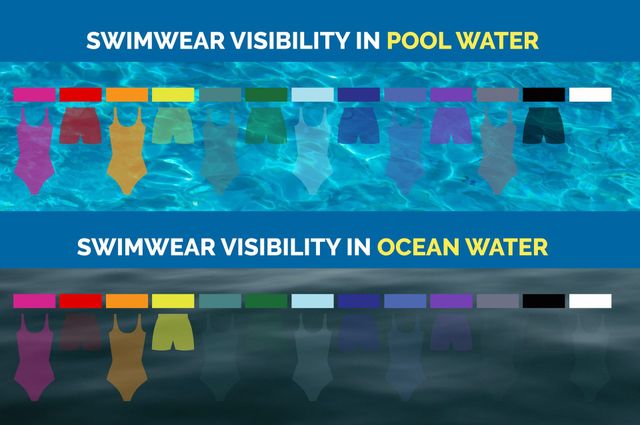
This chart compares the visibility of various swimwear colors in clear pool water versus murky ocean water. Bright, fluorescent colors remain highly visible in both conditions, while blues, greys, and whites tend to disappear, especially in open water.
As the image demonstrates, bright, saturated colors like neon pink, orange, and yellow offer the highest visibility. Conversely, shades of blue and white, which might seem like intuitive choices for a water scene, can render the performer nearly invisible, blending in with the water's color and light reflections.
Case Study: A Multi-Day Ocean Shoot
Let's apply these principles to a concrete scenario.
The Brief: You are designing the hero bikini top for a lead actress in a romantic song sequence. The shoot is scheduled for three days on a beach in the Maldives. The scenes involve swimming in the saltwater, lounging on the sand under bright sun, and a brief shot in a chlorinated hotel pool. The garment must look perfect from the first take to the last.
Your Material Specification Sheet:
-
Main Fabric:
- Type: Polyester/Spandex blend (approx. 82% Polyester, 18% Spandex).
- Technology: Specify fabric with Xtra Life Lycra® or a high percentage of PBT (Polybutylene Terephthalate) for maximum chlorine, salt, and UV resistance.
- Performance: Must pass AATCC TM162 (chlorine fastness) and ISO 105-E02 (sea water fastness). Must have a certified UPF 50+ rating after pre-conditioning per ASTM D6544.
- Color: Neon Coral. This provides high visual contrast against the blue ocean and white sand, ensuring the actress stands out on camera.
-
Lining Fabric:
- Type: Swimwear lining, typically a nylon or polyester knit.
- Performance: Must be opaque when wet and quick-drying.
-
Elastic:
- Type: Chlorine-resistant braided cotton-wrapped rubber elastic (8-10mm width) for all bands and straps to ensure durable support and comfort.
- Stabilizer (Optional): 6mm clear elastic may be used to stabilize internal cup seams, where it is not under primary tension.
-
Hardware:
- Type: Back clasp and strap sliders made of injection-molded nylon or high-grade plastic.
- Certification: Must be OEKO-TEX Standard 100 certified to be free of harmful substances and skin irritants.
-
Thread:
- Type: 100% Polyester thread (e.g., Gutermann Mara 70). This will resist degradation and color bleaching from UV and chemical exposure.
By creating such a detailed specification, you move from hoping a design will last to engineering it for success.
Conclusion
Today's lesson marks a critical shift in your design process, moving from pure construction to material science and environmental resilience. You've learned that selecting materials for aquatic scenes is a technical discipline requiring a deep understanding of how fabrics and components react to chemical, UV, and mechanical stresses.
Key Takeaways:
- For performance swimwear, Polyester-Spandex blends offer superior resistance to chlorine and UV light compared to Nylon-Spandex.
- Professional material selection relies on specifying fabrics that meet standardized test protocols, such as AATCC and ISO standards for colorfastness.
- Chlorine-resistant rubber elastic is the industry standard for durable swimwear; common apparel elastics will fail.
- All hardware must be corrosion-resistant, with plastic or specially coated metals being safe choices.
- Bright, neon colors offer the best visibility in water, an important consideration for both safety and cinematic impact.
Next Lesson Preview
Now that you are equipped with the knowledge to select the right materials, our next lesson will focus on translating those materials into a design. We will begin the pattern drafting process for our first bikini top: the classic, adjustable triangle top, a staple of swimwear design.