Introduction
In our last two lessons, we explored how to adapt your foundational block for specialized silhouettes—the upward lift of the balconette and the invisible support of the deep-plunge. Today, we shift our focus from style-specific adaptations to a core principle of bra engineering: the multi-part cup. This technique is not about creating one specific look, but about gaining a new level of control over shape and support.
This lesson directly addresses the primary challenge of designing for Bollywood: creating garments that provide exceptional support for heavier busts during vigorous, high-impact dance routines. You will learn to develop a three-part cup pattern, moving beyond simple dart manipulation to using seams as sophisticated engineering tools. This allows you to dictate projection, lift, and containment with a precision that is essential for both performance and aesthetics.
The Engineering of Support: Encapsulation
Before we start cutting up patterns, it's crucial to understand why a multi-part cup is superior for high-impact support. Most basic sports bras use compression—they simply squeeze the breast tissue against the chest. While effective for smaller busts, this method is often uncomfortable and insufficient for larger cup sizes.
A far more sophisticated approach is encapsulation, the principle behind traditional underwired bras. Instead of flattening the chest, encapsulation separates and supports each breast in its own individually structured cup. A multi-part cup is the ultimate expression of this principle in a fabric bra. The seams are not merely decorative; they create a three-dimensional structure that can be precisely tailored to the breast's shape and volume.
The most effective high-performance bras, especially for dance, use a combination of both methods.
A Manufacturer’s Guide: How to Engineer a High-Impact Sports Bra That Actually Works? - HAVING
This guide from a performance apparel manufacturer provides an excellent, engineering-focused overview of bra support. It will ground our pattern-making in solid biomechanical principles.
Read the section Pillar #1. Pay close attention to the table "The Science of Support," which clearly defines Compression, Encapsulation, and the powerful Combination method. This is the foundational theory for the pattern we are about to create.
By drafting a multi-part cup, you are engineering an encapsulation system. The seams act as vectors of tension, allowing you to build projection, lift, and containment directly into the pattern.
The Anatomy of a Multi-Part Cup
At its simplest, a three-part cup divides the single-piece darted cup into three distinct pieces: an upper cup and two lower cup sections.
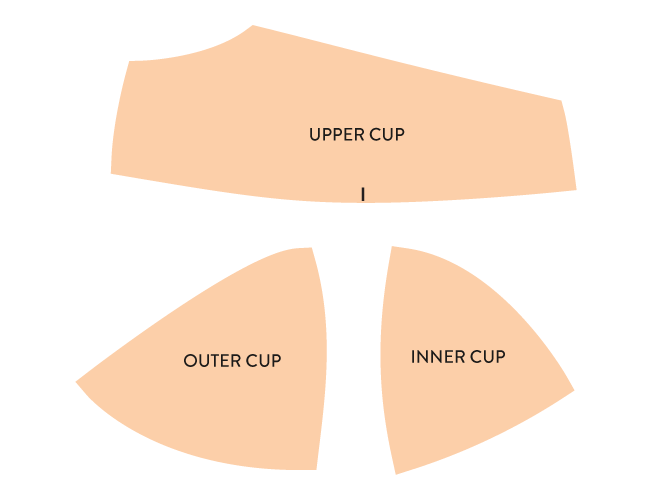
The seams introduced between these pieces give you granular control:
- Vertical Seams: Primarily control forward projection. They are instrumental in creating a prominent, defined apex and pushing the breast tissue forward, away from the underarm.
- Horizontal Seams: Primarily control lift and the roundness of the lower cup. They create a "shelf" of support under the bust.
More complex designs, like the one shown below, may use four or more pieces, including a side "power bar" for even greater side support and forward-push.

The Interdependent Geometry of Cup Seams
Given your background in statistics and experimental design, you'll appreciate that the dimensions of these pattern pieces are not independent variables. You can't simply increase the length of one seam to increase projection without affecting the entire system. This is a common pitfall in pattern alteration.
A fantastic blog post from "Hugs for Your Jugs" conducts a small experiment that demonstrates this principle perfectly. The author independently alters the Horizontal Hemisphere (HH)—the length of the cup across the widest point—and the Bottom Cup Depth (BCD)—the length from the wireline to the apex—and documents the unexpected, and often detrimental, results on the fit.
The relationship between horizontal hemisphere and bottom cup ...
This article is a deep dive into the complex geometry of a bra cup. It uses an experimental approach that will likely resonate with your analytical background to show why seams are part of an interconnected system.
Please read the entire article. As you do, focus on these key concepts: The Experiment: Note the control bra and the specific alterations made to HH and BCD in Cups 1 and 2. The Results: Compare the expected results to the actual outcomes. The key insight is that changing one dimension causes the entire cup to rotate or distort in unforeseen ways. The Explanation: The author's analysis of what's happening is crucial. Pay close attention to the explanations for why increasing or decreasing HH alone creates problems, and why increasing or decreasing BCD alone also leads to poor fit. The Conclusion: The most important takeaway is in the section "The Relationship between HH and BCD". The author states that HH and BCD are in a fixed ratio. Multi-part cups are the tool that allows us to define this ratio and the resulting 3D curvature with precision.
This article brilliantly demonstrates that introducing seams is not just about adding complexity; it is about gaining the necessary control points to enforce a specific, stable, and supportive geometric shape.
Drafting the Three-Part Cup
Now, let's translate this theory into a practical drafting method. We will draft a three-part cup from scratch, using a system of measurements and dart intakes that allows us to build the desired shape. This method is particularly effective for creating deep, supportive cups suitable for larger busts.
The following video provides a very clear, systematic approach to drafting what begins as a four-part cup system and is then consolidated into a final three-part pattern.
How To Draft A Perfect Three Part Burst Cup With A Deep Effect For Your Corset /Detailed Tutorial/
The "needles_by_tiara" tutorial, "How To Draft A Perfect Three Part Burst Cup," is a detailed guide that starts from basic measurements and builds a highly contoured cup. The instructor's method of creating and then eliminating dart intake is a powerful way to visualize the creation of 3D shape.
Follow the drafting process step-by-step. The key phases are: Foundation: Watch how the initial grid is established with the Over Bust, Bust, and Underbust lines (the setup). Darting - Part 1: Observe the contouring at the underbust and the creation of the vertical dart legs (the darting process). These darts are creating the depth and curvature. Separation: See how the pattern is prepared for cutting. All the shaded areas represent the volume that is being shaped (marking and labeling). Consolidation: This is the key step. After cutting the four initial pieces, watch how the upper center front and upper side front are joined together to create the single upper cup piece, resulting in the final three-part pattern (creating the three-part cup). You don't need to focus on the seam allowance part at the end; the critical part is understanding the drafting logic.
Case Study: The Lavish Dance Finale
Let's put this technique to work in a high-stakes Bollywood scenario.
Scenario: The climactic scene of a period drama features the heroine, who has a full DD+ bust, performing a powerful Kathak-fusion dance. Her blouse is made of heavy, raw silk and is encrusted with intricate zardozi embroidery and semi-precious stones. The choreography involves rapid spins, deep backbends, and expressive, powerful arm movements. The bra, built into the blouse, must be flawless.
Design & Engineering Challenge:
- Support: Manage the weight of both the breast tissue and the heavy embellishments.
- Shape: Create a proud, rounded, and projected silhouette that befits a royal heroine, avoiding the "flattened" look that can occur under heavy fabrics.
- Security: Ensure zero bounce, spillage, or garment shift during the intense choreography.
Design Solution using a Multi-Part Cup:
- Pattern Strategy: A four-part cup is chosen for maximum control. This includes an upper cup, two lower cup sections, and a "power bar" on the side.
- Vertical Seam: A strong vertical seam is drafted into the lower cup. This is the primary tool for creating forward projection. It acts like an I-beam, giving the cup structure and pushing the apex of the bust forward, creating a majestic profile and preventing the bust from spreading sideways under the weight of the embroidered silk.
- Horizontal Seam: This seam provides powerful lift. Its curve is carefully drafted to create a supportive "shelf" for the lower part of the bust. This seam will bear a significant tensile load, transferring the weight of the bust upward toward the strap attachment points. The upper cup piece above this seam can be made of a slightly lighter, less embellished fabric to reduce bulk near the neckline.
- Power Bar: This additional vertical piece is added to the side of the cup. Its function is purely structural. It connects directly to the strap and the underwire, preventing breast tissue from spilling towards the underarm during spins and arm movements. It effectively acts as a retaining wall, keeping everything centered and secure.
By using this engineered, multi-seam approach, the designer creates a garment that is both beautiful and a high-performance piece of technical equipment. The actress is fully supported, allowing her to perform the demanding choreography with power and grace, confident that her costume is as robust as her performance.
Conclusion
Today, you've moved beyond simple pattern adaptation into the realm of true pattern engineering. By understanding the principle of encapsulation and the interdependent geometry of cup seams, you can now build support and shape directly into the structure of your garments. The multi-part cup is one of the most powerful tools in your design arsenal, especially when creating for the demanding context of Bollywood performance.
Key Takeaways:
- Superior support for larger busts comes from encapsulation (separating and shaping) rather than just compression (squeezing).
- Multi-part cups use seams as engineering tools to control the three-dimensional shape, managing projection (with vertical seams) and lift (with horizontal seams).
- The dimensions of cup pieces (like HH and BCD) are interdependent. Altering them in isolation leads to poor fit; they must be drafted as part of an integrated system.
- For maximum support in high-impact scenarios, a four-part cup including a power bar provides essential side containment and forward shaping.
Next Lesson Preview
Having mastered the engineering of the multi-part cup for support, we will next turn our attention to a specific aesthetic application of these principles. In our next lesson, we will draft a traditional choli-cut bra pattern, as seen in many historical-fiction Bollywood films. We will explore how to adapt the seam placements and cup shapes you've learned today to create this iconic, culturally specific silhouette.