Introduction
Welcome to the module on Quality Assurance and Stress Testing. In our previous lessons, we completed the full construction of a bikini top, focusing on how engineering choices, like the type of clasp, are critical for performance under pressure. We are now shifting our focus from construction to validation. For a Bollywood costume designer, this is where a garment proves it is not just beautiful, but also indestructible enough for the demands of the set.
This lesson marks the beginning of that process. We will establish the fundamental vocabulary for analyzing garment durability by learning to define key stress vectors and identify potential failure points. Your background in statistics and operations research, particularly in analyzing complex systems and causal relationships, will be exceptionally valuable here. We will treat the garment as an engineered system subjected to dynamic forces, and our goal is to systematically map these forces based on an analysis of high-impact, acrobatic choreography. By the end of this lesson, you will be able to watch a dance sequence and translate the performer's movements into a concrete map of stress vectors acting on their costume.
Part 1: Deconstructing Movement into Stress Vectors
In engineering, a stress vector describes the force acting on a surface. It has both magnitude (how much force) and direction (where it's pulling). For a costume designer, this isn't just an abstract concept; it's the key to predicting and preventing a wardrobe malfunction during a critical take. When analyzing choreography, we can break down these forces into several primary types:
- Tensile Stress: This is a pulling or stretching force. It occurs when a fabric is stretched to its limit, for example, during a split or a deep backbend. The primary stress vector is aligned with the direction of the stretch.
- Shear Stress: This is a force acting parallel to a surface. Imagine a dancer twisting their torso rapidly. The fabric of their bra experiences shear as the top layer of the fabric is pulled in one direction relative to the bottom layer.
- Compressive Stress: This is a pushing or squeezing force. While less common for the fabric itself, it’s critical for components like foam cups or the underband, which are compressed against the body.
- Abrasive Stress: This is the stress from friction and rubbing. Floorwork, contact with a dance partner, or interaction with props (like aerial silks) can cause pilling or even tear the fabric surface.
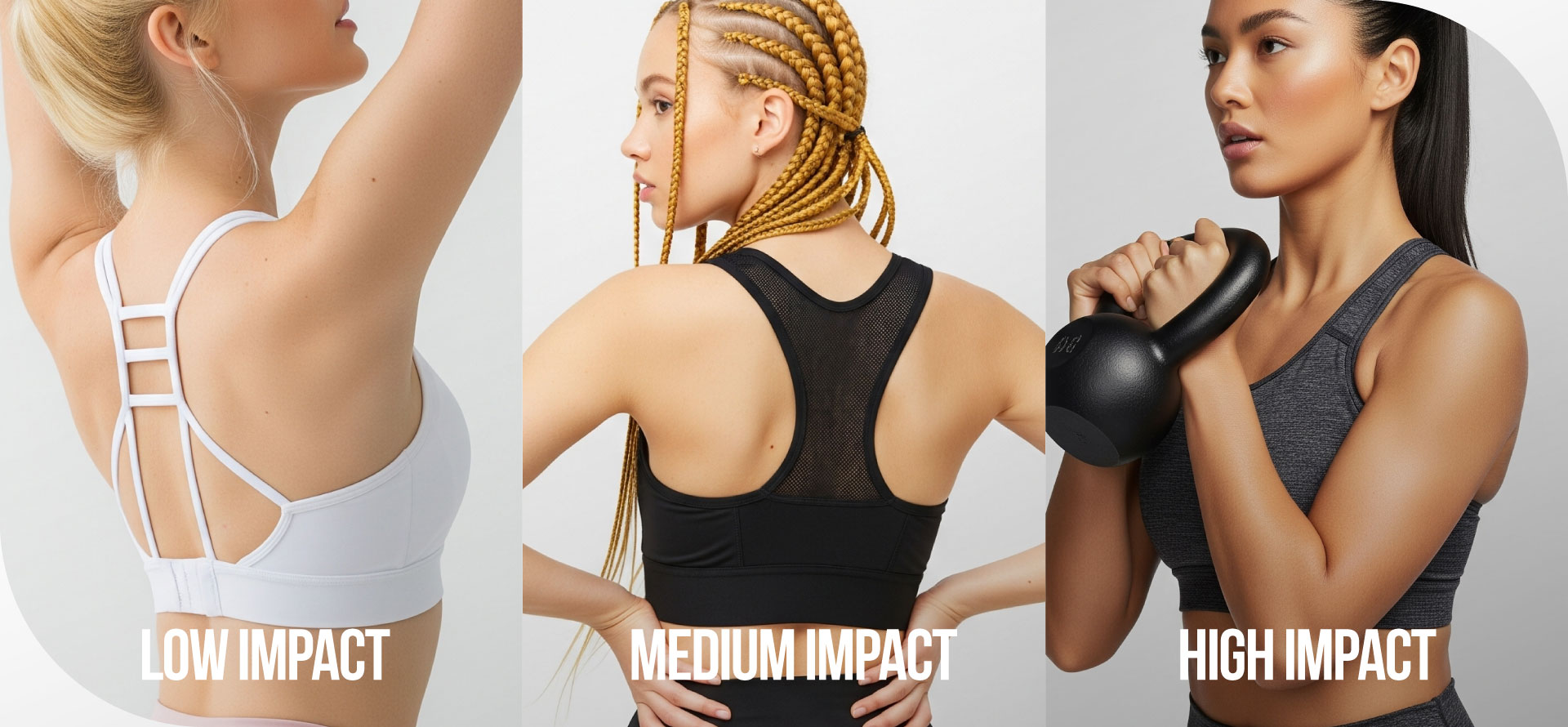
Consider the designs shown in the image below. The transition from a "low impact" to a "high impact" design is a direct response to an increase in the magnitude and complexity of these stress vectors. The high-impact bra uses wider straps and a fuller back to distribute powerful tensile and shear forces over a larger area, reducing the stress at any single point.
Part 2: Identifying Material and Structural Failure Points
Once we have identified the stress vectors, we can predict where they will concentrate and cause failure. Failure points fall into two main categories: material failure (the fabric itself gives way) and structural failure (the way the garment is put together fails).
The article "Fabric Engineering in Performance Wear" provides an excellent overview of the material properties required to withstand these stresses, using the demanding sport of pole dance as a case study, which is an excellent proxy for acrobatic Bollywood routines.
Fabric Engineering in Performance Wear: What Makes Polewear ...
This article from ArtGo Sport breaks down why technical fabrics are essential for high-performance garments. It details the properties that prevent common material and structural failures.
Begin by reading the introduction to understand the performance demands. Then, focus on three key sections: Elastic Recovery and Shape Retention: This discusses material fatigue, a primary failure mode where fabric loses its "snap-back." Durability Under Friction and Load: This section covers abrasion resistance and fabric tearing. Seam Placement and Biomechanical Design: This explores how construction choices create or mitigate structural failure points.
As the article highlights, key failure points include:
-
Material Failure:
- Loss of Elastic Recovery: The fabric sags and no longer provides support. This happens when the elastane fibers are repeatedly stretched beyond their limit, failing to return to their original length. This is a catastrophic failure for a support garment.
- Abrasion and Pilling: The fabric surface is damaged by friction, leading to a worn appearance and eventually, thinning that can result in a tear.
- Tearing: The fabric itself rips under excessive tensile or shear stress.
-
Structural Failure:
- Seam Bursting: The thread holding a seam together breaks. This is common at points of high tensile stress, like where a strap joins a cup.
- Component Failure: The underband rolls or folds, hardware breaks, or an underwire pokes through its casing.
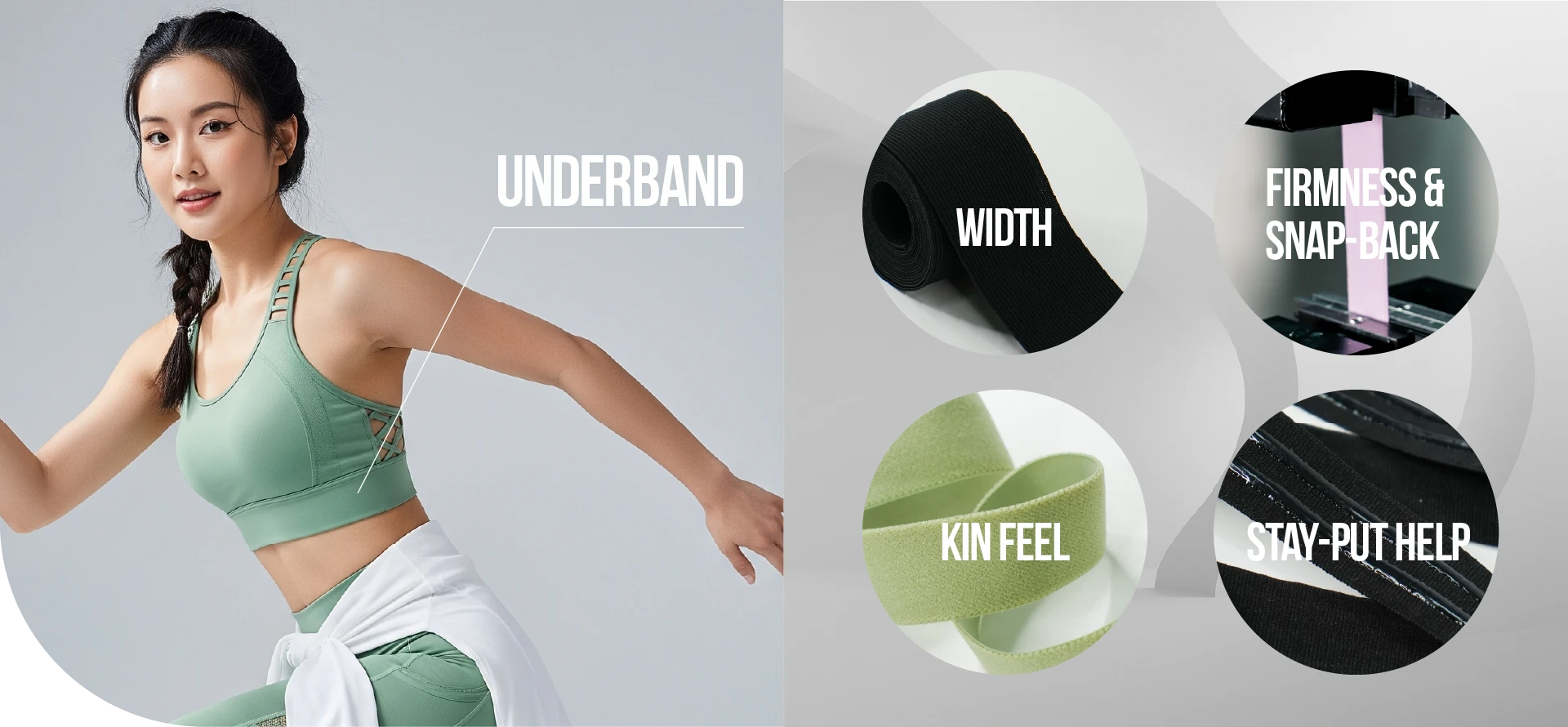
The underband is the primary anchor of the bra and a hub for stress vectors. Its design is critical for preventing structural failure.
Part 3: The Biomechanics of Support - A Quantitative Approach
To truly engineer a garment, we need to move beyond a qualitative description and look at the underlying biomechanics. The fundamental job of a sports bra is to control the movement of the breast relative to the torso during dynamic activity. Uncontrolled relative motion is the source of the most significant stress on the garment's components and on the Cooper's ligaments within the breast.
A fascinating study, "Breast-torso movement coordination during running," provides a quantitative framework for understanding this relationship. Given your background, the methodology will be of particular interest, as it uses techniques like vector coding to analyze the phase relationship between two oscillating systems (the breast and the torso).
Breast-torso movement coordination during running in different breast support
This research paper offers a deep dive into the biomechanics of breast support. It quantifies how different bra types control motion. We will focus on the conceptual takeaways and the analytical framework used.
Please read the following sections: The Introduction, which frames the problem in terms of coupling, predictability, and complexity transfer—concepts familiar from stochastic processes. The Vector coding subsection in the Methods. This explains how movement is quantified into four patterns: in-phase, anti-phase, torso dominant, and breast dominant. The first two paragraphs of the Discussion. They explain the practical implications of achieving "in-phase" coordination. The first two paragraphs of the Conclusion, which summarize the "locking" mechanism of effective bras.
The key takeaways from this research provide a powerful lens for our design work:
- In-Phase vs. Anti-Phase Motion: The goal of a high-support bra is to create in-phase motion, where the breasts move in unison with the torso. The most damaging and uncomfortable situation is anti-phase motion, where the breasts are still moving up while the torso is moving down after a jump. This lag generates immense strain on the bra's straps and band.
- The 'Locking' Mechanism: A well-engineered bra, particularly an encapsulation style, effectively "locks" the breast to the torso. This minimizes independent movement and dramatically reduces the magnitude of the stress vectors the fabric and seams must handle.
- Quantifying Chaos: Without proper support, breast motion is more chaotic and less predictable. The paper shows that with increasing support, the motion of the breast becomes more predictable based on the motion of the torso. A design that fails to control this motion subjects the garment's structure to erratic, multi-directional forces, increasing the probability of failure.
By analyzing choreography through this biomechanical lens, you can identify which movements are most likely to induce anti-phase motion (e.g., high jumps, drops, abrupt changes in direction) and therefore require the most robust structural solutions.
Conclusion
In this lesson, we have laid the groundwork for the entire quality assurance process. We moved from the general idea of performance to a specific, analytical framework for understanding garment stress. By deconstructing choreography into stress vectors and mapping them to potential failure points, we can preemptively engineer solutions rather than react to failures.
Key Takeaways:
- Stress Vectors: Garment stress is not a single value but a vector with magnitude and direction (tensile, shear, etc.) that can be mapped by analyzing a performer's movements.
- Failure Points: Failures can be material (fabric fatigue, tearing) or structural (seam bursts, component breakage). They occur where stress vectors concentrate.
- The Biomechanical Goal: The primary function of a support bra is to minimize the relative motion between the breast and torso, creating "in-phase" movement.
- Engineering Control: An effective bra imposes a "locking" mechanism, reducing the chaotic, independent motion of the breasts and thereby mitigating the most destructive forces acting on the garment.
Next Lesson Preview
Now that you can identify and define the stresses a garment will face, our next step is to measure them. In the next lesson, we will leverage your expertise in Design of Experiments to "Design a standardized testing protocol to measure fabric and seam resilience against multi-directional stress." You will learn how to create repeatable, quantitative tests to validate that your material and construction choices can withstand the forces we've defined today.