Bonjour!
In our last lesson, we established the rules for conjugating the three groups of regular French verbs. This was a huge step, as it unlocked your ability to use thousands of verbs correctly. However, as with any language, some of the most important verbs don't play by the rules.
Today, we will focus on four of the most common and essential irregular verbs in French. Mastering them is non-negotiable for achieving fluency, as they appear constantly in everyday conversation, professional contexts, and academic work.
Our goal for this lesson is to learn how to conjugate and use these four "super verbs" in the present tense:
aller(to go)faire(to do/make)prendre(to take)venir(to come)
Let's dive in and tackle these one by one.
1. The Challenge of Irregular Verbs
Before we begin, it's helpful to understand why these verbs are different. Unlike the regular verbs we saw last time, there isn't a simple stem-and-ending pattern that applies to all of them. They often have multiple stems and unique endings that simply need to be memorized.
To get a quick overview of this concept, let's watch the beginning of this video.
Group 3 Irregular French Verbs (Present Tense)
In this clip from 'Group 3 Irregular French Verbs' by Learn French With Alexa, the presenter explains that these verbs lack consistent patterns. This will set the right expectation: these verbs are learned through practice and memorization, not by a single rule.
Watch from the beginning until 02:17. Don't worry about the list of 25 verbs she mentions; just focus on the main idea that these 'Group 3' verbs are irregular and require a different approach.
Now that we know what we're up against, let's conquer our first, and most irregular, verb.
2. Aller (to go)
Aller is one of the most frequently used verbs in French. Its conjugation is highly irregular and doesn't resemble its infinitive form at all in most cases.
Let's watch how to conjugate and pronounce it. This video also provides excellent context on how to use it correctly when talking about places.
ALLER - Present tense and prepositions // French conjugation course // Lesson 9
This video, 'ALLER - Present tense and prepositions' by The perfect French with Dylane, is a complete guide to the verb. We'll watch it in parts.
First, watch from 01:33 to 03:24. Pay close attention to the pronunciation of each form. Note the common expressions like 'Comment allez-vous?' and 'Ça va?'.
Here is the full conjugation in a table for your reference.
| Subject | Aller (to go) |
|---|---|
| Je | vais |
| Tu | vas |
| Il/Elle/On | va |
| Nous | allons |
| Vous | allez |
| Ils/Elles | vont |
A key part of using aller is pairing it with the correct preposition. You don't just "go," you "go to somewhere." In French, the word for "to" (à) combines with definite articles (le, la, les).
aller **à la**+ feminine place (e.g.,à la piscine- to the pool)aller **au**(à+le) + masculine place (e.g.,au restaurant- to the restaurant)aller **aux**(à+les) + plural place (e.g.,aux toilettes- to the restrooms)aller **à l'**+ place starting with a vowel (e.g.,à l'école- to school)aller **chez**+ a person's name or a professional (e.g.,chez le docteur,chez Paul)
Let's see this explained with clear examples.
ALLER - Present tense and prepositions // French conjugation course // Lesson 9
Let's continue with the same video from Dylane to master these prepositions.
Watch from 03:41 to 07:17. Focus on understanding when to use 'à la', 'au', 'aux', and 'chez'. This is crucial for using 'aller' correctly in conversation.
Test your understanding!
Complete the sentences with the correct form of aller and the appropriate preposition (à la, au, à l', chez).
- Nous ___ ___ supermarché. (We are going to the supermarket - masculine)
- Tu ___ ___ piscine. (You are going to the pool - feminine)
- Je ___ ___ le médecin. (I am going to the doctor's)
Show answer
- Nous allons au supermarché.
- Tu vas à la piscine.
- Je vais chez le médecin.
3. Faire (to do/make)
Faire is another powerhouse verb used in countless expressions. It can mean "to do" or "to make," and context determines the translation.
20 Most widely used French verbs and their conjugation
Let's look at the conjugation table for 'faire' from the Preply article '20 Most widely used French verbs'. This will be our main reference.
Scroll to verb #5, 'Faire (to do)'. Focus only on the 'Présent (Present)' column for now. Note the unique forms, especially 'vous faites' and 'ils/elles font'.
Here's the conjugation for easy access:
| Subject | Faire (to do/make) |
|---|---|
| Je | fais |
| Tu | fais |
| Il/Elle/On | fait |
| Nous | faisons |
| Vous | faites |
| Ils/Elles | font |
Faire is used in many activities. Since you're interested in sports and nutrition, you'll use it often:
faire du sport- to play sports / to work outfaire la cuisine- to cookfaire les courses- to do the grocery shopping
In a professional or networking context, a common question is:
Qu'est-ce que vous faites dans la vie ?- What do you do for a living?
4. Prendre (to take)
Prendre is a versatile verb. While its primary meaning is "to take," it's also used for having food or drink, and for taking transportation.
This visual guide is perfect for understanding its many uses.
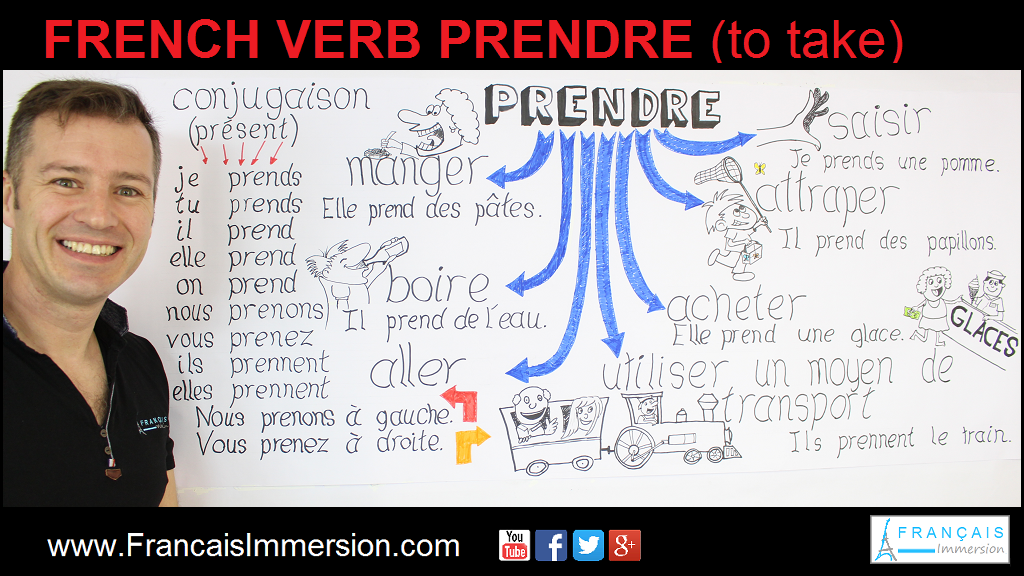
For the conjugation, let's use a clear table.
20 Most widely used French verbs and their conjugation
Let's find the conjugation for 'prendre' in the Preply article.
Scroll to verb #6, 'Prendre (to take)'. Again, just focus on the 'Présent' column. Notice how the 'd' disappears in the plural forms.
A helpful trick with prendre is that other common verbs are conjugated just like it, for example apprendre (to learn) and comprendre (to understand).
Je **prends** le bus.(I take the bus.)J'**apprends** le français.(I am learning French.)Tu ne **comprends** pas.(You don't understand.)
Test your understanding!
Choose the correct verb (prendre, apprendre, or comprendre) and conjugate it to complete the sentence.
- Nous ___ le train pour Paris. (We are taking the train to Paris.)
- Est-ce que vous ___ la question ? (Do you understand the question?)
- Ils ___ à coder. (They are learning to code.)
Show answer
- Nous prenons le train pour Paris.
- Est-ce que vous comprenez la question ?
- Ils apprennent à coder.
5. Venir (to come)
Our final verb for today is venir. It's essential for talking about origins and arrivals.
20 Most widely used French verbs and their conjugation
Last table! Let's get the conjugation for 'venir' from the same Preply article.
Scroll to verb #10, 'Venir (to come)'. Observe the stem change: 'vien-' for singulars and 'ils/elles', but 'ven-' for 'nous' and 'vous'.
Like prendre, venir has a family of verbs that follow its pattern, such as devenir (to become) and tenir (to hold).
Je **viens** de France.(I come from France.)Elle **devient** médecin.(She is becoming a doctor.)
A very common structure is venir de + infinitive, which means "to have just done something."
Je **viens de finir** mon travail.- I have just finished my work.
Conclusion
Excellent work today! You've just learned to conjugate four of the most fundamental verbs in the French language. While they require memorization, their importance cannot be overstated. They are the building blocks for countless conversations.
Key Takeaways:
- Irregular verbs like
aller,faire,prendre, andvenirmust be memorized as they don't follow standard patterns. Alleris highly irregular and requires specific prepositions (au,à la,aux,chez) to indicate direction.Faireis used for "to do" or "to make" and appears in many common expressions for activities (faire du sport).Prendremeans more than just "to take"; it's used for food, drinks, and transportation. Verbs likecomprendreandapprendrefollow the same pattern.Veniris used for "to come" and forms the recent past withvenir de.
Next Lesson: We will build on our verb knowledge by exploring reflexive verbs. These are key to describing daily routines, such as se lever (to get up) and s'habiller (to get dressed), which will bring you one step closer to talking about your own life in French.
À bientôt