Bonjour!
In our last lesson, we mastered four essential irregular verbs: aller, faire, prendre, and venir. You're now equipped to talk about where you're going, what you're doing, and where you're from.
Today, we'll build on that foundation to make your conversations more personal. We will explore reflexive verbs, which are the key to describing your daily life. This is a crucial step toward your goal of discussing your routine in both casual and professional settings. By the end of this lesson, you will be able to describe your daily routine using common reflexive verbs like se lever (to get up) and s'habiller (to get dressed).
Let's begin!
1. What Are Reflexive Verbs?
Reflexive verbs describe an action that the subject does to themself. Think about actions like "I wash myself," "you get yourself dressed," or "he wakes himself up." In French, this "self" action is made explicit using a special pronoun.
To understand this concept and see what these "reflexive pronouns" are, let's watch the first part of a helpful video.
PYF Reflexive Verbs - Present Tense
This video, 'PYF Reflexive Verbs - Present Tense' from the channel Learn French With Alexa, provides a very clear introduction to what reflexive verbs are and which pronouns to use.
Watch from 00:15 to 04:13. Focus on two key things: The idea that the action 'reflects' back to the person doing it. The list of reflexive pronouns and which subject they correspond to.
As the video explained, the reflexive pronoun always comes before the verb. Here is a summary of the reflexive pronouns that correspond to each subject:
| Subject Pronoun | Reflexive Pronoun | English Meaning |
|---|---|---|
| Je | me (m') | myself |
| Tu | te (t') | yourself |
| Il / Elle / On | se (s') | himself / herself / oneself |
| Nous | nous | ourselves |
| Vous | vous | yourself / yourselves |
| Ils / Elles | se (s') | themselves |
You'll notice the (m'), (t'), and (s'). This is called elision, and it happens when the verb that follows starts with a vowel or a silent 'h'. For example, you say je m'habille (I get dressed), not je me habille.
2. How to Conjugate Reflexive Verbs
Conjugating a reflexive verb is a two-step process:
- Choose the correct reflexive pronoun to match your subject.
- Conjugate the verb itself according to its group (e.g., -er, -ir, -re), just as you've done before.
Let's see this in action with the verb se laver (to wash oneself).
PYF Reflexive Verbs - Present Tense
Let's continue with the same video from Learn French With Alexa to see a full conjugation example.
Watch from 04:13 to 07:14. Pay attention to how the reflexive pronoun and the verb ending work together for each subject. Notice the 'double nous' (nous nous lavons) and 'double vous' (vous vous lavez).
Here's the structure in written form. Notice how the verb lever is just a regular -er verb, but the addition of the reflexive pronoun changes its meaning from "to lift" to "to get up."
Talking about school life and daily routine in French
This article from BBC Bitesize, 'Talking about school life and daily routine in French', has a great grammar section that clearly lays out the conjugation of a reflexive verb.
Read the two sections under 'Grammar - Reflexive verbs in the present tense' and 'Reflexive verbs that begin with a vowel or silent h'. This will give you clear tables and examples for se lever and s'habiller.
Test your understanding!
Complete the following sentences with the correct reflexive pronoun and the correct present tense form of the verb in parentheses.
- Je ___ à 7h00. (
se réveiller- to wake up) - Nous ___ pour aller au travail. (
se préparer- to get ready) - Est-ce que tu ___ tard le week-end ? (
se coucher- to go to bed)
Show answer
- Je me réveille à 7h00.
- Nous nous préparons pour aller au travail.
- Est-ce que tu te couches tard le week-end ?
3. Common Verbs for Your Daily Routine
Now, let's learn the essential vocabulary for describing your day. Many daily actions—from waking up to going to sleep—are reflexive in French.
This image provides a great visual list of the most common reflexive verbs you'll need.
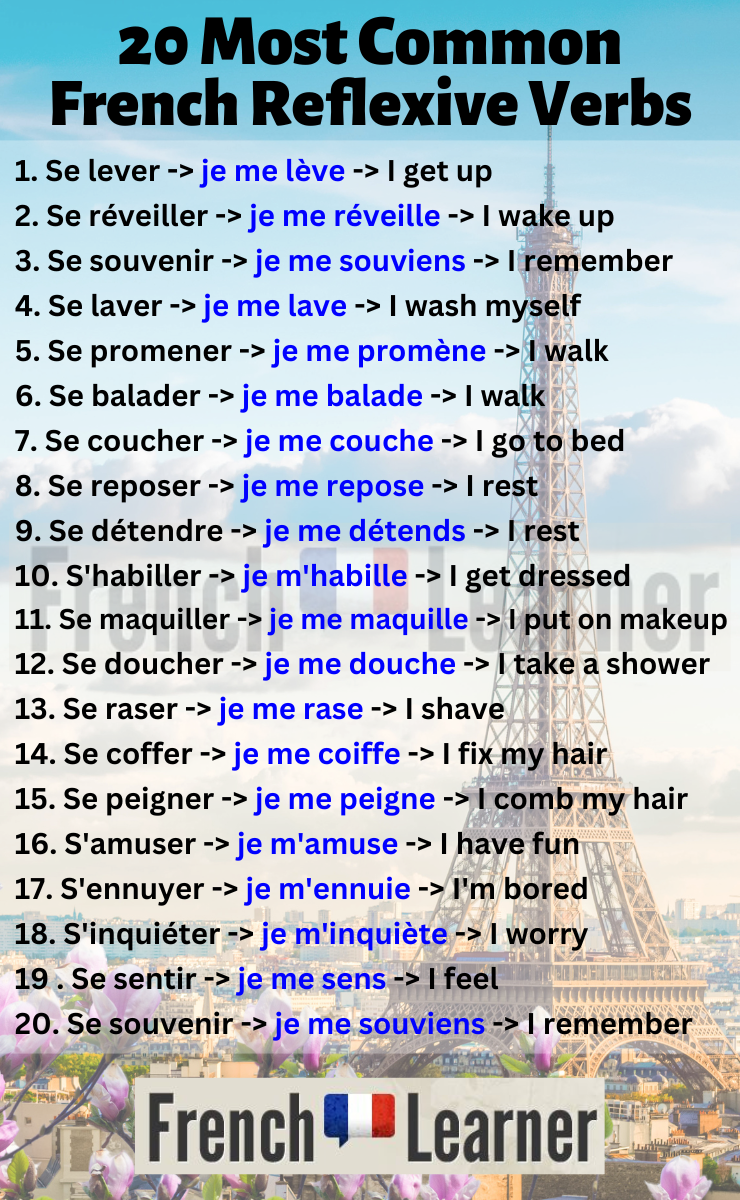
Here are a few key verbs from that list, perfect for describing a typical morning:
se réveiller- to wake upse lever- to get upse doucher- to take a showerse brosser les dents- to brush one's teeths'habiller- to get dressedse coucher- to go to bed
4. Putting It All Together: Describing Your Day
You now have the grammar and the vocabulary. Let's combine them to form sentences and tell the story of a typical day.
French Daily Routines: Reflexive Verbs & Present Tense
This article, 'My Day in French: Mastering Daily Routines with Reflexive Verbs', provides excellent examples of how to build a narrative about your day.
Read the section 'Building Your Daily Routine Narrative'. Notice how reflexive verbs are mixed with non-reflexive verbs (like prendre and aller, which you learned last lesson) to create a more complete description.
Now, let's practice your listening skills and see how a native speaker describes her day.
Talking about school life and daily routine in French
In the BBC Bitesize article, there's a short video of a woman named Detchen describing her routine. It's a perfect real-world example.
Find the section 'Video - Describing daily routine' and watch the video. Then, read the French transcript below it and check your understanding with the English translation. Listen for verbs like se réveiller, s'habiller, and se coucher.
Now it's your turn! Using the verbs you've learned, try to describe your own morning. This is excellent practice for fluency. Since you are interested in sports and nutrition, feel free to include sentences like Je me lève et je fais du sport (I get up and I do sport) or Je me prépare un petit-déjeuner sain (I prepare myself a healthy breakfast).
Practice describing your morning
Write 3-4 sentences in French describing what you typically do in the morning. For example: "I wake up at..., then I get up. I take a shower and I get dressed."
Try to write your sentences first, then look at the example below.
Show example answer
- D'habitude, je me réveille à six heures et demie. (Usually, I wake up at 6:30.)
- Puis, je me lève et je me douche. (Then, I get up and I take a shower.)
- Après la douche, je m'habille et je prends mon petit-déjeuner. (After the shower, I get dressed and I have my breakfast.)
Conclusion
Félicitations (Congratulations)! You've successfully learned how to use reflexive verbs to describe daily actions. This is a major step in being able to talk about your personal life and routines, which is fundamental to achieving conversational fluency.
Key Takeaways:
- Reflexive verbs describe an action done to oneself and require a reflexive pronoun (
me, te, se, nous, vous, se). - The reflexive pronoun is placed before the conjugated verb.
- The verb part is conjugated normally in the present tense, while the pronoun matches the subject.
- Remember to use elision (
m',t',s') before a verb starting with a vowel or silent 'h' (e.g.,je m'habille). - You can now build a simple narrative of your day using verbs like
se lever,se doucher, andse coucher.
Next Lesson: You can now make statements about your daily life. In our next lesson, we will learn how to ask questions. You'll learn how to use intonation, est-ce que, and inversion to ask people about their routines, professions, and more, which is essential for engaging in two-way conversations.
À bientôt