Bonjour ! Welcome to the next lesson in our module on French for Professional Settings.
In our last session, we focused on how to introduce yourself confidently in a job interview by answering the classic question, « Parlez-moi de vous ». Today, we shift from spoken to written communication, which is often the very first contact you'll have with a potential employer or professional contact.
Your goal for this lesson is to identify the key phrases used for opening and closing a formal French email. Mastering these essential building blocks is the first step toward writing professional and respectful emails, a skill we will put into practice in our next lesson.
1. The Anatomy of a Formal French Email
Just like a professional outfit, a formal email has a standard structure that shows you understand the conventions of the environment. The main parts are:
L'objet(The Subject Line)La formule d'appel(The Salutation / Opening)Le corps du message(The Body of the message)La formule de politesse(The Closing Formula)La signature(The Signature)
To get a quick overview of this structure, let's watch two short clips from the video "Comment écrire un email formel en français?" by Parlez-vous FRENCH.
Comment écrire un email formel en français? - How to write a formal email in French?
This video provides a clear and simple breakdown of how to structure a formal email in French. We'll start with the subject line and the overall message structure.
Please watch these two clips: 00:47 - 01:26: Focus on why a clear subject line (l'objet) is so important. 02:42 - 03:20: Pay attention to how the message is structured into paragraphs and the crucial reminder to always use the formal vous, which you mastered in our first lesson of this module.
As you saw, a clear subject and a well-structured message using vous are fundamental to making a good professional impression.
2. Formal Greetings: Les Formules d'Appel
The way you start your email is your first-impression. The greeting, or formule d'appel, immediately sets the tone. In a professional context, you must choose a formal and respectful opening.
Let's watch another clip from the same video to see the most common options.
Comment écrire un email formel en français? - How to write a formal email in French?
Now, let's zoom in on the greeting. The phrase you choose depends on whether you know the recipient's name, gender, or title.
Watch from 01:26 to 02:42. Notice how the greeting changes in different scenarios, such as writing to someone you don't know versus a colleague.
To help you remember these key phrases, the following article provides a handy reference table.
How to start, write and sign off an email in French
This article from Berlitz offers a clear summary of formal greetings, including how to address someone by their professional title (like a director or president).
Please read the section 'Email greetings in French' and review the table. This is a great reference sheet to save for when you start writing your own emails.
Here's a quick summary of the most important greetings to know:
- When you don't know the recipient's name:
Madame, Monsieur, - When you know the name and gender:
Monsieur Dupont,orMadame Dubois, - When addressing someone by their title:
Monsieur le Directeur,orMadame la Présidente,
Test your understanding!
You want to email a company's general information address (e.g., info@company.com) to ask about career opportunities. You don't know who will read the email. What is the most appropriate formal greeting to use?
Show answer
The best greeting is Madame, Monsieur,. This is the standard, respectful formula for when you don't know the specific name or gender of the recipient.
3. Formal Closings: Les Formules de Politesse
Ending an email correctly is just as important as starting it well. The closing, or formule de politesse, leaves a lasting impression. French can be more elaborate than English in this regard, but for emails, the trend is towards shorter, but still formal, phrases.
Let's see what our video guide recommends for email closings.
Comment écrire un email formel en français? - How to write a formal email in French?
Let's look at the common options for closing a formal email. As you'll see, they are often simpler than the very long formulas used in traditional letters.
Watch from 05:03 to 06:11. The presenter explains different closing formulas and then mentions the final step: the signature, which should include your full name and contact details.
While there are many options, there is one closing phrase that is incredibly common and versatile in professional French emails.
How to Write an Email in French: A Complete Guide
This article from the blog 'La Pause Café Croissant' highlights the single most useful closing phrase you should learn.
Read section '4. The end (La conclusion)'. Pay special attention to the author's top recommendation and the explanation of why it's so useful.
As the article emphasizes, Cordialement, is your most reliable choice. It's the equivalent of "Kind regards" or "Best regards" and is appropriate for nearly all professional contexts.
Other common options include:
Bien à vous,(A slightly warmer, but still formal, alternative toCordialement,)Meilleures salutations,(Best regards,)
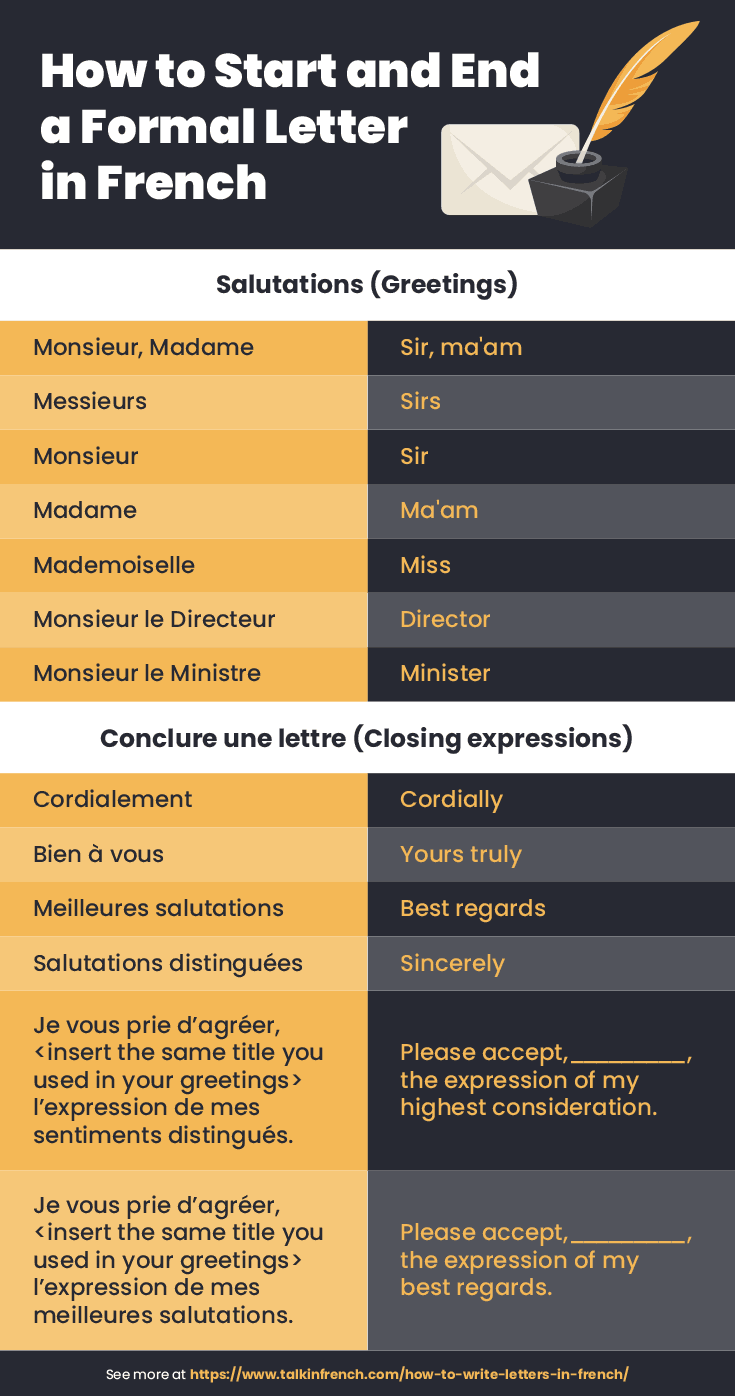
You may also encounter very long formulas, like those in the chart below. These are typically reserved for highly formal or administrative correspondence, like a formal letter, rather than a daily email.
Conclusion
Bravo ! You are now familiar with the essential phrases that frame a professional French email. Knowing how to open and close your message correctly demonstrates respect and cultural awareness, which are crucial in any professional setting.
Key Takeaways:
- Structure Matters: A formal email always includes a clear
Objet,Formule d'appel,Corps du message,Formule de politesse, andSignature. - Formal Greetings: Start with
Madame, Monsieur,if the recipient is unknown, orMonsieur/Madame [Last Name],if they are known. - Formal Closings:
Cordialement,is the most common, safe, and professional closing for emails.Bien à vous,is another excellent option. - Signature: Always end with your full name and, in a professional context, your title or contact information.
Next Lesson Preview:
Now that you can identify these key phrases, you're ready to put them to use. In our next lesson, we will move on to the next step: writing a simple professional email to request information or an appointment. You will combine today's phrases with sentences to form a complete, polite, and effective message.
À la prochaine !