Bonjour ! Welcome back to our module on French for Professional Settings.
In our last lesson, you mastered the use of the formal vous register, a cornerstone of professional French. You learned why it's crucial for showing respect in contexts like job interviews and business meetings.
Today, we will put that knowledge into immediate, practical use. Your goal is to introduce yourself as a job seeker and describe your professional goals. We will focus on tackling the most common opening question in any French job interview: « Parlez-moi de vous » ("Tell me about yourself"). This lesson is a major step toward your goal of using French in a professional environment.
1. Understanding the Interviewer's Goal
When a recruiter asks « Parlez-moi de vous », they aren't asking for your life story. They want a concise, professional summary that helps them understand three key things.
To learn what these three things are, and what common mistakes to avoid, let's watch a video from Thomas l'Ingénieur, who specializes in career advice for the French market.
💼 Parlez Moi de Vous en Entretien : Comment Répondre ? Étudiants & Ingénieurs
This video, 'Parlez Moi de Vous en Entretien', breaks down exactly how to answer this critical interview question. We will focus on the core structure he recommends.
Please watch from the beginning to 08:06. Pay close attention to: The three mistakes to avoid (01:47). The three essential elements a recruiter is looking for (03:51). The alternative 'Présent - Passé - Futur' (Present - Past - Future) structure, which is a very effective way to frame your answer (07:23).
As the video explains, a strong answer should be a brief narrative that covers:
- Qui vous êtes (Who you are - Present): Your current status and key strengths.
- Ce que vous pouvez apporter (What you can contribute - Past): Your relevant skills and experiences.
- Ce que vous voulez (What you want - Future): Your career goals and why you're interested in this specific role.
This "Present - Past - Future" structure is your roadmap for the perfect introduction.
2. Building Your Introduction: Essential Vocabulary
Now that you have the structure, let's gather the French phrases you'll need to build your own introduction. The following resource is an excellent source for professional vocabulary.
Interviewing in French: 50 essential phrases, questions, ...
The article 'Interviewing in French: 50 essential phrases' from italki provides a fantastic list of ready-to-use expressions for job interviews.
Read the sections 'Self-introduction formulas' and 'Discussing skills and strengths'. You don't need to memorize everything, just identify a few phrases that seem useful for each part of our 'Present - Past - Future' structure.
Here are some key phrases from that resource, organized by our structure:
1. Le Présent (Who you are):
Je m’appelle [votre nom].(My name is [your name].)Je suis passionné(e) par [domaine].(I am passionate about [field].)Je suis quelqu’un de très organisé(e) / rigoureux(se) / créatif(ve).(I am a very organized / rigorous / creative person.)
Note: Remember to make the adjective agree with your gender (-efor feminine).
2. Le Passé (What you can contribute):
Mon parcours m’a permis de développer des compétences en…(My background has allowed me to develop skills in…)Mes principales compétences incluent…(My main skills include…)J’ai une forte capacité à résoudre des problèmes.(I have a strong ability to solve problems.)J’aime travailler en équipe.(I enjoy teamwork.)
3. Le Futur (What you want):
Aujourd'hui, je cherche à...(Today, I am looking to...)Mon objectif professionnel est de...(My professional goal is to...)Je souhaite intégrer une entreprise comme la vôtre pour...(I wish to join a company like yours in order to...)
3. Handling the "No Experience" Challenge
A common concern is, "How do I talk about my past contributions if I don't have professional experience?" This is a normal situation for job seekers at the start of their career. Recruiters don't expect a long list of jobs; they look for potential.
The key is to connect your skills from other areas of your life—academics, personal projects, or even sports and hobbies—to the needs of the job.
This next video is specifically for candidates without formal experience.
Entretien d'embauche sans expérience, stage, alternance (7 erreurs de débutant)
This video, 'Entretien d'embauche sans expérience', directly addresses your situation. The coach explains how to turn your lack of experience into a strength.
Watch the following two clips: 01:27 - 02:53: This section explains that recruiters hiring beginners are looking for potential and the ability to learn. 11:39 - 13:29: This 'bonus' section is incredibly valuable. It lists 10 categories of arguments you can use, drawing from life experience, sports, community life, etc. Pay special attention to argument #5, 'Sports practice', given your interest.
As the video highlights, you can draw from many sources:
- Sports practice (
la pratique sportive): Shows team spirit (esprit d'équipe), competitiveness (esprit de compétition), and discipline. - Life experience (
l'expérience de vie): Shows adaptability (capacité d'adaptation). - Personal projects (
les projets personnels): Can demonstrate skills like organization, creativity, or technical ability.
Think about your own interests. How has your interest in sports, for example, helped you develop discipline, resilience, or teamwork? These are all valuable professional qualities.
Test your understanding!
Imagine you are applying for a junior role in a cybersecurity company (connecting to your interest in security). Which of these phrases would be most effective for demonstrating your potential, even without work experience?
a) "Je n'ai pas d'expérience." (I have no experience.)
b) "Pendant mon temps libre, j'ai suivi des formations en ligne sur la sécurité des réseaux et j'ai monté mon propre petit laboratoire à la maison pour m'entraîner. Cela m'a permis de développer ma capacité à résoudre des problèmes de manière autonome." (In my free time, I took online courses on network security and set up my own small lab at home to practice. This allowed me to develop my ability to solve problems independently.)
c) "J'ai toujours été bon avec les ordinateurs." (I've always been good with computers.)
Show answer
Option (b) is the best. It doesn't just state an interest; it provides a concrete example of initiative (j'ai suivi des formations), practical application (j'ai monté mon propre laboratoire), and a resulting professional skill (résoudre des problèmes de manière autonome). It demonstrates passion and potential, which is exactly what recruiters are looking for in a beginner.
4. Putting It All Together: A Model Introduction
Let's assemble these pieces into a coherent introduction. We will create a template based on the "Présent - Passé - Futur" model, designed for a candidate at the beginning of their career.
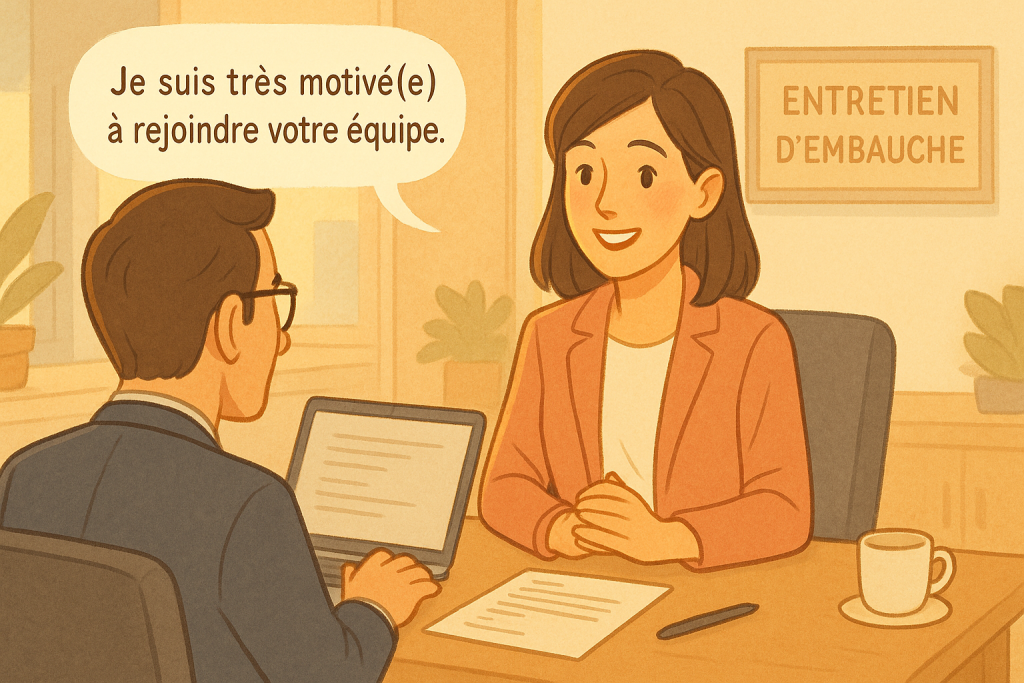
Here is a template you can adapt:
Modèle d'introduction (Introduction Template)
[Le Présent]Bonjour Monsieur/Madame, je m'appelle [Votre Nom]. Je suis un(e) jeune diplômé(e) / candidat(e) passionné(e) par le domaine de [votre domaine d'intérêt, ex: la sécurité informatique]. Ce qui me caractérise, c'est ma curiosité et ma grande capacité d'apprentissage.
(Hello Sir/Madam, my name is [Your Name]. I am a recent graduate / candidate passionate about the field of [your field of interest, e.g., IT security]. What defines me is my curiosity and my strong ability to learn.)
[Le Passé]Bien que je débute ma carrière, j'ai pu développer des compétences concrètes grâce à [votre expérience pertinente, ex: mes projets personnels / ma pratique sportive]. Par exemple, en tant que [votre rôle, ex: capitaine de mon équipe de sport], j'ai appris l'importance de la discipline et de la collaboration pour atteindre un objectif commun.
(Although I am starting my career, I was able to develop concrete skills thanks to [your relevant experience, e.g., my personal projects / my sports practice]. For example, as [your role, e.g., captain of my sports team], I learned the importance of discipline and collaboration to reach a common goal.)
[Le Futur]Aujourd'hui, mon objectif est de trouver une opportunité où je pourrai mettre mon énergie et mes compétences au service d'une équipe dynamique. Votre entreprise m'intéresse particulièrement parce que [raison spécifique, ex: vous êtes un leader dans l'innovation / vos valeurs correspondent aux miennes]. Je suis convaincu(e) que je peux rapidement devenir un atout pour votre équipe.
(Today, my goal is to find an opportunity where I can apply my energy and skills to a dynamic team. Your company interests me particularly because [specific reason, e.g., you are a leader in innovation / your values align with mine]. I am convinced that I can quickly become an asset to your team.)
Your Turn: Draft Your Introduction
Now it's your turn to practice. Using the template and vocabulary above, try to write one sentence for each part of the introduction that is true for you.
- Le Présent: Who are you? (e.g.,
Je suis un candidat passionné par...) - Le Passé: What skill have you developed through a non-work activity? (e.g.,
Grâce au sport, j'ai appris...) - Le Futur: What is your goal? (e.g.,
Mon objectif est de...)
Take a few minutes to think and write down your sentences. This is the first step to building a confident and effective self-introduction.
Conclusion
Excellent work today! You have learned not just a set of phrases, but a strategic framework for introducing yourself as a job seeker in French. You are now equipped to answer « Parlez-moi de vous » in a way that is professional, confident, and tailored to your unique profile.
Key Takeaways:
- Structure is Key: Use the Present - Past - Future model to tell a compelling story about who you are, what you can do, and where you want to go.
- Leverage All Experiences: Without formal work experience, draw on personal projects, academics, sports, or volunteering to showcase valuable skills like discipline, teamwork, and problem-solving.
- Focus on Potential: Show your enthusiasm, motivation, and ability to learn. This is what recruiters value most in entry-level candidates.
- Always Use
Vous: Remember from our last lesson, every interaction in this context must use the formalvous.
Next Lesson Preview:
You've learned how to make a great impression in person. But before you get the interview, you often need to communicate in writing. In our next lesson, we will focus on identifying key phrases in a formal French email, covering the essential openings and closings you'll need to request information or an appointment professionally.
Félicitations pour vos progrès et à la prochaine !