Bonjour ! In our last lesson, you did a great job combining the imparfait and passé composé to tell a short story. We ended by noting that to make stories sound even more natural, we need to avoid repeating the same nouns over and over.
That's exactly what we'll focus on today. This lesson is the first step in making your sentences more efficient and fluid. Your learning outcome is to use direct object pronouns (le, la, les) to avoid repetition. Mastering this will make your French sound less like a textbook and more like the fluent conversation you're aiming for.
1. What is a Direct Object Pronoun?
In short, these are little words that replace nouns. Instead of saying "I see the cat," and then "I pet the cat," you can say "I see the cat. I pet it." The word "it" is a direct object pronoun.
In French, the most common ones for replacing things or people are le, la, and les.
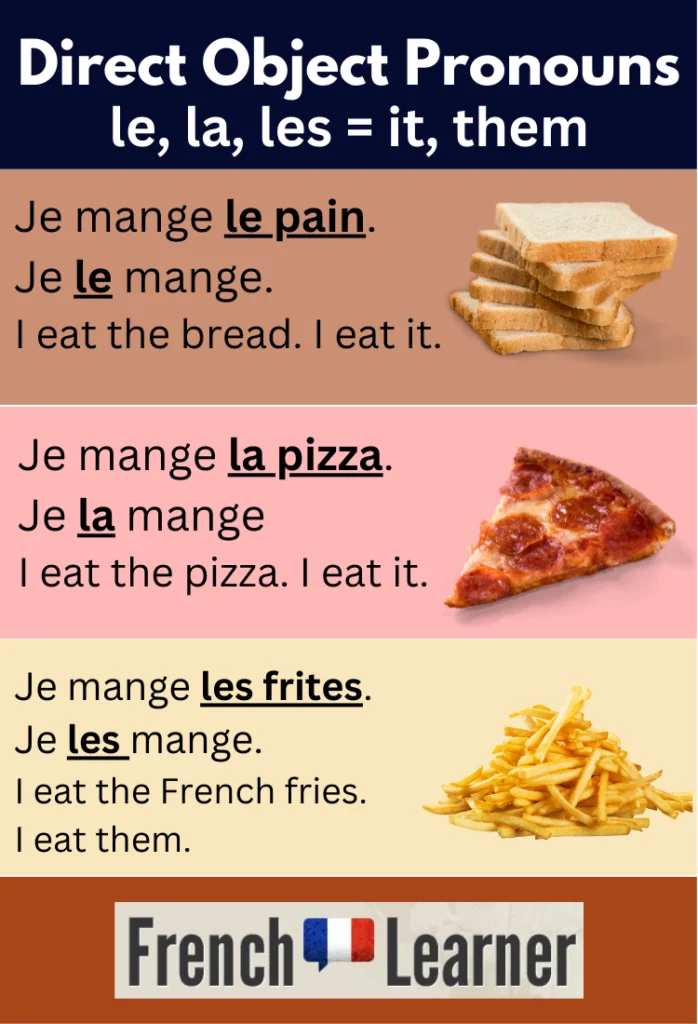
The first step is to be able to spot the direct object in a sentence.
2. How to Find the Direct Object
The direct object is the person or thing that directly receives the action of the verb. The easiest way to find it is to ask "qui?" (who?) or "quoi?" (what?) right after the verb.
Let's look at some examples:
- Elle lit un livre. (She reads a book.)
- Question: Elle lit quoi? (She reads what?)
- Answer: un livre. So,
un livreis the direct object.
- Je vois Marie. (I see Marie.)
- Question: Je vois qui? (I see who?)
- Answer: Marie. So,
Marieis the direct object.
For a clear summary of this technique, let's turn to a quick reading.
French direct object pronouns: Me, te, le, la and how to use ...
The article 'French direct object pronouns' from Preply gives a concise explanation of how to identify the direct object.
Read the section 'Identifying the direct object'. Focus on the 'qui?' or 'quoi?' method and look at the examples provided.
3. Choosing the Right Pronoun: le, la, l', les
Once you've found the direct object, you replace it with a pronoun that matches its gender and number.
lereplaces a masculine singular noun.- le livre (the book) →
le
- le livre (the book) →
lareplaces a feminine singular noun.- la pomme (the apple) →
la
- la pomme (the apple) →
lesreplaces a plural noun (masculine or feminine).- les livres, les pommes →
les
- les livres, les pommes →
A special case: Elision
If le or la comes before a verb that starts with a vowel or a silent 'h', it becomes l'.
- J'aime le chocolat. → *Je **l'*aime. (I like it.)
- Tu écoutes la radio. → *Tu **l'*écoutes. (You listen to it.)
The following video provides a great visual explanation of these pronouns.
Understand Direct Object Pronouns in French | Complément d'objet direct (COD)
Alexa from the 'Learn French With Alexa' channel clearly demonstrates how the pronouns 'le' and 'la' match the gender of the noun and what happens before a vowel.
Watch from 07:51 to 11:58. The first part (until 09:57) explains how the pronoun agrees in gender, using the example 'le film'. The second part (from 09:57) explains the elision rule, using 'la fleur' and 'aimer' as examples.
Test your understanding!
Which pronoun would you use to replace the underlined direct object in this sentence?
Je regarde la télévision.
Show answer
You would use la because télévision is a feminine singular noun. The sentence becomes: Je la regarde.
4. Where to Place the Pronoun
This is where French differs most from English. In English, the pronoun comes after the verb ("I see him"). In French, the direct object pronoun almost always comes before the verb.
Let's review the main placement rules.
Understand Direct Object Pronouns in French | Complément d'objet direct (COD)
This next segment of the same video from Alexa explains the placement rules for the most common situations you will encounter.
Watch from 11:58 to 14:08. Pay close attention to the three main rules presented: Before the conjugated verb (e.g., Je le connais). Before the auxiliary verb in compound tenses like the passé composé (e.g., Je l'ai vu). Before the infinitive when there are two verbs (e.g., Je vais le voir).
Let's summarize those key rules:
-
With one verb (e.g., Present Tense): The pronoun goes right before the verb.
- Tu manges la pomme. → Tu la manges.
- In the negative: Tu ne la manges pas. (The pronoun stays right before the verb, inside the
ne...pas.)
-
With the
Passé Composé: The pronoun goes before the auxiliary verb (avoirorêtre).- J'ai vu le film. → *Je **l'*ai vu.
- Nous avons invité nos amis. → Nous les avons invités.
-
With two verbs (e.g.,
aller+ infinitive): The pronoun goes before the infinitive (the unconjugated verb).- Je vais acheter le livre. → *Je vais **l'*acheter.
5. An Important Agreement Rule for the Passé Composé
You've learned that with the auxiliary avoir, the past participle usually doesn't agree. There is one major exception: When the direct object pronoun comes before the verb, the past participle must agree with that pronoun in gender and number.
This is a tricky rule, but it's essential for writing correctly.
- J'ai acheté la voiture. (féminin singulier)
- → Je l'ai achetée. (We add an
-eto agree withl'which representsla voiture)
- → Je l'ai achetée. (We add an
- J'ai vu les films. (masculin pluriel)
- → Je les ai vus. (We add an
-sto agree withles)
- → Je les ai vus. (We add an
- J'ai pris les photos. (féminin pluriel)
- → Je les ai prises. (We add an
-esto agree withles)
- → Je les ai prises. (We add an
Let's watch a final clip that explains this rule very clearly.
Understand Direct Object Pronouns in French | Complément d'objet direct (COD)
Alexa explains this agreement rule with excellent side-by-side examples.
Watch from 18:25 to 22:15. Focus on the explanation of why 'Nous avons invité' becomes 'Nous les avons invités' and why 'J'ai vu Marie' becomes 'Je l'ai vue'. This directly connects to your work with the passé composé.
6. Practice Time
Now, let's put all these rules into practice. The following resource has a set of exercises that are perfect for reinforcing what you've learned.
French direct object pronouns: Me, te, le, la and how to use ...
The Preply article 'French direct object pronouns' you saw earlier has a great practice section at the end. It will allow you to test your understanding of all the rules we've covered.
First, go to the section 'Practice French direct object pronouns with exercises'. Complete both the 'Fill-in-the-blank questions' and the 'Short sentence transformation' exercises on your own. Then, check your work using the 'Answers' section immediately below it.
Conclusion
Très bien! You've just learned a fundamental concept for making your French more natural and fluent. By replacing nouns with pronouns, your sentences become less repetitive and more sophisticated.
Key Takeaways:
- Direct object pronouns (
le,la,les) replace nouns that answer the questionqui?orquoi?after a verb. - The pronoun must match the noun's gender and number (
lefor masc.,lafor fem.,lesfor plural). - The most important rule: the pronoun is placed before the verb (or the auxiliary verb in
passé composé). - In the
passé composéwithavoir, the past participle must agree in gender and number with the preceding direct object pronoun.
Next Lesson Preview:
In our next lesson, we'll continue this topic by looking at indirect object pronouns (lui, leur). These pronouns also help avoid repetition but answer the question "to whom?" instead of "what?". For example, "I am talking to Paul" becomes "I am talking to him." You'll see that they follow very similar placement rules.
À la prochaine!