Bonjour! In our last lesson, we took a big step toward making your French sound more natural by using direct object pronouns (le, la, les) to avoid repeating nouns. We learned that these pronouns replace the "what?" or "who?" of a verb's action.
Today, we'll continue this journey toward fluency by looking at another set of essential pronouns. Your learning outcome for this lesson is to use indirect object pronouns (lui, leur) to avoid repetition. These pronouns answer the question "to whom?", which is common in professional and social conversations, like giving information to a colleague or talking to friends.
1. From Direct to Indirect: What's the Difference?
In the last lesson, you learned to find the direct object by asking quoi? (what?) or qui? (who?) after the verb.
- Je vois le chien. (I see the dog.) -> Je vois quoi? -> le chien. (Direct Object)
An indirect object is typically the person who receives or benefits from the action, but not directly. We find it by asking à qui? (to whom?) or à quoi? (to what?).
Let's look at a sentence with both:
- Je donne le livre à Marie. (I give the book to Marie.)
- Je donne quoi? ->
le livre(The Direct Object) - Je donne à qui? ->
à Marie(The Indirect Object)
- Je donne quoi? ->
This distinction is crucial. To get a clear explanation, let's watch a short video.
Understanding POI and COI in French! 🇫🇷
This video from 'Learn French With Alexa' clearly defines the indirect object (complément d'objet indirect, or COI) and shows how to identify it in a sentence.
Watch the first 3 minutes and 17 seconds of the video. Focus on how the presenter uses the questions 'what?' (quoi?) and 'to whom?' (à qui?) to separate the direct object from the indirect object.
2. Introducing lui and leur
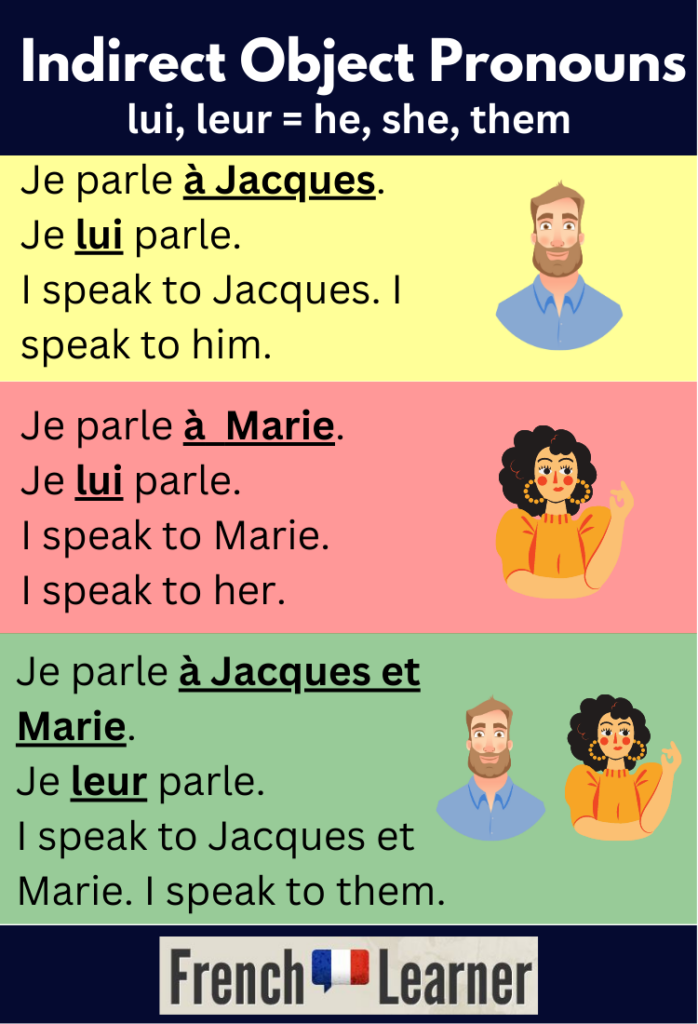
Just as le, la, and les replace direct objects, lui and leur replace indirect objects. This makes your sentences much more efficient.
luireplaces a singular indirect object (one person).leurreplaces a plural indirect object (two or more people).
Here are two key things to remember:
Luiis gender-neutral: It means both "to him" and "to her". This simplifies things! You don't need to worry about whether the person is masculine or feminine.Leuris invariable: It never adds an-s. It's always justleurwhen used as an indirect object pronoun.
Let's see them in action:
- Je parle à Paul. → Je lui parle. (I'm speaking to him.)
- Je parle à Marie. → Je lui parle. (I'm speaking to her.)
- Je parle à mes parents. → Je leur parle. (I'm speaking to them.)
This infographic provides a perfect visual summary of this concept.
Test your understanding!
Which pronoun would you use to replace the underlined indirect object in this sentence?
Le manager donne les instructions à son assistante. (The manager gives the instructions to his assistant.)
Show answer
You would use lui. Even though assistante is feminine, lui is used for any single person. The sentence becomes: Le manager lui donne les instructions.
3. The Golden Rule: Verbs with à
How do you know for sure when to use lui or leur instead of the direct object pronouns you learned last time? The secret lies in the verb's structure.
Indirect object pronouns are used with verbs that are followed by the preposition à before a person.
For example:
parler à quelqu'un(to speak to someone)téléphoner à quelqu'un(to phone someone)donner quelque chose à quelqu'un(to give something to someone)demander quelque chose à quelqu'un(to ask someone for something)
If the verb doesn't have à before the person or object, you use a direct object pronoun.
voir quelqu'un(to see someone) -> Je vois Paul. -> Je le vois.appeler quelqu'un(to call someone) -> J'appelle Paul. -> *Je **l'*appelle.
This video does an excellent job of comparing these two types of verbs.
Lui, leur OR le, la, les in French? Pick correctly EVERY TIME with this trick - French pronouns
The channel 'French in Plain Sight' explains this 'trick' of looking for the preposition 'à' to decide which pronoun to use. The comparison it makes to the direct object pronouns from our last lesson is very helpful.
Watch from 01:19 to 04:04. Pay close attention to the contrast between verbs like 'parler à' (which need 'lui'/'leur') and verbs like 'regarder' (which need 'le'/'la'/'les').
To make this practical, it's useful to start learning some of the most common verbs that are followed by à.
How To Use Le La Les Lui Leur in French
This article provides a convenient list of common verbs that use the preposition 'à'. Familiarizing yourself with these will help you use 'lui' and 'leur' correctly and automatically over time.
Focus on the section '1- List of the common French verbs that take preposition à'. Pick 3 verbs from the list and try to make a simple sentence for each, like 'J'écris à un client.' (I am writing to a client.)
4. Placement and Common Pitfalls
Just like direct object pronouns, indirect object pronouns are placed before the verb.
- Je lui parle. (I speak to him/her.)
- Je ne lui parle pas. (I don't speak to him/her.)
- J'ai parlé à Sophie. -> Je lui ai parlé. (I spoke to her.)
- Je vais parler à Sophie. -> Je vais lui parler. (I am going to speak to her.)
Two common points of confusion to avoid:
-
leurvs.leurs: The indirect object pronounleur(to them) is invariable (it never changes). Don't confuse it with the possessive adjectiveleurs(their), which is used before a plural noun.- Pronoun: Je leur parle. (I speak to them.)
- Adjective: Ce sont leurs livres. (These are their books.)
-
luivs.l': The pronounluinever contracts before a vowel. The elisionl'is only forleorla.- Correct: Je lui envoie un e-mail. (I send an email to him/her.)
- Incorrect: Je l'envoie un e-mail.
5. Practice
Now, let's practice choosing the correct pronoun. The following exercise mixes direct (le, la, les) and indirect (lui, leur) pronouns, which is a great way to test your understanding from this lesson and the last one.
How To Use Le La Les Lui Leur in French
It's time to apply what you've learned. This exercise will challenge you to select the correct pronoun based on the verb in the sentence.
Go to the section 'Exercice to practice pronouns le, la,les, lui, leur'. Complete questions 2, 3, 5, 6, 8, 10, and 11 on your own. Then, check your answers using the 'Exercise correction' section.
Conclusion
Excellent work! You have now learned how to use both direct and indirect object pronouns. This is a significant milestone that will make your French more concise, sophisticated, and closer to your goal of fluency.
Key Takeaways:
- Indirect object pronouns
lui(to him/her) andleur(to them) replace nouns that answer the questionà qui?. - The key is to identify verbs constructed with the preposition
à, such asparler à,téléphoner à, anddonner à. luiis for a single person (gender-neutral), andleuris for multiple people (and is invariable).- Like direct object pronouns, they are placed before the main verb or the auxiliary.
Next Lesson Preview:
In the next lesson, we will do a comprehensive review of pronoun placement. You'll master where to place le, la, les, lui, and leur in a variety of tenses and sentence structures, including negative sentences and questions. This will give you the confidence to use them correctly in any context.
À la prochaine!