Hello! Welcome back to your guitar journey.
In our last lesson, you mastered the "master recipe" for the major scale: the W-W-H-W-W-W-H formula. You now know that this scale isn't just a random collection of notes, but a structured palette of sounds that forms the foundation for countless songs.
Today, we're going to learn how to use that palette to create harmony. We'll select specific notes from the major scale to build the most fundamental chords in all of Western music: major and minor triads. This lesson is all about understanding the "why" behind the chord shapes you already play and the ones you're about to learn.
Your learning outcome for this lesson is to explain how major and minor triads are built by stacking thirds from the major scale.
Part 1: From a Scale to a Chord — The "Skip-a-Note" Method
The simplest type of chord is a triad, which, as the name suggests, is a group of three notes. The core idea behind building them is remarkably simple: you start on a note from the major scale and then consistently skip the next note.
Let's use the G Major scale you practiced last week as our example:
G - A - B - C - D - E - F#
- Start on the first note (the root): G
- Skip the second note (A) and take the third: B
- Skip the fourth note (C) and take the fifth: D
Played together, the notes G, B, and D form a G Major triad. These three notes—the root, 3rd, and 5th degrees of the scale—are the essential ingredients.
This process is often called "stacking thirds". Let's start with a quick reading that clarifies this concept.
Understanding the basics of guitar chord theory
This article, 'Understanding the basics of guitar chord theory' from Happy Bluesman, clearly explains how to create a basic triad by selecting notes from the major scale.
Read the section titled 'Creating triads'. It introduces the idea of triads being made of three notes separated by a third and explains the 'skip-a-note' logic using the C Major scale.
Part 2: The Two "Flavors" of Thirds
You might be wondering: if we use the same "skip-a-note" process, how do we end up with different types of chords, like major and minor?
The answer lies in the fact that not all thirds are created equal. In our previous lessons, we defined intervals by the number of semitones (frets) between them. The interval of a "third" can have two main qualities:
- A Major Third (M3) spans 4 semitones (4 frets). It has a bright, happy sound.
- A minor Third (m3) spans 3 semitones (3 frets). It has a darker, more melancholic sound.
This subtle one-fret difference is what gives major and minor chords their distinct emotional character.
Playing Thirds on Guitar - Guitar Music Theory Lesson
This video from Ry Naylor Guitar, 'Playing Thirds on Guitar', offers a concise explanation of major and minor thirds. Seeing and hearing the difference is key.
Watch from 00:43 to 02:01. Focus on how a major third is defined as four frets and a minor third as three frets. Notice how lowering a major third by one fret (one semitone) transforms it into a minor third.
Part 3: The Triad Formulas
Now, let's combine these two ideas. A triad is built by stacking two thirds on top of a root note. The specific combination of major and minor thirds creates the triad's overall quality.
Here are the two fundamental formulas:
-
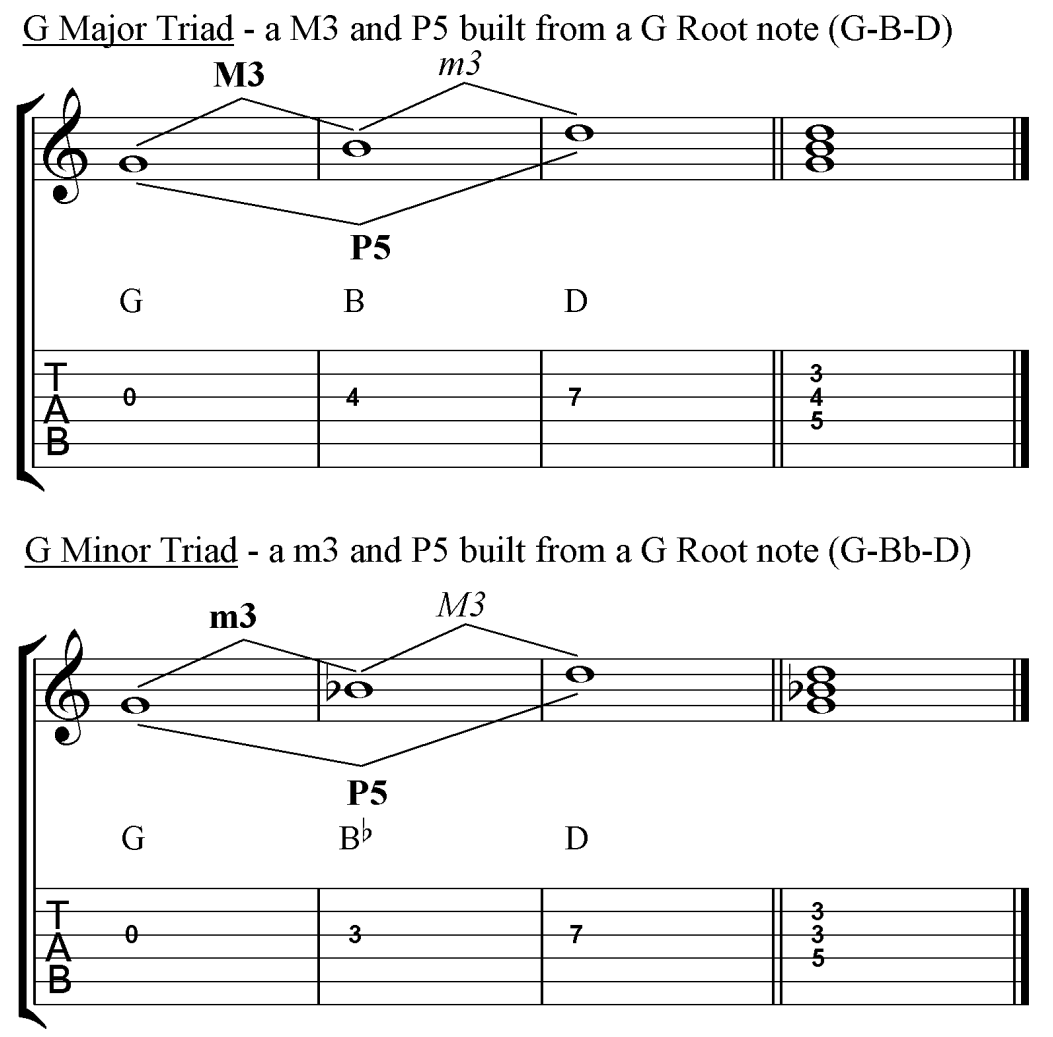
Major Triad: Root + Major Third + minor Third
- The interval from the Root to the 3rd is a Major Third (4 frets).
- The interval from the 3rd to the 5th is a minor Third (3 frets).
- Example: G Major (G → B is 4 frets; B → D is 3 frets)
-
Minor Triad: Root + minor Third + Major Third
- The interval from the Root to the 3rd is a minor Third (3 frets).
- The interval from the 3rd to the 5th is a Major Third (4 frets).
- Example: A minor (A → C is 3 frets; C → E is 4 frets)
Notice that in both cases, the total distance from the root to the 5th is 7 semitones (a Perfect Fifth). The only note that changes is the 3rd.
This table from the Applied Guitar Theory website summarizes it perfectly.
Major Scale Chords: What they are and how to build them
This article, 'Major Scale Chords: What they are and how to build them,' provides a clear, systematic breakdown of triad formulas.
Read the section 'Chord Theory' up to the start of 'Building Major Scale Chords'. Pay close attention to the table that defines the four qualities of triads. For now, just focus on the 'Major' and 'Minor' rows.
This image provides a great visual summary of the structure of Major and minor triads.
Part 4: Building All the Triads of a Major Scale
Now for the main event. What happens if we apply our "stacking thirds" method starting on every single note of the major scale, using only the notes available within that scale?
This process is called harmonizing the scale, and it reveals a beautiful, predictable pattern of chord qualities. It's the theoretical engine that generates the chords for any given key.
Let's watch a detailed walkthrough of this process. The instructor will build a triad off each of the seven degrees of the major scale and analyze the quality of each one.
Music Theory for Guitar - Diatonic Major Scale Triads
The video 'Music Theory for Guitar - Diatonic Major Scale Triads' by Move Forward Guitar demonstrates this process step-by-step. This is the core concept of today's lesson.
Watch from 04:40 to 12:14. First, see how the triad built on the 1st degree is major (04:40-05:47). Then, follow along as he builds a triad on the 2nd degree, 3rd degree, and so on, using only the notes from the original major scale. Observe which ones turn out major and which ones turn out minor.
As you saw in the video, harmonizing the major scale always produces the same pattern of triad qualities:
- 1st degree: Major
- 2nd degree: minor
- 3rd degree: minor
- 4th degree: Major
- 5th degree: Major
- 6th degree: minor
- 7th degree: diminished (We will focus on this chord type in a later lesson)
To solidify this, let's review the same process in a written format, using our familiar G Major scale.
Major Scale Chords: What they are and how to build them
Let's return to the 'Major Scale Chords' article. This section provides a written breakdown of exactly what you just saw in the video, using the G Major scale.
Read the section 'Building Major Scale Chords'. Go through each scale degree (1st through 6th) and see how the intervals between the notes result in either a major or minor triad, confirming the pattern above. Don't worry about the 7th degree for now.
This structure is a fundamental blueprint in music. The fact that the chords on the 1st, 4th, and 5th degrees are major, while the 2nd, 3rd, and 6th are minor, is the basis for countless chord progressions in rock, blues, and pop.
Part 5: Connecting Theory to Your Guitar
So, how does this theory connect to the chords you already play? An open G major chord on your guitar might use all six strings, but it's still just a G major triad. The only notes present are G, B, and D, simply repeated in different octaves.
Let's read a short section that makes this crucial connection.
Understanding the basics of guitar chord theory
This final reading from the 'Understanding the basics of guitar chord theory' article will give you that 'aha!' moment, linking the three-note triad concept to the familiar chord shapes you already know.
Read the section 'Triads & chords'. It clearly explains how common open chords like C major and G major are just triads with some notes repeated.
Conclusion
Great work today! You've taken a significant step from simply knowing what to play to understanding why it works. This knowledge is the key to unlocking the fretboard and thinking more musically.
Key Takeaways:
- Triads are three-note chords built by stacking thirds (or skipping every other note) from a scale. The core notes are the root, 3rd, and 5th.
- The quality of a triad is determined by the specific "flavors" of the thirds used:
- Major Triad = Major 3rd (4 frets) + minor 3rd (3 frets).
- Minor Triad = minor 3rd (3 frets) + Major 3rd (4 frets).
- Harmonizing the major scale (building a triad on each degree) creates a predictable pattern of chords: Major, minor, minor, Major, Major, minor, and diminished.
Preview of the Next Lesson:
We've now established the theory of what a triad is. In the next lesson, we will get practical. You will learn how to construct and play major and minor triads on the fretboard using movable shapes. This will allow you to find and play these essential harmonic building blocks anywhere on the neck.