Hello! Welcome back to your guitar course.
In our last lesson, we explored intervals, the fundamental distances between notes. You learned how to measure these distances in semitones (frets) and identify their shapes on the fretboard. This was a crucial step in understanding the "why" behind the music you play.
Today, we'll use that knowledge to assemble those building blocks into something incredibly powerful: the Major Scale. We will learn a universal formula that allows you to construct this scale starting on any note. This scale is the blueprint for a vast amount of Western music, forming the basis for countless melodies, solos, and chord progressions in the rock and blues genres you love.
By the end of this lesson, you will be able to construct major scales using the W-W-H-W-W-W-H formula.
Part 1: The "Magic Formula" of the Major Scale
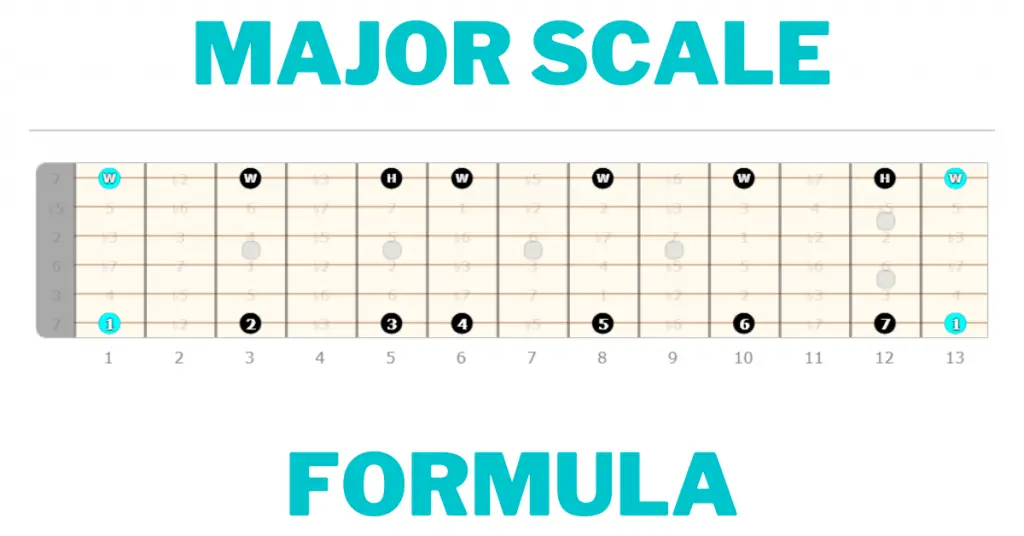
In the previous lesson, you learned that a one-fret distance is a half step (or a minor 2nd interval), and a two-fret distance is a whole step (or a major 2nd interval). The major scale is simply a specific, seven-note sequence of these steps.
The formula is: Whole - Whole - Half - Whole - Whole - Whole - Half
Or, as a shorthand: W-W-H-W-W-W-H
Memorize this pattern. It is the key that unlocks every major scale.
Let's start with a video that introduces this formula and clarifies what whole and half steps look like on the guitar.
Music Theory for GUITAR #1: Major Scales
This video, 'Music Theory for GUITAR #1: Major Scales' by Scott Paul Johnson, clearly explains the W-W-H-W-W-W-H formula. It's a great starting point.
Watch from 01:06 to 02:31. The instructor presents the formula and defines whole and half steps on both guitar and piano, which helps solidify the concept.
Another very effective way to remember this pattern is to think of it as a phone number, where 2 represents a whole step (2 frets) and 1 represents a half step (1 fret).
The "phone number" is: 221-2221.
This visual and numerical pattern might appeal to your background in design and information systems—it's a simple, elegant algorithm for generating a pleasing musical structure.
Part 2: Building a Scale with the Formula
Now, let's see how this formula works in practice. We'll use it to systematically figure out the notes for any major scale. This process reveals exactly why some keys have sharps (♯) and others have flats (♭).
We'll return to Scott Paul Johnson's video. He uses a "scratch paper" method with a piano keyboard layout, which is an excellent way to visualize the process of applying the W-W-H formula, regardless of the instrument.
Music Theory for GUITAR #1: Major Scales
Let's watch how the formula is applied to build a C Major scale (which has no sharps or flats) and then an A Major scale (which requires sharps).
Watch from 02:31 to 07:49. First, observe how the C major scale (C-D-E-F-G-A-B) perfectly fits the W-W-H-W-W-W-H pattern without any alterations. Next, pay close attention to how he constructs the A major scale. When a step in the natural musical alphabet doesn't fit the formula (e.g., B to C is a half step, but the formula requires a whole step), he modifies the note with a sharp to 'correct' the distance. This is the logic behind key signatures.
Your Turn: Quick Theory Exercise
Before moving on, grab a pen and paper and try this yourself. Let's build a G Major scale.
- Start with the root note: G
- Apply the formula step-by-step:
- G + Whole Step = ?
- ... + Whole Step = ?
- ... + Half Step = ?
- ...and so on, until you return to G.
Remember to use your fretboard knowledge from our first lesson to count the frets if you get stuck. The notes of the musical alphabet must always stay in order (G, A, B, C, D, E, F...).
(You should find that you need to alter one of the notes to make the formula work. The correct answer is G-A-B-C-D-E-F#-G).
Part 3: Taking the Formula to the Fretboard
Understanding the theory is one thing; playing it is another. Let's translate this formula into motion on the guitar.
The One-String Method
The most direct way to see and feel the W-W-H-W-W-W-H pattern is to play it along a single string. This removes the complexity of changing strings and allows you to focus purely on the sequence of intervals.
Learn the Major Scale on Guitar
This article from the Blues Guitar Institute explains the benefit of learning scales on a single string. It makes the abstract formula tangible.
Read the sections 'What is the Major Scale?' and 'Learn the Major Scale on One String'. This will reinforce the formula and show you how to apply it linearly.
Now, let's see this one-string method in action.
Music Theory for GUITAR #1: Major Scales
Let's go back to the Scott Paul Johnson video. He demonstrates playing several major scales linearly on one string, making the pattern very clear.
Watch from 15:05 to 18:27. Notice how the physical pattern of fret movements is identical for C major, F major, and D major. The only thing that changes is the starting fret.
The Positional Method: A More Practical Shape
While the one-string method is great for learning, it's not very practical for playing melodies or solos. We typically play scales "in position," across several strings. There are many patterns for this, which we will cover in depth in a later module. For now, let's learn one of the most common and useful shapes.
This shape starts with the root note on the 6th string (the low E string).
Music Theory for GUITAR #1: Major Scales
Finally, let's see how the linear scale can be 'wrapped' to fit into a compact, movable shape.
Watch from 22:04 to 23:49. The video demonstrates a G Major scale played in position. Pay attention to the fingering and the path the scale takes across the strings. This is a 'closed' shape, meaning it uses no open strings and is therefore fully movable anywhere on the neck.
This specific pattern is your first truly movable scale shape. If you start it on the 3rd fret of the low E string (G), you get the G Major scale. If you slide the entire shape up two frets and start on the 5th fret (A), you get the A Major scale. This is a foundational concept for navigating the fretboard.
Part 4: Practice Plan
Your preference for structured learning will be very useful here. Consistent, focused practice is key to internalizing this. Here is a plan for the next few days, based on the exercises from the Blues Guitar Institute.
Goal: Master the G Major scale as your first reference point.
(Notes: G - A - B - C - D - E - F#)
-
Day 1-2: Single-String Practice (Focus: Internalizing the W-W-H pattern)
- Play the G Major scale ascending and descending on the G string (open 3rd string).
- As you play each note, say its name out loud: "G... A... B... C... D... E... F-sharp... G..."
- Repeat this on the D string (starting on the 5th fret).
- Aim for 5 clean repetitions on each string.
-
Day 3-4: Positional Practice (Focus: Memorizing the movable shape)
- Use the movable shape we learned, starting on the 3rd fret of the low E string.
- Play the scale ascending and descending. Use a metronome at a slow tempo (e.g., 60 bpm), playing one note per click.
- This time, as you play, say the interval number (scale degree): "1... 2... 3... 4... 5... 6... 7... 1(octave)..." This connects the shape back to its underlying structure.
- Aim for 5-10 clean repetitions.
-
Day 5-6: Moving the Shape (Focus: Understanding movability)
- Take the exact same shape you practiced for G major and move it up to the 5th fret. Your first note is now A.
- Play the A Major scale using this shape. The fingering pattern is identical.
- Try to name the notes as you play them (A - B - C# - D - E - F# - G#). Notice how the sharps appear automatically because you are using the correct shape.
Conclusion
Excellent work. You've now learned the master recipe for the major scale, a cornerstone of music theory. You can not only derive the notes of any major key but also play it on the fretboard in a practical, movable way.
Key Takeaways:
- The major scale is built with the formula: Whole-Whole-Half-Whole-Whole-Whole-Half (W-W-H-W-W-W-H).
- This formula is universal and allows you to construct a major scale starting from any of the 12 notes in music.
- Sharps and flats are necessary to maintain the W-W-H pattern when starting on different root notes.
- Major scale patterns on the guitar are movable. The same shape can be used to play in different keys simply by changing the starting fret.
Preview of the Next Lesson:
Now that we can build the major scale, what can we do with it? The notes of the scale are like a palette of colors. In our next lesson, we will learn how to pick specific notes from this palette—the 1st, 3rd, and 5th degrees—to build major and minor triads. These three-note chords are the absolute foundation of harmony in rock, blues, and pop music.