Welcome back. The previous lesson connected Diwali lights with a traditional account of Rama, Sita, and Lakshmana’s return to Ayodhya. This lesson follows a different connection between story and practice: in one Tamil Deepavali household example, the day begins before sunrise with an oil bath, and Narakasura’s defeat is one important story associated with the occasion. The aim is to understand both the connection and its limits—not to turn one household’s practice into a rule for southern India.
A victory told in more than one way
Narakasura is an asura, a powerful figure whose harmful actions bring him into conflict with Krishna. In a telling discussed by The Hindu, he troubles divine beings, sages, and others. Krishna goes to confront him with Satyabhama, his consort. The account identifies Satyabhama with Bhudevi, or Mother Earth, and says that she urges Narakasura’s punishment. Krishna kills Narakasura in her presence. The victory can be understood as righteousness prevailing over harmful conduct.
Read the short account before considering how its details vary. The same article also gives one devotional explanation of the festival oil bath.
Celebration of Deepavali - The Hindu
Read “Celebration of Deepavali” in The Hindu for its account of Krishna, Satyabhama, and Narakasura, and for the religious meaning it assigns to the oil bath.
In the opening part of the article, after the sentences contrasting the Puranas and Dharma Sastras, read the Narakasura account. Stop before the paragraph beginning “Dharma Sastra grantha.” Then find the final short paragraph beginning “On the day of Deepavali, called Narakachaturdasi” and read the bath explanation. Notice who the article says kills Narakasura, what Satyabhama does, and how it describes the oil and water.
Satyabhama’s presence matters even where Krishna delivers the fatal blow. Her identification with Bhudevi gives the confrontation a family connection to Narakasura, and her words make her an active participant rather than a bystander. Other popular retellings give Satyabhama a still more decisive role, saying that she herself kills Narakasura. These should not be collapsed into a single account: “Krishna kills him while Satyabhama is present” and “Satyabhama kills him” differ on a central detail. Neither should be silently substituted for what The Hindu article actually says.

The previous lesson treated the return to Ayodhya as a sacred narrative, not a verified record of a first historical Diwali. The same distinction applies here. A family can understand Deepavali through Narakasura’s defeat without claiming that the event and every present-day custom have been independently documented as a continuous historical sequence.
The day begins before sunrise
Return now to the festival timeline from the first module. Naraka Chaturdashi is associated, in a common sequence, with the day before the new-moon Diwali evening. But the center of a family’s celebration need not be the same day or time of day as the main evening in that sequence. In the Tamil household account below, attention falls on early morning: oil is applied before sunrise, then washed off in a bath.
Read the reported household description with two questions of interpretation in mind: what does the person quoted say happens, and what meaning does she give it? Her emphatic description of “Tamil Deepavali” conveys the importance of the practice to her; it is not a survey of every Tamil household.
Read the opening household account in The Indian Express to see how a pre-dawn oil bath is performed and understood in one reported Tamil example.
At the start of the article, read from the paragraph beginning “On the auspicious day of Deepavali” through the quoted account attributed to Padma Mathrubootham, ending with her explanation of the greeting about the holy bath: the morning account. Further down, after the paragraph comparing northern and southern stories, read from “As per mythology, goddess Mahalaxmi” through the sentence about leaving behind jealousy: the symbolic explanation. Focus on the reported ritual and symbolic meanings, rather than treating the article’s broad regional claims as rules for every family.
In the household account, an older family member applies a little sesame oil to people’s heads before sunrise; the oil is then washed off. The speaker calls the bath Ganga snanam—a holy bath associated in meaning with the Ganges—and describes relatives asking whether it has been taken. That greeting shows how a private act of washing can also become part of a shared festival morning.
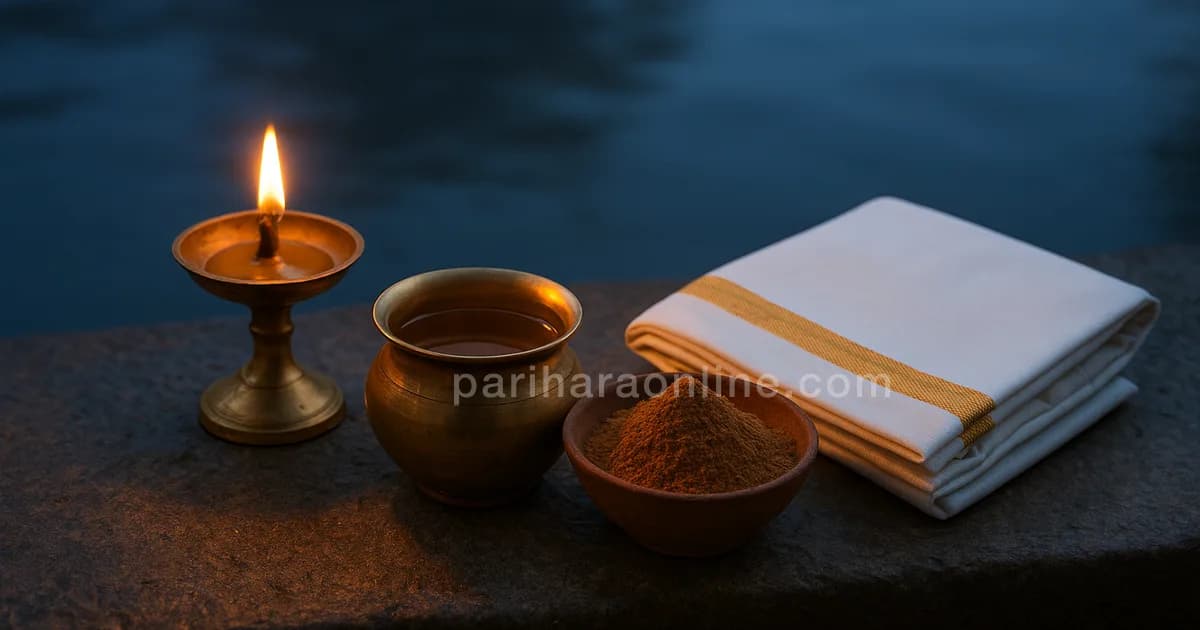
The two readings offer related, though not identical, ways of explaining the bath. The Hindu reports the devotional belief that Lakshmi is present in the oil and Ganga in the water. The Indian Express includes an interpretation of the bath as a fresh beginning, leaving behind quarrels and jealousy. These are meanings assigned to the practice, not claims that ordinary washing physically removes moral faults. Nor does the Narakasura story require us to imagine the bath as a reenactment of the battle. Story and ritual can belong to the same celebration without every gesture depicting an episode in the story.
Connecting the story, bath, and household—carefully
A careful explanation can hold three levels together. The festival story marks Narakasura’s defeat as the end of harmful conduct; its retellings differ over Satyabhama’s part in that defeat. The calendar association places Naraka Chaturdashi near the new-moon celebration studied earlier. The household practice, in the reported example, makes the festival’s beginning tangible through a pre-dawn oil bath understood as holy and renewing.
Those levels illuminate one another, but none makes the others universal. Knowing that a family takes an oil bath does not tell you whether it recounts Krishna as the slayer, Satyabhama as the slayer, or the story at all that morning. Likewise, knowing that Narakasura’s defeat is important to a family does not tell you exactly who applies the oil, which preparations they use, or which day receives the greatest emphasis. Those details belong to family custom and would require the family’s own account.
This is why “southern Deepavali” is too broad a label for a single ritual script. The reported Tamil example is specific enough to study: it gives a time, an action, a household role, and an explanation of holiness. It is not evidence that all Tamil families—still less all southern families—celebrate alike. It also need not compete with the Ayodhya account from the previous lesson. The two lessons show different ways people connect a festival season to sacred stories and lived practice.
What to carry forward
The Narakasura account associates Deepavali with the defeat of harmful conduct, while its variants give Krishna and Satyabhama different roles. In one reported Tamil household example, a pre-dawn oil bath marks a holy, renewing start to the day. The story helps explain the occasion; the bath gives that occasion a lived form. Neither establishes a universal southern practice.
Next, you will turn from this early-morning example to a representative household Lakshmi puja, examining how cleaning, lamps, rangoli, and offerings can express welcome and auspicious prosperity without becoming a checklist for every home.