Welcome back. The previous lesson followed one Tamil household’s pre-dawn oil bath and showed how a practice can carry meaning without defining Deepavali for everyone. This lesson shifts to a representative Lakshmi puja on the main Diwali evening. You will see how preparing a home, lighting lamps, making a rangoli, and offering food can express welcome and hopes for prosperity—without turning those actions into a checklist for every family.
Making a home ready
In many Hindu celebrations of Diwali, Lakshmi is worshipped as a goddess associated with prosperity and good fortune. Puja means devotional worship; it may include prayers, offerings, and light. In a Lakshmi-focused household, cleaning is more than a practical way to prepare for visitors. It can also express the wish to make the home a fitting place to welcome the goddess.
Read the Museum of Art & Photography’s short account of this connection. Its description is useful as a representative example, not a prescription for how puja must be performed.
The Story of Diwali — Google Arts & Culture
The Museum of Art & Photography describes how household preparation, lamps, and offerings can be understood as ways of welcoming Lakshmi.
Find the subsection “Lakshmi Puja,” just after the postcard captioned “Postcard depicting Shri Maha Laxmi Pujan.” Read the short account, beginning with the paragraph about the new-moon day and ending with its list of offerings. Stop before the next postcard commentary. Notice how the account connects each action to a welcome rather than presenting a required sequence of supplies.
The account describes people cleaning or painting the house to welcome Lakshmi, then lighting lamps and making offerings after sunset. “To welcome” is the key to interpreting the scene. A clean, cared-for space conveys readiness; light makes the home bright and inviting on a dark new-moon evening. These are devotional meanings, not a claim that cleaning guarantees wealth or that a home left undecorated has failed to celebrate.
Auspicious prosperity is broader than simply acquiring money. It can include a household’s hopes for sufficient food, well-being, flourishing work, and good fortune. A family may give particular weight to one of these meanings. The same action—lighting a lamp, for instance—can also recall the return to Ayodhya studied earlier. One meaning does not cancel the other.
At the threshold: patterns and light
A doorway is a natural focus for a welcome. Some households decorate the floor near an entrance with a rangoli, a pattern made with materials such as colored powder, grains, or flowers. Designs and names vary. The pattern marks the space as festive and cared for; in a Lakshmi puja setting, it may also help express an invitation to auspiciousness. It is not necessary to assume that every rangoli depicts Lakshmi or that every household makes one.
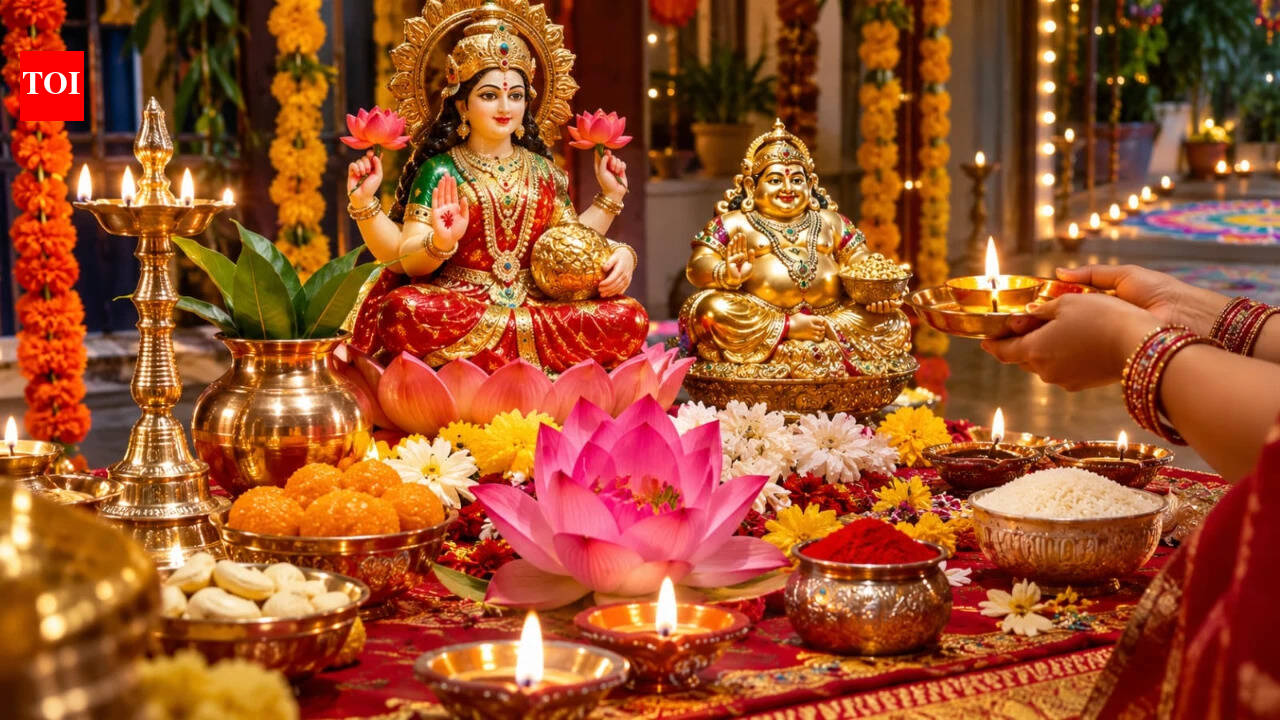
The lamps, often called diyas, carry a related meaning. Placed around an entrance or worship space, they make the welcome visible. Their light may be understood as countering darkness and misfortune, while also serving as an offering in worship. The image below shows how lamps and flowers can transform a small arrangement; it does not document a required household layout.

Watch the selected passages from ReligionForBreakfast’s What is Diwali? for the transition from home preparation to Lakshmi puja.
ReligionForBreakfast’s “What is Diwali?” connects rangoli and cleaning with preparations for the main evening, then explains the belief that Lakshmi is welcomed into the home.
Near the end of the festival-timeline discussion, watch home preparations for cleaning and rangoli. Continue with Lakshmi puja for decorated entrances, prayers, offerings, and aarti. Treat the video’s “third day” as part of a common festival sequence, not a rule that fixes every family’s principal celebration day.
The video describes entrances made bright and welcoming and mentions prayers and offerings during puja. It also notes that some people worship Ganesha alongside Lakshmi. Those details help you recognize a possible household arrangement, but they do not make Ganesha’s presence, an open doorway, or any particular decoration obligatory. The shared interpretive thread is welcome; the physical arrangements can differ.
At the worship space: offerings and abundance
Consider a representative evening scene: a family has prepared a space for worship, lit lamps, and set out sweets or fruit before Lakshmi’s image. An offering is not merely an ornament in this scene. Presenting food can express devotion, gratitude for provision, and hope that the household will continue to have enough. What a family offers may reflect what is available, customary, or meaningful to them.
Prosperity becomes especially tangible when a household connects it with its sources of food. The following regional account gives one example. Read it as a description of traditions associated with Chhattisgarh, not as evidence that every household there does the same things.
Incredible India’s account gives a more specific example of how a decorated entrance and agricultural produce can express welcome and abundance.
Find “3. Day Three: Mahalakshmi Puja / Main Diwali,” then “Major Traditions of Lakshmi Pujan in Chhattisgarh” and its subsection “Worship of Paddy Ears and Traditional Measuring Vessels (Paili/Kaatha).” Read the introductory explanation and examples. Begin with the paragraph relating Lakshmi to food grain and paddy; continue through the decorated entrance, symbolic footprints, paddy ears, and filled measuring vessels. Stop at “Worship Rituals and Offerings (Bhog).” Focus on what the footprints and filled vessels mean, rather than memorizing their names.
In that account, symbolic footprints lead inward from the entrance, making the idea of Lakshmi’s welcome visible in the decoration. Fresh paddy and vessels filled with grain point to abundance not as an abstract sum of money but as food that sustains a household. These details deepen the meaning of “prosperity” while showing why materials differ: a family’s inherited customs and surroundings can shape what it places before the goddess.
The same distinction applies to the sweets, dry fruits, coconut, and flattened rice listed in the Museum of Art & Photography’s account. They are examples of offerings, not a minimum set. A particular offering’s significance depends partly on the worshippers’ tradition and understanding; its mere presence in a photograph cannot tell you everything the family intends by it.
Interpreting without making a checklist
The four practices in this lesson fit together as an expression of hospitality and auspicious hope. Cleaning readies the home. Rangoli can mark an entrance as festive and welcoming. Lamps illuminate the space and may serve in worship. Offerings present valued food before Lakshmi and can give material form to gratitude and hopes for abundance. This is a way to interpret a representative Lakshmi puja, not a test for whether a Diwali celebration is complete.
It also matters whose interpretation is being described. For worshippers, Lakshmi’s welcome may be a devotional reality. From outside a particular household, you can accurately explain that belief and its visible expressions without claiming to know what any family believes from its decorations alone. Conversely, a home without a rangoli might still hold Lakshmi puja; a home with lamps might light them for another story or observance. Visible similarities do not establish identical meanings.
What to carry forward
A household Lakshmi puja can make welcome and auspicious prosperity tangible through a prepared home, decorated threshold, light, and food offerings. The practices work together symbolically, but neither their precise form nor their presence is universal. The contrast with the previous lesson’s pre-dawn household example shows why it is more useful to ask what a practice means in its setting than to search for one Diwali ritual script.
Next, you will compare this Lakshmi-focused example with a Bengali Kali Puja example, where a different devotional focus can shape observances during the same festival season.