Hello! Welcome back to your Kubernetes crash course.
In our last few lessons, we covered workloads that run to completion, either once (Jobs) or on a schedule (CronJobs). These are perfect for stateless, task-based operations like batch processing or running cleanup scripts. However, the backbone of many complex systems consists of applications that need to maintain state—databases, message queues, and other services that remember data across requests and restarts. Your experience managing Kafka platforms is a prime example of working with such a stateful system.
This lesson addresses exactly that challenge. Your learning outcome is to describe the characteristics and use cases of StatefulSets for stateful applications. We will explore why standard Deployments fall short for these scenarios and how StatefulSets provide the necessary guarantees to run them reliably in Kubernetes.
This is a conceptual overview, aligning with the "breadth-first" approach of this course. You won't be creating a StatefulSet yourself, but you will gain the critical understanding needed to design solutions for and troubleshoot stateful services, a common requirement in Platform Engineering interviews.
1. What is a "Stateful" Application?
Before we dive into Kubernetes objects, let's solidify the difference between "stateless" and "stateful" applications. A stateless application treats every request as a new, independent transaction. A web server serving static files is a classic example. In contrast, a stateful application remembers data from previous interactions. Databases are the most common example.
To get a clear picture, let's start with a short, illustrative video.
Kubernetes StatefulSet simply explained | Deployment vs StatefulSet
The video 'Kubernetes StatefulSet simply explained' from TechWorld with Nana provides an excellent introduction to the concept of stateful vs. stateless applications.
Watch the first 2 minutes and 13 seconds (00:00 - 02:13). Focus on how it distinguishes between applications that just process requests (stateless) and those that store and track data over time (stateful).
As the video explains, applications like a Node.js web front-end can be stateless, but the MongoDB database it connects to is stateful. The key takeaway is that stateful applications require their data to persist and be consistently accessible.
2. Why Deployments Aren't Suitable for Stateful Applications
You've learned about Deployments for managing stateless applications. In a Deployment, Pods are treated like interchangeable "cattle." They get random names (e.g., my-app-6d8d8d67c-xqz4k), can be terminated and replaced at will, and often share storage. This model is highly resilient for stateless apps but breaks down for stateful ones.
Let's explore exactly why Deployments are a poor fit for something like a database cluster.
Understanding StatefulSets in Kubernetes
The video 'Understanding StatefulSets in Kubernetes' by That DevOps Guy gives a fantastic and detailed breakdown of the problems that arise when you try to run a stateful application, like a SQL database, using a Deployment.
Watch from 05:00 to 12:31. Pay close attention to the three fundamental problems he identifies: shared storage leading to data corruption, lack of a stable network identity for clustering, and random, unordered scaling.
To summarize the critical issues with using Deployments for stateful services:
- No Stable Identity: Pods get random names and IP addresses on each restart. A database master trying to find its replicas (or vice-versa) would be impossible if their network identities were constantly changing.
- Shared Storage Problem: Multiple Pods in a
Deploymenttypically share a singlePersistentVolumeClaim(if any). Most databases are not designed to have multiple instances writing to the same files simultaneously, which leads to data corruption. - Unordered Operations:
Deploymentsscale up and down randomly. For a database cluster, you often need to add or remove nodes in a specific, graceful order to allow for data resynchronization. ADeploymentmight terminate the master node first, causing an outage.
3. The StatefulSet Solution
To solve these problems, Kubernetes provides the StatefulSet workload API. It's designed specifically to manage stateful applications by providing guarantees that Deployments do not.
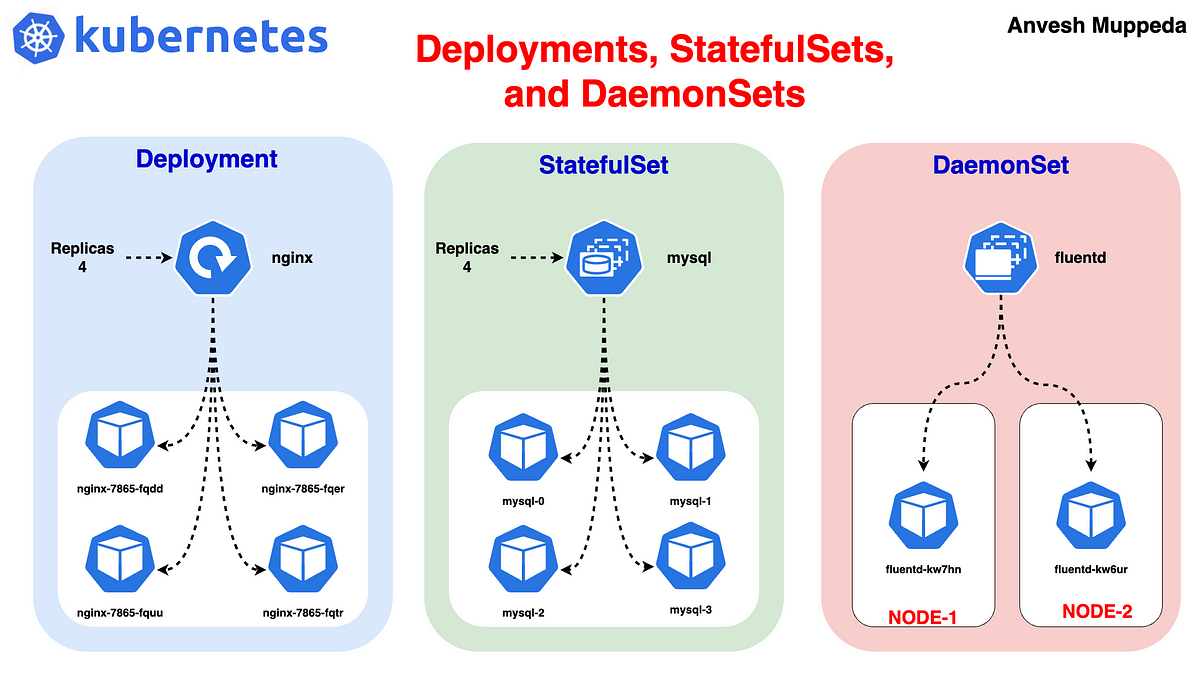
The architecture of a StatefulSet revolves around providing stability.
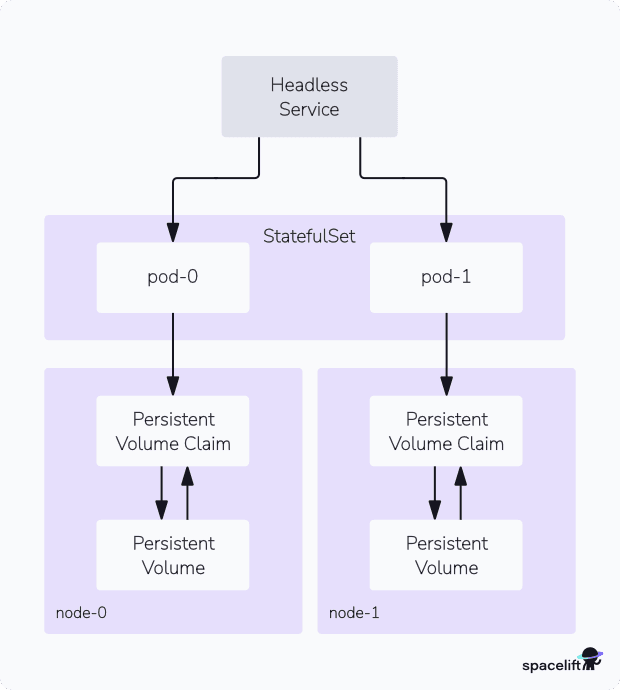
A StatefulSet achieves this through three core guarantees: a stable identity, stable storage, and ordered operations. Let's dig into the official documentation to understand these concepts precisely.
The official Kubernetes documentation on StatefulSets is the definitive source. We'll read the sections that define what a StatefulSet is and how it establishes a 'sticky' identity for its Pods.
First, read the introduction at the top of the page. Then, read the section 'Using StatefulSets' to understand the requirements that lead to using them. Finally, read the crucial 'Pod Identity' section, which explains the Ordinal Index, Stable Network ID, and Stable Storage. These are the core features you need to know.
Let's break down those guarantees based on the documentation:
1. Stable, Unique Network Identity
- Predictable Pod Names: Pods are named with an ordinal index:
<statefulset-name>-0,<statefulset-name>-1, etc. Ifweb-0dies, its replacement is also namedweb-0. - Stable DNS Entries:
StatefulSetsare used with a special "Headless"Service(one whereclusterIPis set toNone). This service doesn't load-balance. Instead, it creates a unique DNS record for each Pod, likeweb-0.nginx.default.svc.cluster.local. This gives every Pod a stable, resolvable network endpoint that other Pods in the cluster can rely on.
2. Stable, Persistent Storage
- Each Pod gets its own dedicated
PersistentVolumeClaim(PVC). This is defined via avolumeClaimTemplatessection in theStatefulSetmanifest. - The storage is "sticky." When the
web-0Pod is recreated, it re-attaches to the exact same PVC that the oldweb-0was using, ensuring its data is preserved.
3. Ordered, Graceful Operations
- Deployment and Scaling Up: Pods are created one at a time, in order of their index (
0, 1, 2, ...).web-1will not start untilweb-0is fully up and ready. This is vital for cluster formation where a primary node must exist before replicas can join. - Deletion and Scaling Down: Pods are terminated in the reverse order (
...2, 1, 0). This allows for graceful cluster shutdown, ensuring replicas are removed before the primary.
Test your understanding!
An application team wants to deploy a 3-node ZooKeeper cluster (a distributed coordination service). They propose using a standard Deployment with 3 replicas and a single ReadWriteMany PVC that all replicas can mount. As the Platform Engineer, what concerns would you raise, and why would you recommend a StatefulSet instead? Mention at least three specific features of a StatefulSet that address these concerns.
Show answer
Your concerns with the Deployment approach should be:
- Data Integrity: ZooKeeper nodes maintain their own state and are not designed to have multiple instances writing to the same underlying file system. A shared PVC would likely lead to data corruption.
- Cluster Discovery: The nodes need to find and communicate with each other to form a quorum. With a
Deployment, Pod names and IPs are ephemeral, making reliable peer discovery impossible. - Uncontrolled Scaling: If the
Deploymentis scaled down, it might terminate the leader node, causing the entire cluster to lose quorum and become unavailable.
You would recommend a StatefulSet because its features directly solve these problems:
- Stable Storage: The
volumeClaimTemplatesin aStatefulSetwould create a separate PVC for each ZooKeeper Pod (e.g.,zookeeper-0,zookeeper-1,zookeeper-2), giving each its own isolated storage. - Stable Network Identity: Using a Headless Service, each Pod gets a predictable and stable DNS name (e.g.,
zookeeper-0.zookeeper-svc...). This allows the nodes to reliably find each other to form and maintain the cluster. - Ordered Operations: The ordered deployment (
0, 1, 2) and teardown (2, 1, 0) ensures the cluster can be scaled up and down gracefully without accidentally taking down the leader and breaking quorum.
4. Use Cases and Real-World Considerations
The characteristics of StatefulSets make them the go-to solution for running almost any kind of clustered, stateful service in Kubernetes. Common use cases include:
- Replicated Databases: MySQL, PostgreSQL, MongoDB
- Distributed Key-Value Stores: etcd, Consul, ZooKeeper
- Message Brokers: Apache Kafka, RabbitMQ
In your work with Kafka, each broker has a unique broker.id and is responsible for its own set of topic-partition log files on disk. This maps perfectly to a StatefulSet model, where each Kafka Pod would get a stable identity (e.g., kafka-0 maps to broker.id=0) and its own persistent volume to store its partition data.
However, StatefulSets aren't a magic bullet. They come with important caveats that a Platform Engineer must understand.
Guide to Kubernetes StatefulSet - Limitations of StatefulSets
This article from Spacelift, 'Guide to Kubernetes StatefulSet', has an excellent section on the limitations and common 'gotchas' you'll encounter in the real world.
Read the section 'Limitations of StatefulSets'. This is crucial practical knowledge for anyone managing stateful workloads.
Here are the key limitations to remember:
- Orchestration, Not Application Management: A
StatefulSetwill give you a Pod nameddb-0with its own storage. It does not configure the application inside to become a database primary. You are still responsible for the application-level clustering logic (often handled via init containers or startup scripts). - PVCs Are Not Deleted By Default: To prevent accidental data loss, when you delete a
StatefulSetor scale it down, its PVCs remain. This is a safety feature, but it can lead to orphaned volumes and unexpected costs if you don't have a process to clean them up. ThepersistentVolumeClaimRetentionPolicyis the modern way to control this behavior. - Parallel Deletion of the
StatefulSetObject: While scaling down is ordered, deleting the entireStatefulSetobject itself causes all its Pods to be terminated in parallel. Best practice is to scale theStatefulSetdown to 0 replicas first, wait for all Pods to terminate gracefully, and then delete the object.
Conclusion
You now have a solid conceptual understanding of StatefulSets and their critical role in the Kubernetes ecosystem. You can confidently explain why Deployments are insufficient for stateful applications and describe the specific guarantees that StatefulSets provide.
Key Takeaways:
- Stateful applications require stable identities and persistent data.
Deploymentsfail for stateful apps due to their ephemeral, interchangeable nature.StatefulSetsprovide three core guarantees:- Stable Network Identity (predictable names, unique DNS via a Headless Service).
- Stable Storage (dedicated PVC per Pod via
volumeClaimTemplates). - Ordered Operations (sequential deployment and reverse-order teardown).
- While
StatefulSetshandle the infrastructure orchestration, you are still responsible for the application's internal clustering logic.
Next Up:
We have now concluded our look at the primary workload controllers in Kubernetes. We've covered running stateless applications (Deployments), batch tasks (Jobs), scheduled tasks (CronJobs), and now the conceptual basis for stateful applications (StatefulSets).
The next logical step is to secure these workloads. In the next lesson, we will begin our module on security and access control by exploring how Kubernetes manages identity for both humans and applications, starting with the topic: Describe the difference between user accounts and ServiceAccounts for Kubernetes authentication.