Introduction
In our last lesson, we adopted the mindset of a linguist by embracing descriptivism—the scientific practice of analyzing language as it is actually used, rather than prescribing how it should be used. We saw that non-standard varieties like African American Vernacular English are not "incorrect" but are complete, rule-governed systems. This naturally raises a profound question: if languages can vary so much, what, if anything, do they all have in common?
Today, we transition from exploring variation to seeking unity. Our goal is to identify specific examples of linguistic universals in cross-linguistic data. We will investigate the fascinating patterns and hidden rules that appear in languages all over the world, from the order of words in a sentence to the way we name colors. For someone with your interest in literature and philosophy, exploring these universals opens a window into the shared architecture of human language and, perhaps, the human mind itself.
What is a Linguistic Universal?
A linguistic universal is a pattern that occurs systematically across natural languages. Some are thought to be true for every single language, while others are strong tendencies. To get a handle on the key concepts, let's start with a foundational reading.
The Wikipedia article 'Linguistic universal' provides a concise introduction to the topic. It defines the term and, crucially, explains the different types of universals linguists talk about.
Please read the introduction and the 'Terminology' section. As you read, focus on distinguishing between these four key concepts: Absolute vs. Statistical (or tendencies) Implicational vs. Non-implicational
As you've just read, universals aren't all-or-nothing. Here's a quick summary:
- Absolute Universals: These are properties claimed to exist in all languages. A classic example is: "All languages have nouns and verbs." These are quite rare.
- Statistical Universals (Tendencies): These are features that are overwhelmingly common but have known exceptions. For example, the vast majority of languages have nasal consonants (like /m/ and /n/), but a few do not.
- Implicational Universals: These are "if-then" statements connecting two properties. They are powerful because they reveal hidden dependencies in language structure. A famous example we'll explore is: "If a language has a VSO (Verb-Subject-Object) basic word order, then it will use prepositions, not postpositions."
- Non-Implicational Universals: These simply state the existence of a feature, like "All languages have pronouns."
Understanding these distinctions is key, because much of the work in this area involves uncovering these "if-then" relationships and statistical tendencies.
Syntactic Universals: The Order of Things
One of the most well-studied areas of linguistic universals is syntax, specifically the order of the core elements of a sentence: the Subject (S), Verb (V), and Object (O).
Logically, there are six possible ways to order these three elements:
- SOV (e.g., Japanese: Watashi wa pan o taberu / I TOPIC bread OBJ eat)
- SVO (e.g., English: I eat bread)
- VSO (e.g., Welsh: Bwytaodd Siôn fara / Ate John bread)
- VOS (e.g., Malagasy)
- OVS (e.g., Hixkaryana)
- OSV (e.g., Nadëb)
Are these orders equally common? Take a look at the data in this table and on the world map.

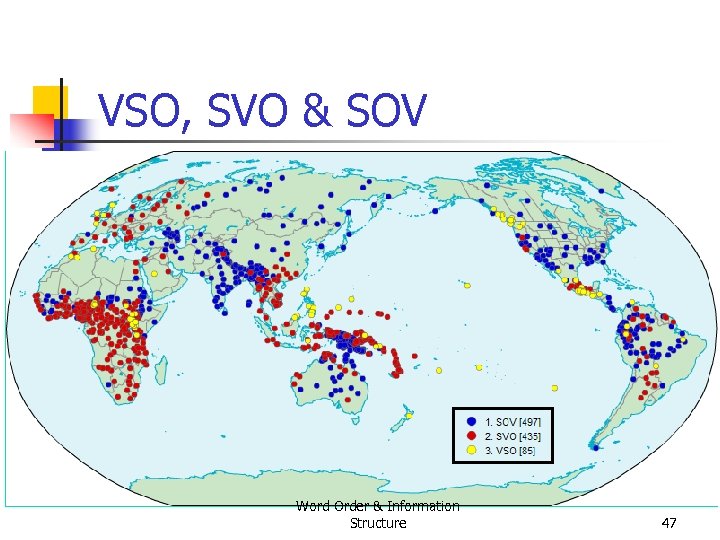
The data is clear: SVO and SOV dominate, accounting for nearly 90% of the world's languages. This leads to a powerful statistical universal, first formulated by Joseph Greenberg:
Universal 1: In declarative sentences with a nominal subject and object, the dominant order is almost always one in which the subject precedes the object.
Why should this be? The following video offers some compelling cognitive explanations.
WORD ORDER | This Video Enjoyed You
The video 'WORD ORDER | This Video Enjoyed You' from the Artifexian channel provides a clear, concise explanation for why some word orders are far more common than others.
Please watch from the beginning to 03:10. Pay close attention to the three principles the video proposes to explain the dominance of subject-first languages: Theme First Principle Animacy First Principle Verb-Object Bonding
Implicational Universals in Word Order
The patterns get even more interesting when we look at implicational universals. As mentioned earlier, there's a strong correlation between the order of the verb and object, and the choice between prepositions (like in, on, with) and postpositions (which follow the noun).
Let's dig into this using a foundational text on the topic.
Greenberg's linguistic universals
The 'Greenberg's linguistic universals' article explains the patterns he discovered. We'll focus on how basic word order predicts other structural features.
Please read the section 'Basic Word Order Patterns'. Notice the 'if-then' logic. For example, it states that VSO languages (Type I) are 'invariably prepositional'.
This reveals a deeper principle of "structural harmony." Languages tend to be consistently head-initial or head-final. The "head" is the core word of a phrase.
- In a prepositional phrase like "in the house," the preposition in is the head, and it comes first. This is head-initial.
- In Japanese, you say ie no naka ni (house of inside in), which is equivalent to "in the house." The particles no and ni are postpositions; they come after the noun. This is head-final.
The tendency is:
- SVO & VSO languages are overwhelmingly head-initial and use prepositions.
- SOV languages are overwhelmingly head-final and use postpositions.
Test your understanding!
You are studying a newly discovered language. You observe that its basic sentence structure is Subject-Object-Verb (SOV). Based on linguistic universals, would you predict that this language is more likely to have prepositions (like English 'to the city') or postpositions (a structure like 'the city to')? Why?
Show answer
You would predict that the language is very likely to have postpositions. This is because SOV order is a hallmark of head-final languages. In a head-final structure, the verb (the head of the verb phrase) comes last, and this pattern tends to extend to other phrases. Therefore, in a prepositional/postpositional phrase, the adposition (the head) would also be expected to come last, making it a postposition.
Beyond Syntax: Universals in Morphology and Semantics
These universal patterns aren't confined to sentence structure. They appear in the structure of words (morphology) and meaning (semantics) as well.
-
Morphological Universal: Consider how we build complex words. A very strong universal (Greenberg's Universal 28) states that if a word has both derivational and inflectional affixes, the derivational affix is always closer to the root.
- Derivational affixes create new words (e.g., teach -> teach*-er*).
- Inflectional affixes add grammatical information (e.g., teacher -> teacher*-s*).
- The order is always
ROOT-DERIVATION-INFLECTION(teach-er-s), neverROOT-INFLECTION-DERIVATION(teach-s-er). This holds true across countless languages.
-
Semantic Universal: A fascinating example comes from color terms. Linguists Berlin and Kay found that languages don't develop color words randomly. There is a universal hierarchy.
- If a language has 2 terms, they are black & white (or dark & light).
- If it has 3, the third is red.
- If it has 4, the next is green or yellow.
- If it has 5, the next is both green and yellow.
- If it has 6, the next is blue.
- The next is brown, followed by purple, pink, orange, or grey.
This suggests that the way we perceive and categorize the world isn't arbitrary, but follows patterns rooted in our shared biology and cognition.
The Big Debate: Is There a "Universal Grammar"?
The existence of universals led linguist Noam Chomsky to propose his famous theory of Universal Grammar (UG). The idea is that humans are born with an innate "language faculty"—a kind of genetic blueprint containing the fundamental principles of all languages. Variation arises because this blueprint has "switches" (parameters) that are set differently by exposure to a specific language.
In recent years, Chomsky refined this to the idea that the one true universal, the unique cognitive ability for language, is recursion.
Inside the Fiercest Debate in Linguistics | Otherwords
This video from the 'Otherwords' series, 'Inside the Fiercest Debate in Linguistics,' explores the theory of Universal Grammar and its most controversial challenge.
Please watch the following segments: 01:12 - 02:05: This introduces Chomsky's initial idea of Universal Grammar. 06:23 - 07:52: This explains the modern version of the theory, which boils down to one key feature: recursion. 08:04 - 09:42: This presents the famous counter-argument involving the Pirahã language. Focus on what recursion is and why the claims about Pirahã are so significant.
As the video explains, recursion is the ability to embed a phrase inside another phrase of the same type, creating potentially infinite structures. For example:
- This is the house.
- This is the house [that Jack built]. (A sentence embedded in a noun phrase)
- This is the cat [that chased the rat [that lived in the house [that Jack built]]].
The claim by linguist Daniel Everett that the Pirahã language of the Amazon lacks recursion struck at the very heart of Chomsky's theory. If even one language exists without recursion, it cannot be an absolute universal, and the foundation of modern UG is shaken. This debate is still active today and shows that the search for universals is a dynamic and contentious part of linguistics.
Conclusion
Today we've journeyed from the diversity of language to its underlying unity. We've seen that despite surface-level differences, languages are constrained by a set of shared principles, or universals.
Key takeaways:
- Linguistic universals are patterns that appear across a large number of languages. They can be absolute, statistical, or implicational.
- In syntax, there are strong tendencies for word order. Most languages are SOV or SVO, with the subject preceding the object. Implicational universals link features like basic word order to the use of prepositions or postpositions.
- In morphology, the ordering of affixes follows universal rules, such as derivational morphemes being closer to the root than inflectional ones.
- In semantics, concepts like color terms appear to develop along a universal, hierarchical path.
- The search for universals is tied to major theories like Chomsky's Universal Grammar, and the potential universality of features like recursion is a subject of intense scientific debate.
A Look Ahead:
So far in this course, we've dealt with language as an abstract system—its rules, varieties, and universal properties. In our next module, we're going to get physical. We will begin our study of Phonetics, the science of speech sounds. Our first lesson will focus on how we use our mouth, tongue, and lungs to produce the fundamental building blocks of speech: consonants.