Introduction
Hello and welcome to our fourth lesson. In our previous session, we explored the crucial difference between linguistic competence (your hidden, intuitive knowledge of language) and performance (how you actually use language, complete with slips and errors). We saw that a native speaker's "mistakes," like typos or slips of the tongue, are performance issues, not evidence of faulty language knowledge.
Today, we will expand this non-judgmental perspective from individual errors to entire language varieties. Your goal is to apply the principle of descriptivism when analyzing non-standard language varieties or informal speech. We will confront the common impulse to label certain ways of speaking as "bad" or "incorrect" and instead adopt the scientific stance of a linguist. For you, as a writer and reader, this will provide a new lens for appreciating the rich diversity of dialogue in literature and understanding the social dynamics of language in the world around you.
Two Stances: Prescribing vs. Describing
In the study of language, there are two fundamentally different approaches: prescriptivism and descriptivism. Much of traditional schooling and style guidance is prescriptive; it tells you how you should use language. Linguistics, as a science, is descriptive; it seeks to understand and document how people actually use language.
This short video provides an excellent overview of this core distinction.
Prescriptivism vs. Descriptivism
The video 'Prescriptivism vs. Descriptivism' by Evan Ashworth clearly lays out the two approaches that define our topic today.
Please watch from 00:24 to 03:28. As you watch, pay close attention to the different goals of the prescriptivist (to correct) and the descriptivist (to understand the context and patterns of use).
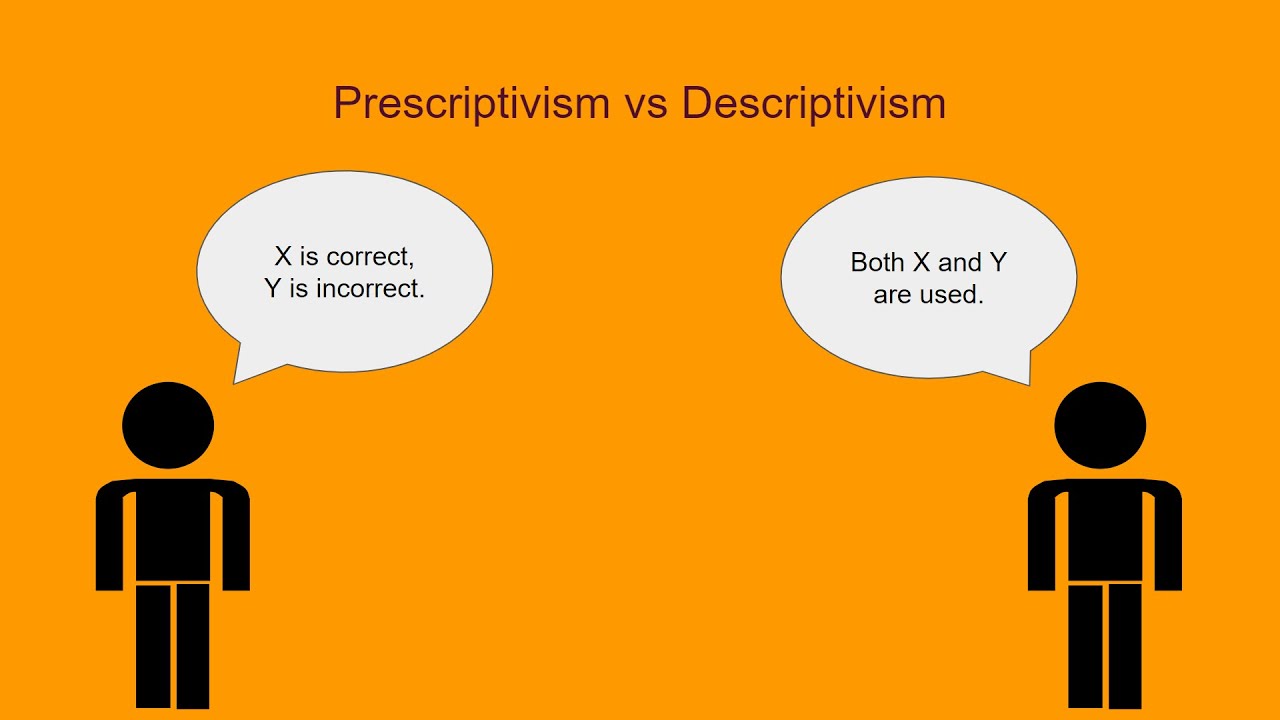
As the video explained, a prescriptivist acts like a judge, enforcing rules like "Don't use double negatives." A descriptivist, on the other hand, acts like a scientist. If they hear someone say, "I ain't seen nothing," their reaction isn't to correct it, but to ask questions: Who uses this structure? In what situations? What function does it serve in this particular language variety?
This image neatly captures the difference in mindset:
What is "Standard English"?
The rules of prescriptivism are usually based on a variety of language called "Standard English." This is the form of English typically used in government, media, and education. But is it linguistically superior to other varieties?
From a descriptive standpoint, the answer is no. Standard English is just one dialect among many. Its prestige comes not from any inherent linguistic quality, but from the social and historical power of the groups who use it.
The renowned linguist David Crystal makes this point powerfully in the following clip.
Academic English - Prof. David Crystal on standard vs. non-standard English
In this excerpt from a talk, Professor David Crystal explains the true status of Standard English in the linguistic landscape.
Please watch from 02:34 to 05:27. Notice the negative terms often used for other varieties ('broken English', 'substandard') and his key assertion that Standard English is, in fact, a minority dialect, especially in spoken form.
Crystal’s key points are transformative for how we view language:
- Social Value vs. Linguistic Validity: Terms like "proper" or "substandard" are social judgments, not linguistic ones. A descriptivist recognizes that varieties like African American English, Appalachian English, or Singaporean English are not "broken" versions of Standard English. They are distinct, complete, and rule-governed systems.
- Standard English as a Minority: The vast majority of English speakers worldwide use features that are considered "non-standard," such as double negatives or the word "ain't."
To begin analyzing language like a linguist, we must set aside the idea of a single "correct" English and see all varieties as equally worthy of study.
Applying Descriptivism: A Case Study of 'Ain't'
Now, let's put this principle into practice. A classic target of prescriptive criticism is the word ain't. A prescriptivist simply says, "Don't use it. It's wrong." What does a descriptivist do? They analyze its structure and function.
The following reading offers a clear, practical example of descriptive analysis.
2.3. Prescriptivism and descriptivism – The Linguistic ...
This text from 'The Linguistic Structure of Words and Sentences' provides a case study that perfectly illustrates the descriptive approach.
Please read the section titled 'Case study on ain’t'. Focus on how the analysis reveals a systematic pattern that Standard English is missing.
The descriptive analysis reveals something fascinating: ain't isn't just a random "mistake." In many dialects, it systematically fills a gap in the Standard English contraction system.
| Full Phrase | Standard Contraction |
|---|---|
| is not | isn't |
| are not | aren't |
| have not | haven't |
| am not | ? |
There is no standard contraction for "am not." (Amn't exists in some varieties, like Irish and Scottish English, but not in standard American or British English). The question "I am going, aren't I?" feels awkward to many. In varieties where ain't is used, it logically and consistently fills this slot: "I am going, ain't I?".
This is the essence of descriptive analysis: we move beyond "right/wrong" to uncover the internal logic of a linguistic system.
Analyzing Non-Standard Features in Texts
This same descriptive lens can be applied to any feature of a non-standard variety. When we encounter these features in literature or transcripts, we can analyze them as part of a coherent grammatical system.
Consider these examples from African American Vernacular English (AAVE), drawn from literary texts like Kathryn Stockett's The Help:
-
Double Negatives: "She don't make no fuss being in here by herself."
- Prescriptive view: This is incorrect; two negatives make a positive.
- Descriptive view: In AAVE, as in many other languages like Spanish and French, multiple negative words do not cancel each other out. Instead, they work together to reinforce the negation. This is a systematic rule known as "negative concord."
-
Subject-Verb Agreement: "When Miss Hilly gone, Miss Walter say real low..."
- Prescriptive view: Incorrect. The verb should be "says" to agree with the third-person singular subject "Miss Walter."
- Descriptive view: In AAVE, the
-sending on present-tense verbs is often absent. This isn't a random error; it's a regular feature of the dialect's grammar. The meaning is perfectly clear from the context.
By applying descriptivism, what might first appear as a collection of "errors" reveals itself to be a structured, rule-governed dialect with its own grammatical competence.
Test your understanding!
Consider the following sentence, a feature of many English dialects: "We was waiting for hours."
How would a prescriptivist analyze this sentence? And how would a descriptivist analyze it?
Show answer
-
Prescriptivist Analysis: "This is grammatically incorrect. The subject 'we' is plural, so the verb must be the plural form 'were.' The correct sentence is 'We were waiting for hours.'"
-
Descriptivist Analysis: "This sentence displays a common feature of several English varieties where the past tense of the verb 'to be' is regularized, using 'was' for all persons and numbers (I was, you was, he was, we was, they was). This variation in the subject-verb agreement rule is a systematic feature of this dialect's grammar, different from the rule in Standard English."
Conclusion
Today we've drawn a firm line between prescribing rules and describing reality. Adopting a descriptive mindset is the first major step toward thinking like a linguist. It allows us to analyze any form of language—from the most formal prose to the most informal slang—as a valid, structured system worthy of investigation.
Key takeaways:
- Prescriptivism judges language and dictates "correct" usage, usually based on a socially prestigious "standard" variety.
- Descriptivism, the approach of modern linguistics, observes and analyzes how language is actually used by its speakers without passing judgment.
- "Standard English" is one variety among many; its status is due to social power, not inherent linguistic superiority.
- Non-standard varieties are not "broken" or "lazy" forms of language. They are fully-formed linguistic systems with their own consistent grammar, phonology, and vocabulary.
A Look Ahead:
We've just spent time appreciating the vast variation within a language like English. In our next lesson, we will zoom out to ask a different question: Despite all their differences, what do all human languages have in common? We will identify specific examples of linguistic universals in cross-linguistic data, exploring the fundamental properties that unite all languages and offer clues about the human mind itself.