Hello! Welcome to your first lesson in our English grammar course. I understand you've decided to shift your focus from physics to mastering the fundamentals of English, and that's a fantastic goal. We'll start at the very beginning, with the basic building blocks of the language.
In this lesson, you will learn to identify the eight parts of speech: noun, pronoun, verb, adjective, adverb, preposition, conjunction, and interjection. Understanding the role each word plays in a sentence is the most important first step toward building clear, correct, and more complex sentences later on.
1. What Are Parts of Speech?
Think of parts of speech as job titles for words. Every word in a sentence has a specific job to do, whether it's naming something, describing an action, or connecting ideas. When we group words by the job they perform, we get the parts of speech.
This chart gives a clean, color-coded overview of the eight main categories and their functions.
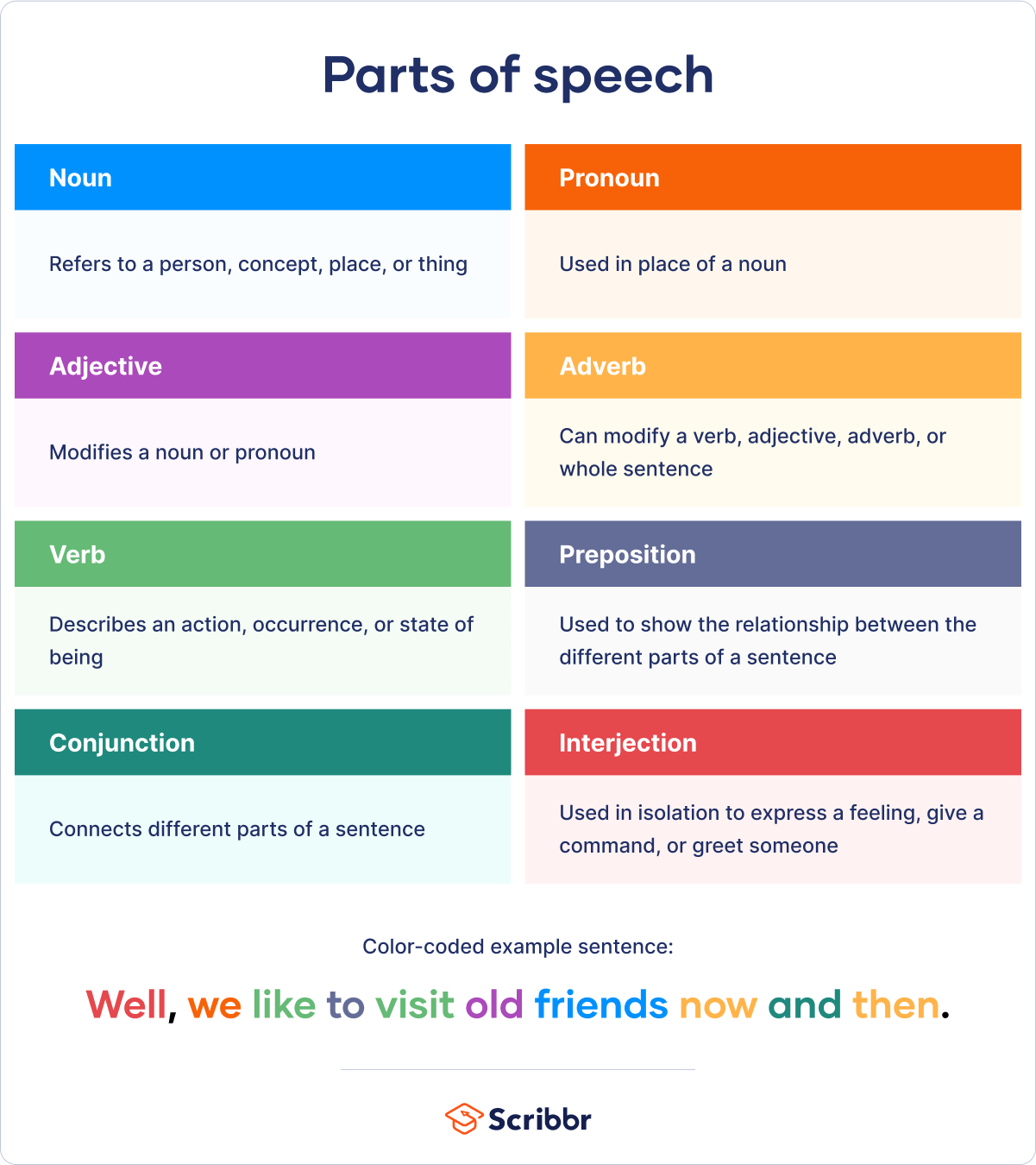
For a more formal definition, let's turn to a short reading.
The 8 Parts of Speech: Rules and Examples
This article from Grammarly provides a clear and concise introduction to the concept of parts of speech.
Please read the section titled What are parts of speech?. This will solidify the idea that a word's category is determined by its function.
The key takeaway is that we classify words based on their role and how they relate to other words in a sentence.
2. An Overview of the Eight Categories
Now, let's get a quick tour of all eight parts of speech. The following video provides a concise explanation of each one, with clear examples. This will give you a solid mental map before we dive deeper into each category.
8 Parts of Speech in English Grammar Overview (+ Example Sentences & Quiz!)
The video "8 Parts of Speech in English Grammar Overview" from the Sparkle English channel is an excellent, compact summary.
Watch the video from the beginning of the explanations up to the start of the quiz. Pay attention to the definition and the one or two example sentences provided for each part of speech.
This quick tour should give you a feel for each "job title." You now have a basic idea of what nouns, verbs, adjectives, and the others do.
3. A Deeper Look at Each Part of Speech
With the overview complete, it's time to explore each category in more detail. The video gave you the quick version; this reading will provide more depth, additional examples, and different types within each category (like common vs. proper nouns, or different types of conjunctions).
The 8 Parts of Speech: Rules and Examples
We'll return to the Grammarly article to examine the detailed definitions and examples for each part of speech.
Please read the section What are the 8 English parts of speech?. As you read through the descriptions of Nouns, Pronouns, Adjectives, Verbs, Adverbs, Prepositions, Conjunctions, and Interjections, try to think of your own example for each one.
4. An Important Nuance: Words Can Change Jobs
One of the most important things to understand in English grammar is that a word's part of speech is not fixed. The same word can be a noun in one sentence and a verb in another, depending on its role. This is a crucial concept that will help you avoid confusion.
For example, consider the word "work":
- "I have a lot of work to do." (Here, work is a noun, a thing.)
- "I work at the university." (Here, work is a verb, an action.)
The Grammarly article explains this concept well.
The 8 Parts of Speech: Rules and Examples
This section will show you how the function of a word determines its part of speech.
Please read the section When a word can be different parts of speech. Pay close attention to the examples for the words work, well, and but.
5. Test Your Knowledge
You've now learned the definitions, seen examples, and explored some key nuances. It's time to put your knowledge into practice. The video you watched earlier has a quiz section that is perfect for this.
8 Parts of Speech in English Grammar Overview (+ Example Sentences & Quiz!)
Let's go back to the Sparkle English video and try the quiz.
Watch the quiz section from the quiz and answers. For each of the 10 sentences, pause the video and try to identify the part of speech of the highlighted word before the answer is revealed.
How did you do? Don't worry if you didn't get them all right. The goal is to practice the process of looking at a word in a sentence and thinking about its function.
Conclusion
In this lesson, we have laid the essential groundwork for our study of English grammar. You learned that words are categorized into eight parts of speech based on their function in a sentence.
Here are the key takeaways:
- Nouns name people, places, things, or ideas.
- Pronouns replace nouns.
- Verbs show action or a state of being.
- Adjectives describe nouns or pronouns.
- Adverbs describe verbs, adjectives, or other adverbs.
- Prepositions show relationships between words (e.g., location, time).
- Conjunctions connect words, phrases, or clauses.
- Interjections express strong emotion.
You also learned that a word can belong to different categories depending on its context. This foundation will be vital for every topic we cover from now on.
In our next lesson, we will build directly on this knowledge. Now that you can identify nouns, we will focus on articles—the small but important words a, an, and the that come before nouns.