Hello! Welcome to the second lesson in your English grammar course. In our last session, we identified the eight parts of speech, with a special focus on nouns as the words that name people, places, things, and ideas. Today, we'll zoom in on the small but powerful words that introduce nouns: articles.
This lesson is dedicated to understanding and using the articles a, an, and the. Mastering them is a key step toward making your English sound natural and precise. You will learn when to use the indefinite articles (a/an) for general things and when to use the definite article (the) for specific things.
1. Two Types of Articles: Indefinite and Definite
Articles are words that specify which noun you're referring to. English has two types:
- Indefinite Articles: a and an. They refer to a general, non-specific noun. Think of "a" or "an" as meaning "one of many."
- Definite Article: the. It refers to a specific, particular noun that both the speaker and listener know about.
A simple way to remember this is:
- A/An = Any one (e.g., "I need a pen." - Any pen will do.)
- The = That specific one (e.g., "I need the pen on your desk." - That specific pen.)
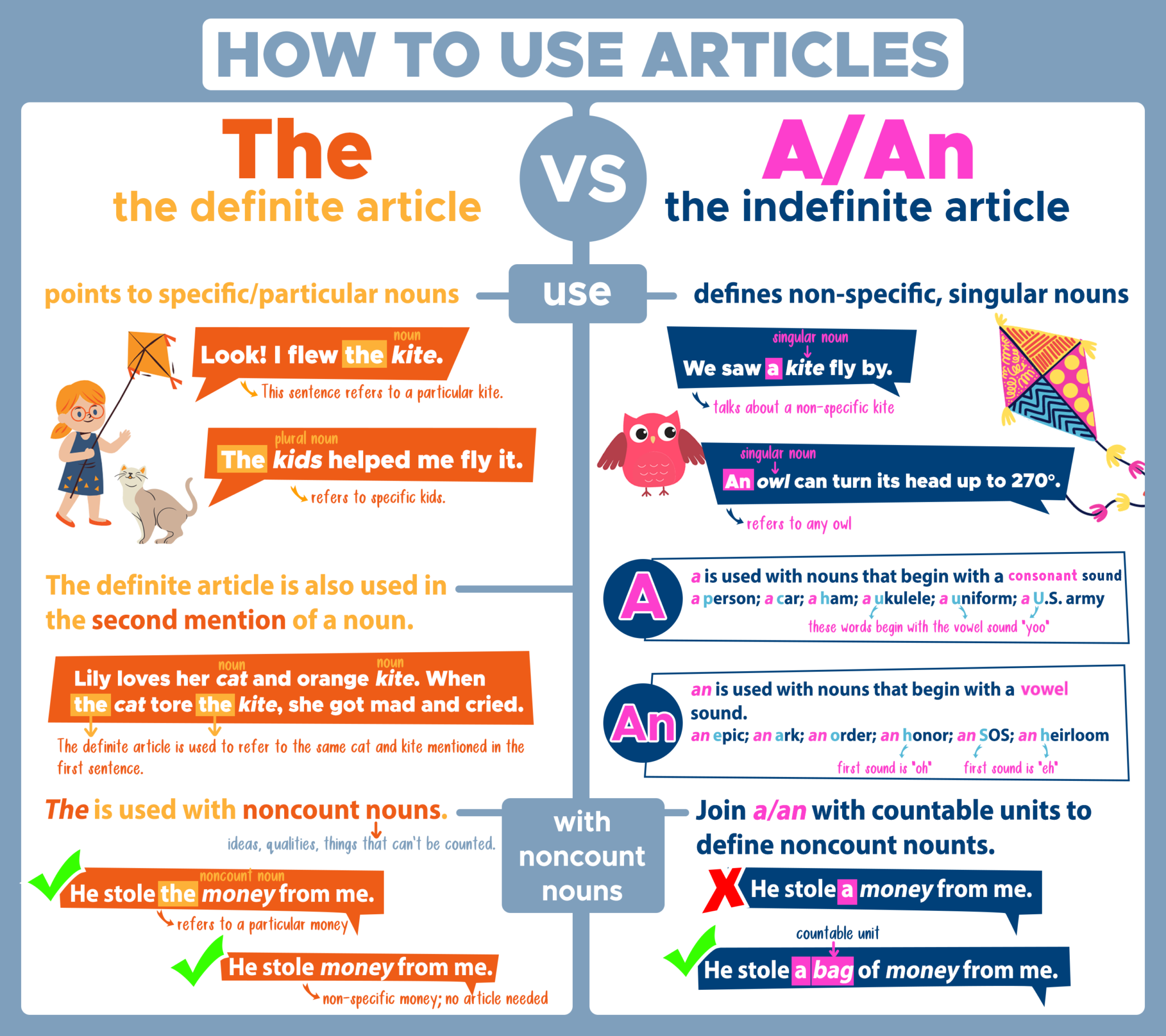
This infographic provides a great visual summary of the core differences.
2. The Indefinite Articles: 'A' and 'An'
The first choice you have to make is between 'a' and 'an'. The rule is simple and depends on the sound of the word that follows, not the letter itself.
- Use a before a word that starts with a consonant sound.
- Use an before a word that starts with a vowel sound (a, e, i, o, u).
Let's watch a short video that explains this rule clearly, including some tricky examples.
ARTICLES - A? An? The? | How can I use these correctly?
This video from Arnel's Everyday English, titled "ARTICLES - A? An? The?", provides clear, step-by-step rules.
First, watch the section explaining the basic rule for 'a' vs 'an' from the beginning of the explanation. Notice the examples like "a university" (which starts with a 'y' sound) and "an x-ray" (which starts with an 'e' sound). Next, continue watching to understand when we use indefinite articles, such as for general things and first mentions, from the rules for a/an.
As the video shows, we use 'a' or 'an' with singular, countable nouns when we aren't referring to a particular one. For example, "I saw a dog" means you saw one non-specific dog.
3. The Definite Article: 'The'
Now, let's turn to 'the'. We use 'the' when we are talking about something specific. This specificity can come from several situations.
- Second Mention: When you mention something for the second time.
- "I saw a dog. The dog was barking." (We now know which dog).
- Uniqueness: When there is only one of something.
- Examples: the sun, the moon, the government, the internet.
- Context: When the context makes it clear which one you mean.
- Example: "Please close the door." (We both know which door).
- Superlatives: With superlative adjectives like best, worst, fastest.
- Example: "This is the best coffee."
Let's return to the video to see a breakdown of the most common rules for using 'the'.
ARTICLES - A? An? The? | How can I use these correctly?
We'll continue with the same video from Arnel's Everyday English.
Watch the section explaining the various uses of 'the' from the explanation of 'the'. Pay attention to the different categories, such as second mention, superlatives, and geographical names. The video also briefly introduces the idea of "zero article" (using no article at all). Watch this short segment from the section on zero article to be aware of this concept, especially for general plural nouns (e.g., "I love dogs").
4. Putting It All Together: A Systematic Approach
With all these rules, it can be helpful to have a clear method for deciding which article to use. The following PDF provides excellent summaries and a very useful flowchart to guide your thinking.
English as a Second Language (ESL): Use of Articles
This document from Germanna Community College offers detailed rules and a helpful decision-making tool.
First, review the rules for indefinite and definite articles to reinforce what you learned from the video. Then, pay close attention to the Flowchart on page 5. You can find it by scrolling down to the page that starts with the flowchart section. This chart walks you through a series of questions to help you choose the correct article (or no article). It is an excellent tool to practice with.
5. Practice Time
Now it's time to apply these rules. The following video presents a series of sentences with missing articles. It's a great way to test your understanding in a quiz format.
English Articles Exercise with Explanation | Quiz for Beginners and Intermediate Learners
This video from EnglishTestBlog.com is an exercise that comes with explanations for each answer.
For each sentence, try to decide whether to use a, an, the, or no article. You can pause the video to think before the answer and explanation are revealed. I recommend you try the exercises covering: Oceans and continents Deserts and superlatives General vs. specific places General plural nouns Unique titles and landmarks
For more independent practice, you can try the fill-in-the-blank exercise in the PDF resource "ESL: Use of Articles" on page 6. The answers are provided on page 7 for you to check your work.
Conclusion
In this lesson, we explored how to use the English articles a, an, and the. These small words play a big role in clarifying whether you are talking about a general concept or a specific item.
Here are the key takeaways:
- Use a/an with singular, countable nouns when referring to a non-specific item. The choice between a (consonant sound) and an (vowel sound) depends on the sound of the next word.
- Use the when referring to a specific item that is unique, has been mentioned before, or is clear from the context.
- In some cases, like with general plural nouns ("dogs are friendly") or most proper names, no article is needed. This is known as the "zero article."
You now have a solid foundation for identifying nouns and using the correct articles before them. In our next lesson, we will continue working with nouns by learning how to use pronouns to replace them, which helps make your writing less repetitive.