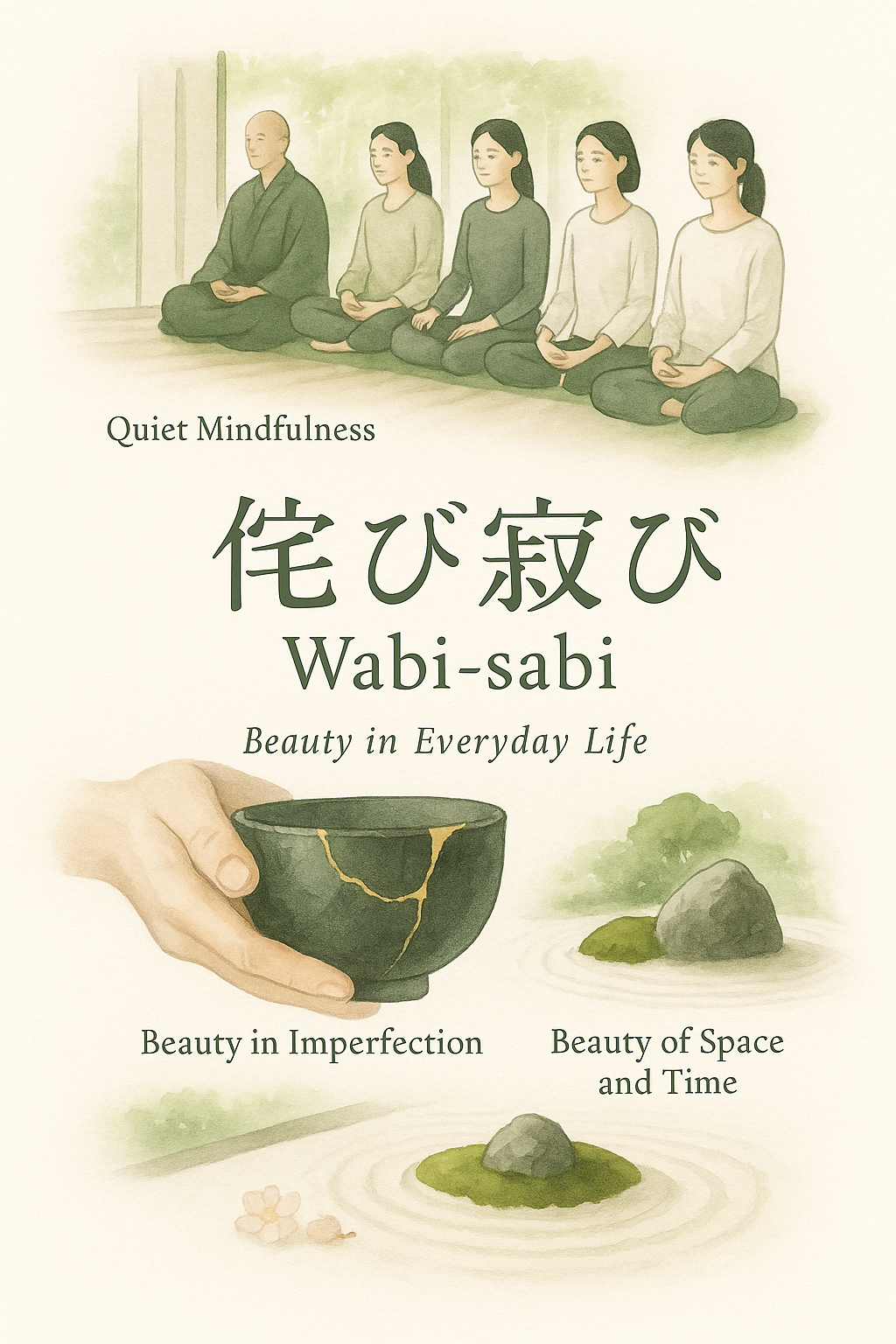
In our last lesson, we explored the foundational sensibilities of mono no aware and hakanai, discovering a worldview that finds profound beauty in the transient and fleeting nature of life. We now turn to a related, yet distinct, aesthetic philosophy: wabi-sabi (侘寂). While mono no aware is the poignant feeling evoked by impermanence, wabi-sabi is the principle of finding beauty in the signs of that impermanence—in imperfection, age, and incompletion.
This lesson will deconstruct the concept of wabi-sabi, tracing its origins in Zen Buddhism and the tea ceremony, and exploring how it has profoundly shaped Japanese literary aesthetics. Understanding this principle will equip you to appreciate narratives that favor suggestion over statement, atmosphere over plot, and the quiet beauty of the flawed over the glamour of the perfect.
Understanding Wabi-Sabi: More Than Just "Imperfect Beauty"
The term wabi-sabi has become a popular shorthand in the West for rustic, imperfect aesthetics. However, to truly grasp its significance, it's essential to understand that it combines two distinct, historically separate concepts. Given your background in analytical methods, you may find this deconstruction of the term particularly useful.
The following video from The School of Life provides an excellent historical and philosophical overview, tracing the evolution of these ideas from Zen Buddhism to the tea ceremony and poetry.
This video, "HISTORY OF IDEAS - Wabi-sabi," offers a compelling narrative of the concept's development. It contrasts the aesthetic with Western ideals of perfection and follows its journey through Japanese history.
Please watch the following segments: The introduction, which defines wabi-sabi as the beauty of the impermanent, imperfect, and modest. The connection to Zen Buddhism, which established the philosophical groundwork. The evolution of the words wabi and sabi from their original negative meanings to more positive aesthetic ideals. The role of the tea ceremony, first with Murata Shukō, who challenged the taste for perfection, and then with Sen no Rikyū, who codified the aesthetic. Finally, the segment on Matsuo Bashō, who captured the spirit of wabi-sabi in haiku.
As the video explained, wabi and sabi began as separate ideas. Let's delve deeper into their original meanings to clarify their distinct contributions to the overall aesthetic.
This article from The Conversation provides a scholarly yet accessible breakdown of the etymology of wabi and sabi, clarifying that their combination into a single term is a relatively recent, non-Japanese development.
Please read the following parts of the article: The introduction, which explains that wabi and sabi are distinct concepts. The section "Miserable poetry," which traces wabi from the verb wabu (to languish). The section "Miserable tea," which explains how this concept of austerity was applied to the tea ceremony as wabi-cha. The section "A lovely loneliness," which defines sabi as deriving from sabu (to rust) and relates it to a specific kind of impersonal loneliness found in nature.
To summarize this important distinction:
- Wabi (侘) refers to a state of being. It evolved from signifying misery and solitude to representing a quiet, rustic simplicity, a contentment with less, and an appreciation for a life stripped to its essentials. It's an inward-focused, subjective experience.
- Sabi (寂) refers to the qualities of an object or scene. It is the beauty that comes with age, the patina of time, the visible marks of wear and weathering. It is the objective manifestation of impermanence, embodying a kind of lonely, austere beauty.
When combined, they create a worldview that finds serene beauty in the humble, the asymmetrical, and the aged. A rustic, moss-covered stone in a garden possesses sabi. The quiet, contemplative state of mind you might experience while observing it is wabi.

Literary Wabi-Sabi: The Aesthetics of the Unfinished
So, how does this appreciation for weathered pottery and quiet moods translate into literature? Wabi-sabi shapes literary aesthetics by influencing theme, tone, and even narrative structure. It fosters a literature that values quietude, suggestion, and the beauty of what is left unsaid.
The following reading provides a concise bridge from the general aesthetic to its literary application.
Wabi-Sabi: Stillness, Asymmetry, and the Beauty of the Incomplete | Gilliam Writers Group
This blog post from the Gilliam Writers Group directly addresses how the principles of wabi-sabi influence literature.
First, read the introductory paragraph, which establishes the connection between the aesthetic and its use in literature. Next, focus on the section that begins "In prose, too...". Read about its application in the works of Yasunari Kawabata, whose Nobel Prize-winning style is noted for being elliptical and atmospheric. Then read about Jun'ichirō Tanizaki's essay, which articulates the sensibility directly. Finally, read the concluding paragraph, starting from "What makes wabi-sabi compelling". This passage brilliantly summarizes how wabi-sabi functions as a form of "resistance to the polished," favoring the sparse line and the intimate voice.
As the text highlights, authors like Kawabata create a wabi-sabi mood not by explicitly stating emotions, but by focusing on fragile gestures and elusive sensations, leaving the reader to inhabit the spaces in between.
The essayist Jun'ichirō Tanizaki, in his famous work In Praise of Shadows, provides perhaps the most eloquent defense of this aesthetic. While his essay is a broader argument for the beauty of darkness and shadow (which we will discuss later under the concept of yūgen), it contains a powerful defense of sabi. Your appreciation for Gothic literature, which finds aesthetic power in decay and gloom, might give you a unique perspective on Tanizaki's argument, though he approaches it from a place of serenity rather than dread.
The video below reviews Tanizaki's essay and highlights a key passage that perfectly encapsulates sabi.
In Praise of Shadows - Jun'ichirō Tanizaki BOOK REVIEW
This video, a review of In Praise of Shadows, discusses Tanizaki's appreciation for the beauty found in things that are not perfectly clean or new.
Watch the segment from where the reviewer discusses Tanizaki's idea that "elegance is filthy." Pay close attention to the quoted passage, where Tanizaki states, "we do love things that bear the marks of grime, soot, and weather, and we love the colors and the sheen that call to mind the past that made them."
This love for the "marks of grime, soot, and weather" is the essence of sabi. In a literary context, this can translate to an interest in worn-out characters, decaying settings, or memories that are faded and fragmented. It is an aesthetic that finds meaning not in a story's polished conclusion, but in its weathered textures and quiet, enduring resonance.
Conclusion
In this lesson, we have added the crucial concept of wabi-sabi to our analytical lexicon. Building on the impermanence of mono no aware, wabi-sabi gives us a framework for appreciating beauty that is modest, flawed, and marked by time.
Key Takeaways:
- Wabi-Sabi is a composite aesthetic celebrating beauty in imperfection, impermanence, and incompletion.
- It is formed from two distinct concepts: Wabi, the profound satisfaction found in rustic simplicity and quiet solitude; and Sabi, the beauty of graceful aging, wear, and the patina of time.
- Rooted in Zen Buddhist philosophy, its principles were most famously codified in the Japanese tea ceremony as a counterpoint to ornate perfection.
- In literature, wabi-sabi influences style and theme, leading to minimalist prose, atmospheric ambiguity, and a focus on suggestive fragments over explicit statements. It finds beauty in what is weathered, partial, and quietly enduring.
In our next lesson, we will shift our focus from the texture of objects to the quality of atmosphere. We will explore yūgen (mysterious depth), shizukesa (inhabited stillness), and komorebi (light filtered through trees), concepts that find profound beauty in what is subtle, suggested, and partially obscured.