Hello! Welcome back to our exploration of the human body.
In our last lesson, we focused on the cell membrane, the "gatekeeper" that controls what enters and leaves the cell. We learned how essential nutrients like glucose are transported inside and saw that some of these transport processes require energy in the form of ATP (adenosine triphosphate).
Today, we will answer the crucial question: How does the cell create this ATP? We will journey inside the cell to a remarkable organelle called the mitochondrion. Often called the "powerhouse of the cell," this is where the chemical energy stored in the food you eat is converted into the universal energy currency your body runs on. Understanding this process is fundamental to grasping how your body manages energy, a key theme in our course on stress and nutrition.
By the end of this lesson, you will be able to describe the role of mitochondria in producing cellular energy (ATP) from nutrients.
What is ATP? The Body's Energy Currency
Before we dive into how it's made, let's quickly revisit what ATP is. ATP, or adenosine triphosphate, is the primary molecule that stores and transfers energy in cells.
Given your background in finance, you can think of ATP as the cell's universal energy currency. Just as a business needs capital to operate, a cell needs ATP to power its activities—from muscle contraction and nerve signals to building new proteins. When you eat, your body is essentially converting the raw materials (food) into this usable currency.
To reinforce this concept, the following video provides a great explanation of ATP's structure and function.
Cellular Respiration: How Do Cells Get Energy?
This clip from the video 'Cellular Respiration: How Do Cells Get Energy?' by Science ABC clearly explains what ATP is and how its chemical structure allows it to store and release energy for the cell to use.
Please watch from timestamp 00:38 to 02:16. Focus on the analogy of ATP as 'energy currency' and how breaking a phosphate bond releases energy.
The Mitochondrion: The Cell's Powerhouse
The primary site for generating this ATP is the mitochondrion (plural: mitochondria). These are tiny, specialized organelles found within your cells. Cells that have very high energy demands, like muscle cells, heart cells, and neurons, can contain thousands of them.
Think of a mitochondrion as a power plant or a furnace. It takes in fuel (derived from nutrients) and, through a series of complex reactions, burns it in the presence of oxygen to produce a massive amount of energy in the form of ATP.
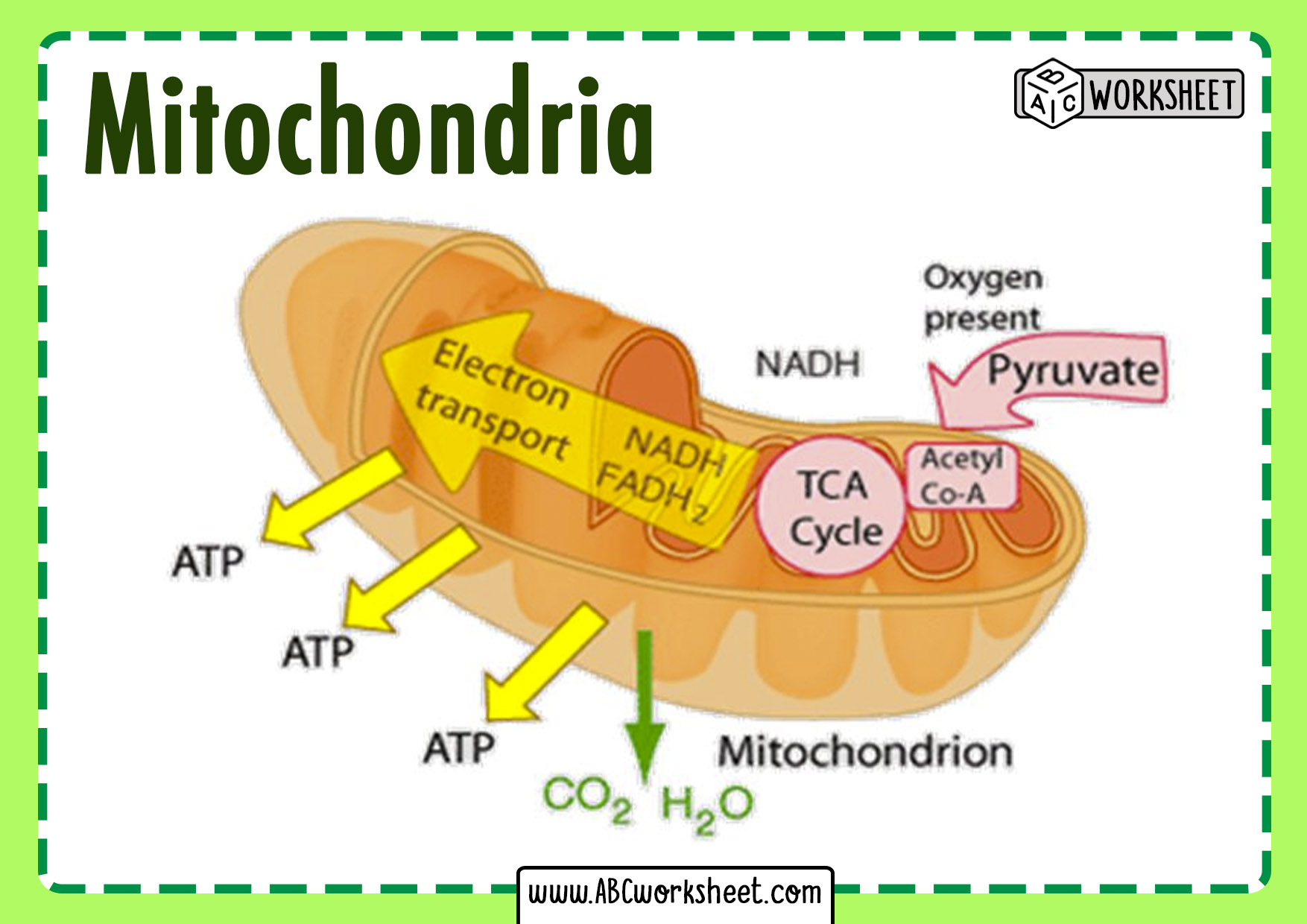
To learn a bit more about the function of this organelle, please read the following short article.
Mitochondria – cell powerhouses
The article 'Mitochondria – cell powerhouses' from ScienceLearn provides a concise overview of the mitochondria's role.
Please read the short introduction and the section titled 'The powerhouse function'. This will solidify the main purpose of mitochondria in the cell.
Cellular Respiration: The Energy Production Line
The process of converting nutrient energy into ATP is called cellular respiration. It is a multi-step pathway that breaks down glucose (a simple sugar from carbohydrates) and other fuel molecules. For simplicity, we'll focus on glucose.
The overall chemical equation for this process is:
Glucose + Oxygen → Carbon Dioxide + Water + ATP
This means the cell takes in glucose and oxygen, and through cellular respiration, it produces carbon dioxide and water as waste products, with the main prize being a large amount of ATP.
The entire process unfolds in three main stages. The following video provides an excellent, animated overview of all three.
Cellular Respiration (UPDATED)
The video 'Cellular Respiration (UPDATED)' by Amoeba Sisters is a fantastic guide through the entire process. It breaks down each stage in a clear and memorable way.
Please watch from timestamp 01:43 to 07:24. This covers the overall equation and walks through the three main stages: Glycolysis, the Krebs Cycle, and the Electron Transport Chain.
Now, let's review those three stages to make sure the key points are clear.
Stage 1: Glycolysis ("Splitting Sugar")
- Where it happens: In the cytoplasm of the cell, outside the mitochondrion.
- What happens: A single molecule of glucose (which has 6 carbon atoms) is split into two smaller molecules called pyruvate (each with 3 carbon atoms).
- Energy Yield: This process generates a very small net profit of 2 ATP molecules. It's a quick, but inefficient, way to make a little energy. It also creates a couple of high-energy electron carriers (called NADH), which we'll see again in Stage 3.

Stage 2: The Krebs Cycle (or Citric Acid Cycle)
- Where it happens: Inside the mitochondrion, in the inner fluid-filled space called the matrix.
- What happens: The pyruvate molecules from glycolysis enter the matrix and are converted into a molecule called Acetyl-CoA. This molecule then enters the Krebs Cycle, which is a series of chemical reactions that complete the breakdown of the original glucose molecule. Carbon dioxide (the waste product you exhale) is released during this stage.
- Energy Yield: The cycle produces another 2 ATP molecules directly. More importantly, its primary job is to load up many more high-energy electron carriers (NADH and FADH₂). Think of these carriers as "asset vouchers" that will be cashed in for a big payoff in the final stage.
Stage 3: The Electron Transport Chain & Oxidative Phosphorylation
- Where it happens: On the highly folded inner membrane of the mitochondrion.
- What happens: This is the main event for energy production.
- The electron carriers (NADH and FADH₂) from the previous stages "cash in" their vouchers by dropping off high-energy electrons at a series of proteins embedded in the inner membrane.
- As these electrons are passed down the chain of proteins (like a current), their energy is used to pump protons (H⁺ ions) from the matrix into the space between the inner and outer membranes. This creates a powerful electrochemical gradient, like water building up behind a dam.
- Finally, the protons rush back into the matrix through a remarkable molecular machine called ATP synthase. As the protons flow through, this enzyme spins like a turbine, using the flow's energy to rapidly generate a large number of ATP molecules.
- The Crucial Role of Oxygen: Oxygen is the final destination for the electrons at the end of the chain. It combines with the electrons and protons to form water (H₂O). Without oxygen, the entire chain gets backed up, and ATP production grinds to a halt. This is precisely why we need to breathe oxygen continuously.
- Energy Yield: This final stage is incredibly efficient, producing approximately 26-34 ATP molecules per glucose molecule. It's the reason mitochondria are known as the cell's powerhouses.
Test your understanding!
Imagine a poison, like cyanide, works by blocking the very last step of the electron transport chain where oxygen accepts electrons. Which stage(s) of cellular respiration could still produce a small amount of ATP, even if the main powerhouse is shut down?
Show answer
The cell could still produce a small amount of ATP from Glycolysis. This is because glycolysis occurs in the cytoplasm and does not directly require oxygen or the machinery of the mitochondrion. It would not be enough to sustain the cell for long, but it highlights that this initial step is separate from the main mitochondrial process.
Conclusion
Today we've peered into the cell's engine room and seen how it generates the energy needed for life.
Let's summarize the key takeaways:
- ATP is the universal energy currency of the cell, powering all cellular activities.
- Mitochondria are the "powerhouses" where most ATP is generated from the breakdown of nutrients like glucose.
- This process, cellular respiration, occurs in three main stages:
- Glycolysis: A quick, initial breakdown of glucose in the cytoplasm for a small ATP gain.
- Krebs Cycle: Completes the breakdown of the fuel molecule inside the mitochondrial matrix, primarily to generate high-energy electron carriers.
- Electron Transport Chain: The major ATP-producing stage on the inner mitochondrial membrane, where the energy from electron carriers is used to power ATP synthase. This stage absolutely requires oxygen.
This process is the bedrock of your body's metabolism. The efficiency of your mitochondria directly impacts your energy levels and overall health. Factors we will discuss later, such as nutrition, exercise, and even chronic stress, can influence how well these tiny powerhouses function.
In our next lesson, we will zoom back out. Now that we've covered the cell's boundary (membrane) and its engine (mitochondria), we will explore how cells with different specializations group together to form the four main types of tissues in the human body.